

Quick Pay-Per-Click (PPC) Facts:
– PPC is an online advertising model.
– You pay a fee each time your ad is clicked.
– It’s used on search engines and social media platforms.
– Helps increase visibility and drive traffic to your website.
Are you a small business owner in Cardiff feeling lost in the digital jungle? Struggling to compete with giants and make your mark online? We’ve got your back! At RD Internet, we understand the hurdles of grabbing attention in a crowded digital space. That’s why we’re diving into Pay-Per-Click (PPC) marketing—a beacon for businesses seeking immediate visibility and targeted traffic.
PPC can be a game-changer for your brand, offering a direct line to prospective customers actively searching for what you provide. But where do you start? This introduction will break down the basics of PPC, offering a stepping stone into a strategy that could redefine your online presence.
PPC allows you to bid for ad space on platforms your customers frequent, whether that’s Google, Facebook, or Instagram. Think of it as buying your way to the spotlight, positioning your brand exactly where and when it counts.
Ready to flip the visibility switch for your business? Dive in as we unravel the essentials of PPC, setting the stage for your digital success.
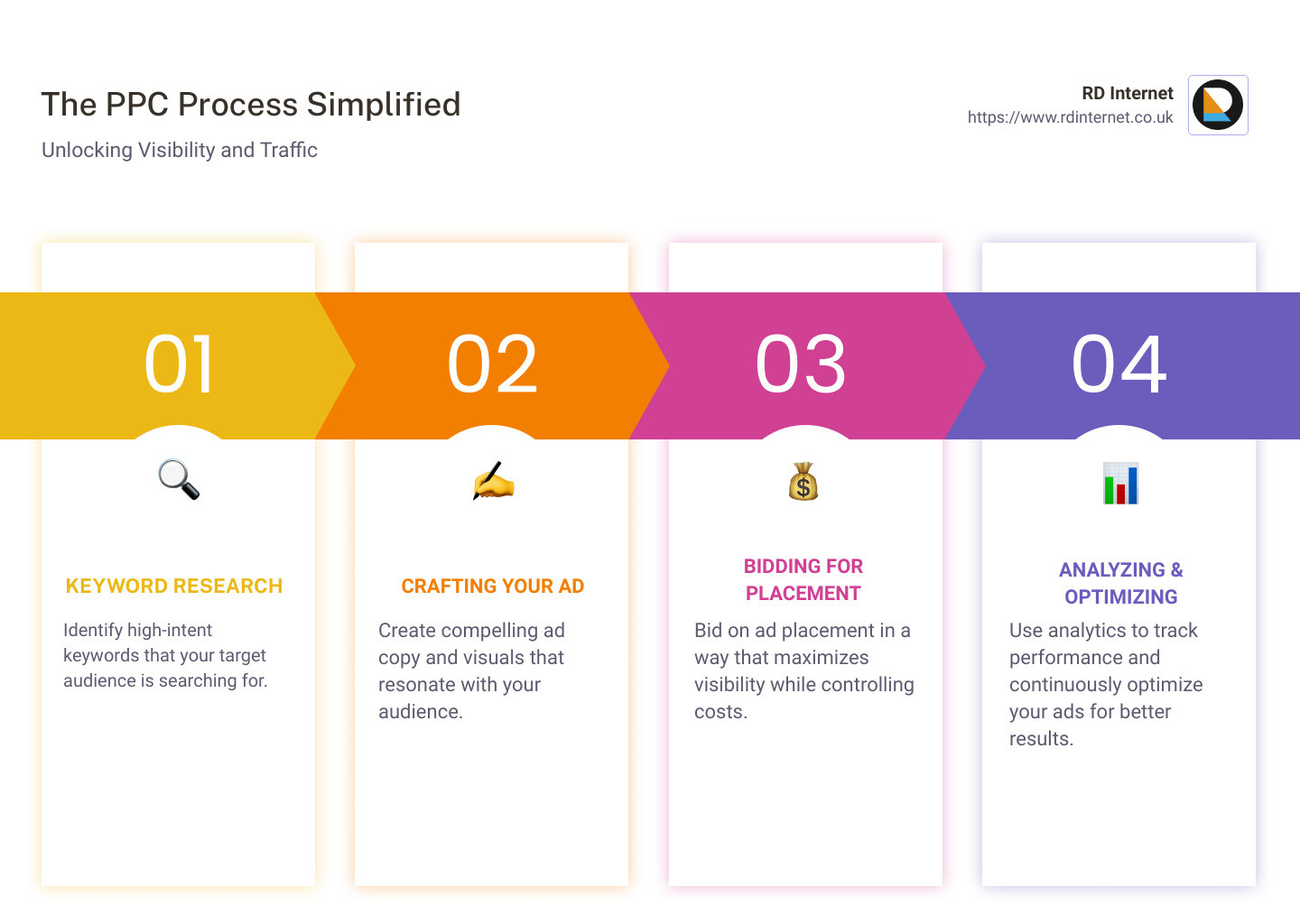
Understanding How Pay-Per-Click (PPC) Works
In the digital marketing world, getting your brand in front of the right eyes at the right time is crucial. That’s where Pay-Per-Click (PPC) advertising comes into play. It’s a model that allows us to drive targeted traffic to our website, ensuring that we’re visible to those who are most likely to be interested in our services.
The PPC Advertising Model
At its core, pay-per-click advertising is straightforward. You create ads, and then you pay a fee each time someone clicks on your ad. It sounds simple, but the true magic of PPC lies in its ability to target specific audiences with precision.
One of the beauties of PPC is its flexibility. Whether you’re a small business in Cardiff trying to stand out in a crowded market or a larger company looking to dominate search engine results, PPC can be tailored to meet your needs.
Key Components of PPC: Bids, Ads, and Keywords
Let’s break down the three pillars that hold up a successful PPC campaign: bids, ads, and keywords.
-
Keyword Research: This is where it all begins. Choosing the right keywords is like selecting the right door to open opportunities. It’s not just about what your business offers but understanding how your customers describe what they’re looking for. Tools like Google’s Keyword Planner can be instrumental in this phase.
-
Ad Auctions: Think of ad auctions as the battleground where visibility is won. Every time a search query matches your chosen keywords, an auction is triggered. But it’s not just about who bids the highest. Google also considers the relevance and quality of your ads, which leads us to…
-
Quality Score and Ad Rank: Your Quality Score is essentially Google’s rating of the quality and relevance of both your keywords and PPC ads. It influences your Ad Rank, which determines your ad position and your Cost-Per-Click (CPC). The better your Quality Score, the less you pay per click and the higher your ad will appear on the search results page.
-
Cost-Per-Click (CPC): This is the amount you pay each time someone clicks on your ad. CPC can vary significantly based on the competitiveness of your keywords and the quality of your ads. Our goal is always to maximize your ROI, ensuring that the cost of clicks is always outweighed by the value they bring to your business.
By understanding and optimizing these key components, you can create a PPC campaign that not only reaches your target audience but does so at a cost that makes sense for your business. The goal of PPC is not just clicks, but driving meaningful traffic that converts into customers.
At RD Internet, we specialize in crafting PPC strategies that align with your business goals. From selecting the right keywords to refining your ad copy, we’re here to guide you through every step of the process, ensuring that your PPC campaign is a resounding success.
Setting Up Your First PPC Campaign
Choosing the Right Platform for Your Ads
When you’re ready to dive into pay-per-click (PPC) advertising, choosing the right platform is your first big decision. Each platform caters to different audiences and serves different purposes. Here’s a quick rundown to help you decide:
- Google Ads: Perfect for reaching a wide audience as they search on Google. It’s ideal for driving traffic to your website fast.
- Facebook Ads: Best for targeting specific demographics and interests on Facebook and Instagram. Great for brand awareness and engagement.
- Microsoft Ads: Targets users on Bing and partner sites. It’s a good choice if you’re looking to extend your reach beyond Google.
- YouTube Ads: If you have compelling video content, YouTube Ads can help you engage with a broad audience.
- LinkedIn Ads: The go-to platform for B2B marketing, allowing you to target professionals by job title, industry, and more.
- Amazon Ads: If you’re selling products, Amazon Ads can place your products in front of people ready to buy.
- Etsy Ads: For those with handmade or unique items, Etsy Ads can increase your shop’s visibility.
- Yelp Ads: Ideal for local businesses looking to attract more customers from their area.
Choosing the right platform depends on where your target audience spends their time and what you’re selling. It’s often worth experimenting with a few platforms to see which one delivers the best return on investment (ROI).
Crafting Effective PPC Ads
Creating ads that capture attention and encourage clicks is crucial. Here are key elements to consider:
- Ad Groups: Organize your ads into groups based on similar themes or products. This helps keep your campaign organized and focused.
- Ad Extensions: Use ad extensions to provide additional information, like contact details or links to specific parts of your website. They can increase your ad’s visibility and click-through rate (CTR).
- Bid Adjustments: Adjust your bids for specific devices or times of day to optimize your ad spend.
- Negative Keywords: Use negative keywords to prevent your ad from showing for searches that aren’t relevant to your business, saving you money on wasted clicks.
For more detailed guidance on crafting effective ads, check out our insights at RD Internet.
Budgeting and Bidding Strategies
Managing your budget effectively is key to a successful PPC campaign. Here are some strategies to consider:
- Set a clear budget: Decide how much you’re willing to spend daily or monthly on your campaign.
- Understand bidding strategies: Whether you’re focusing on maximizing clicks, impressions, or conversions, choose a bidding strategy that aligns with your campaign goals.
- Monitor and adjust: Keep an eye on your campaign’s performance and adjust your bids and budget accordingly to ensure you’re getting the best ROI.
- Consider ROAS: Return on Ad Spend (ROAS) helps you understand the effectiveness of your campaign by comparing the revenue generated to the amount spent.
By carefully selecting the right platform, crafting compelling ads, and managing your budget wisely, you can set up a PPC campaign poised for success. Continuous testing and optimization are key to maximizing your pay-per-click advertising efforts. At RD Internet, we’re committed to helping small business owners in Cardiff and beyond navigate the complexities of PPC advertising to achieve remarkable results.
How to Measure and Optimize Your PPC Campaigns
Successfully running pay-per-click (PPC) campaigns isn’t just about setting them up – it’s about continuously measuring their performance and making necessary adjustments to optimize for better results. Let’s dive into how you can effectively track your PPC campaign’s performance and employ optimization techniques for improved ROI.
Tracking Performance and ROI
Google Analytics and Google Search Console are your best friends when it comes to measuring the success of your PPC campaigns. Here’s how you should use these tools:
-
Conversion Tracking: This is crucial. You need to know if the clicks on your ads are converting into tangible actions such as purchases, sign-ups, or downloads. Google Analytics allows you to set up goals that match these conversions, giving you a clear picture of your campaign’s effectiveness.
-
Click-Through Rate (CTR): CTR is the percentage of clicks your ad receives divided by the number of times your ad is shown. A higher CTR indicates that your ads are relevant and appealing to your target audience. If your CTR is low, it might be time to revisit your ad copy or targeting criteria.
Continuous Optimization Techniques
Optimizing your PPC campaigns is an ongoing process. Here are some techniques that we at RD Internet highly recommend:
-
A/B Testing: Also known as split testing, A/B testing involves creating two versions of your ad or landing page and testing them to see which one performs better. This could involve experimenting with different headlines, ad copy, or call-to-action buttons. By systematically testing these variables, you can continually refine your campaigns for better performance.
-
Ad Copy Optimization: Your ad copy is crucial for attracting clicks. Use insights from your performance data to tweak your headlines and descriptions. Focus on what sets your business apart and be sure to include compelling calls-to-action (CTAs). The goal is to make your ad as relevant and enticing as possible to your target audience.
Key Takeaway: The key to successful PPC campaigns is not just in their creation but in their continuous monitoring and optimization. By regularly tracking key metrics like conversion rate and CTR through tools like Google Analytics, and employing optimization techniques such as A/B testing and ad copy refinement, you can significantly improve your campaigns’ ROI.
At RD Internet, we understand the importance of these steps and are dedicated to helping small businesses in Cardiff and beyond to not just run PPC campaigns, but to optimize them for peak performance. The digital marketing landscape is always evolving, and so should your PPC strategies. Continuous learning and adaptation are your pathways to PPC success.
Common PPC Mistakes to Avoid
Diving into pay per click (PPC) can be both an exhilarating and daunting task, especially for small business owners in Cardiff looking to enhance their online presence. While PPC offers a golden opportunity to boost visibility and drive targeted traffic, certain pitfalls can hinder your success. Let’s discuss some common mistakes in PPC advertising and how to avoid them.
Broad Keyword Terms
One of the initial steps in setting up a PPC campaign involves selecting keywords. A common mistake is opting for overly broad keyword terms. It might seem like a good strategy to reach a wider audience, but it often leads to attracting irrelevant traffic and increasing your costs without improving conversion rates.
Solution: Focus on specific keywords that closely match your product or service. Utilize keyword research tools to find terms that your target audience is searching for, and consider using long-tail keywords. These are longer and more specific keyword phrases that visitors are likely to use when they’re closer to making a purchase decision.
Ignoring Negative Keywords
Not adding negative keywords to your PPC campaigns is like leaving taps open and letting the water (or in this case, your budget) spill over without any benefit. Negative keywords prevent your ads from showing up for searches that are not related to your business, ensuring your budget is spent more efficiently by targeting only those who are interested in what you offer.
Solution: Regularly update your negative keywords list to exclude terms that are irrelevant to your business. This will help refine your ad targeting, reduce wasted spend, and improve the overall efficiency of your campaigns.
Failing to Adjust Bids
Setting and forgetting your bid strategy is a mistake that can cost you more than just wasted ad spend; it can also lead to missed opportunities for optimization. The digital marketplace is dynamic, with competition and search patterns constantly changing. Failing to adjust your bids accordingly can result in your ads not being shown to your target audience or overpaying for clicks that don’t convert.
Solution: Monitor your campaigns closely and be prepared to adjust your bids based on performance data. Consider using automated bidding strategies offered by platforms like Google Ads, which can optimize your bids in real-time to achieve your campaign goals. Whether you’re aiming for more clicks, impressions, or conversions, there’s likely an automated bid strategy that aligns with your objectives.
By steering clear of these common pitfalls, you’re not just safeguarding your budget; you’re also setting the stage for more effective and profitable PPC campaigns. At RD Internet, we understand the intricacies of PPC and are committed to guiding small businesses through the maze of digital advertising. Success in PPC requires continuous monitoring, optimization, and learning. Avoiding these common mistakes is a step in the right direction towards achieving your online marketing goals.
Advanced PPC Strategies and Tools
In the dynamic world of pay-per-click (PPC) advertising, staying ahead means leveraging advanced strategies and tools. At RD Internet, we dive deep into the complexities of PPC to offer small businesses the cutting-edge tactics they need to excel. Let’s explore how you can elevate your PPC campaigns with remarketing, audience targeting, and the strategic use of insightful tools.
Leveraging Remarketing and Audience Targeting
Remarketing Ads are a powerful way to reconnect with visitors who’ve interacted with your website but didn’t make a purchase or complete an action. By displaying targeted ads to these potential customers as they browse the web or use social media, you increase the chances of conversion. It’s like gently reminding them, “Hey, remember us? We’ve got exactly what you need!”
Audience Segmentation further refines your targeting. By dividing your audience based on specific criteria like demographics, interests, or behavior, you can tailor your ads to resonate with different segments. This personalized approach enhances relevance and engagement, making your ads more effective.
Utilizing PPC Tools for Insights and Planning
The right PPC tools can transform how you plan and optimize your campaigns. Here’s a look at a couple of essential tools:
-
Google Trends: This tool is fantastic for understanding what’s currently capturing public interest. Use it to identify trending topics related to your business and tailor your PPC campaigns to capture this traffic.
-
Keyword Planner: A part of Google Ads, this tool helps you discover keywords related to your business and see how searches for these keywords have changed over time. It provides insights into average monthly searches, competition level, and suggested bid amounts.
Using these tools, along with Semrush and SpyFu, you can gain invaluable insights into your competitors’ strategies, conduct thorough keyword research, and fine-tune your bids for maximum ROI. They help you answer critical questions: Which keywords are most effective? What’s the competitive landscape like? How should you adjust your strategy in response?
At RD Internet, we harness these advanced PPC strategies and tools to craft campaigns that not only reach but resonate with your target audience. By leveraging remarketing and audience targeting, we ensure your ads are seen by those most likely to convert. And with our deep understanding of PPC tools, we deliver insights that guide your campaigns towards success.
The key to PPC success lies in continuous optimization and adaptation. By staying informed and agile, you can navigate the ever-changing digital landscape and achieve your marketing goals. Let us help you unlock the full potential of your PPC campaigns with these advanced strategies and tools.
FAQs Addressed
Navigating pay-per-click (PPC) advertising can be daunting, especially if you’re new to the digital marketing scene. To ease this journey, we’ve compiled a list of the most frequently asked questions about PPC. Let’s dive straight into simplifying these concepts.
How Does Pay-Per-Click Work?
Think of pay-per-click as a digital marketplace where you, the advertiser, place bids to have your ads shown to potential customers. Every time someone clicks on your ad, you pay the agreed-upon bid amount. This system allows you to direct targeted traffic to your website, essentially buying visits rather than earning them organically. It’s a quick way to get in front of your audience, with the most popular platforms being Google Ads and Facebook Ads.
How Much Can I Get Paid Per Click?
The cost per click (CPC) can vary widely depending on several factors, including the competitiveness of your keywords and the platform you’re using. On average, businesses might pay anywhere from $0.10 to $1 per click for less competitive keywords. However, for highly sought-after keywords, the cost can skyrocket to $6 or even $7 per click. It’s all about finding the right balance between the cost and the potential return on investment (ROI) for your specific business and industry.
What Does PPC Mean?
PPC stands for pay-per-click, a model of internet marketing where advertisers pay a fee each time one of their ads is clicked. Essentially, it’s a way of buying visits to your site, rather than attempting to “earn” those visits organically. PPC is a broad term that covers a range of platforms and strategies, including search ads, display ads, and social media advertising.
What Is a Good Pay-Per-Click?
Defining a “good” pay-per-click cost is subjective and depends heavily on your business goals, the profitability of your products or services, and your industry. A solid starting point is to aim for a cost that allows you to maintain a healthy profit margin after accounting for the ad spend. Many businesses target a 20% cost-per-acquisition (CPA) or a 5:1 ratio of revenue to ad cost. However, the best approach is to continually test and adjust your bids to find the sweet spot that maximizes both your ROI and overall campaign effectiveness.
At RD Internet, we understand that starting with PPC can be overwhelming. That’s why we’re here to guide you through every step—from choosing the right keywords and setting up your campaigns to optimizing your ads for the best performance. Our goal is to make PPC advertising a fruitful part of your digital marketing strategy, helping you achieve the visibility and growth you’re aiming for.
Conclusion
Emphasizing the Importance of Continuous Learning and Adaptation in Pay-Per-Click Advertising for Achieving Online Marketing Success
In the ever-evolving world of digital marketing, mastering pay-per-click (PPC) advertising is akin to navigating a river that’s constantly changing its course. You might start with a map, but as the landscape shifts, so too must your strategies. At RD Internet, we understand that achieving online marketing success is not about setting a course and sticking to it come what may. It’s about learning, adapting, and evolving.

Why Continuous Learning Matters
The world of PPC advertising is dynamic. New platforms emerge, algorithms change, and consumer behaviors evolve. What worked yesterday may not work tomorrow. That’s why continuous learning is crucial. By staying updated with the latest trends, tools, and techniques, you ensure that your PPC campaigns remain effective and competitive.
The Power of Adaptation
Adaptation is the key to survival in the digital jungle. It’s not just about reacting to changes; it’s about anticipating them. This means regularly reviewing your PPC campaigns, analyzing performance data, and being ready to pivot your strategy when necessary. Whether it’s adjusting your bids, refining your target audience, or experimenting with new ad formats, flexibility can make all the difference.
Our Commitment to Your Growth
At RD Internet, we’re more than just a service provider; we’re your partner in online marketing success. We commit to guiding you through the complexities of PPC advertising, from the basics of setting up your first campaign to the intricacies of advanced strategies. Our expertise is at your disposal, helping you navigate the challenges and seize the opportunities that lie ahead.
Continuous Learning Resources
To support your journey in PPC advertising, we offer a wealth of resources and tools. Whether you’re looking to deepen your understanding of PPC basics or explore advanced strategies, our team is here to provide the insights and assistance you need.
For further reading and to explore our range of services, visit:
In conclusion, pay-per-click advertising offers a potent way to enhance your online presence and drive business growth. But success in PPC is not a one-time achievement; it’s a continuous journey. By embracing continuous learning and staying adaptable, you can navigate the shifting landscapes of digital marketing with confidence and achieve enduring success. Let’s embark on this journey together, with RD Internet as your steadfast guide.
Recent Comments