
Click-per-click (CPC) or pay-per-click (PPC) is a digital marketing model where you, as an advertiser, pay a certain fee each time your ad gets clicked on. In basic terms, it’s a way of buying visits to your site, instead of trying to attract those visits organically.
Essential Aspects to Grasp about CPC:
– It’s also referred to as pay-per-click (PPC) advertising.
– You only incur a charge when a potential customer interacts with your ad by clicking on it.
– Your advertisements can be displayed in search engine results, on various websites, or on social media platforms.
– The cost fluctuates, typically ranging between £1 – £2 for the Google Search Network and less than £1 for the Google Display Network.
Are you a small business owner grappling with the ever-changing online landscape? Are you feeling overwhelmed with the increasing competition on the digital front, and are you unsure how to navigate it? We, at RD Internet, understand your predicament.
With the evolution of the internet, the competition is no longer just limited to your immediate geographical area. In digital marketing, you are competing with businesses across the globe. How then, do you make your brand stand out? How do you direct the right demographic traffic to your website efficiently? Here comes the solution: Click-per-click (CPC) advertising.
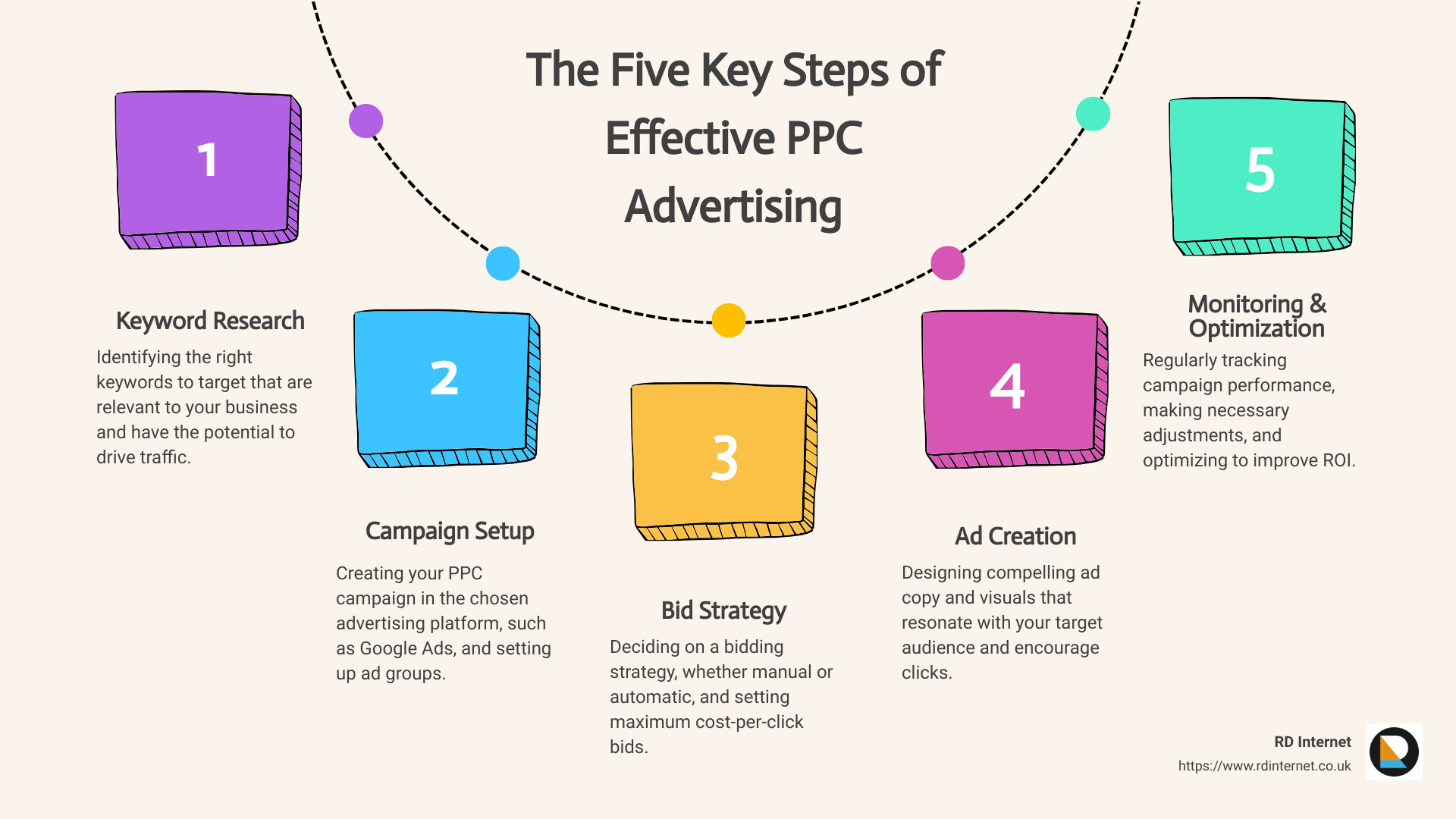
Understanding the Basics of PPC
What is Pay-Per-Click (PPC)?
Pay-Per-Click (PPC), also known as click per click, is an innovative online advertising model that allows businesses to pay only when their ad is clicked on by a potential customer. It’s an effective way for businesses to buy visits to their sites rather than attempting to earn those visits organically.
One of the major benefits of PPC is the opportunity it presents for businesses to reach their target audience in a precise manner, leading them directly to their website, products, or services. Beyond search engines like Google, PPC advertising can be utilized on social media platforms such as Facebook, Instagram, and others, presenting a vast digital arena for businesses to reach potential customers.
The Difference Between CPC, CPM, CPL, CPA/CPS, and CPI
It’s crucial to understand the various cost models associated with online advertising, such as CPC, CPM, CPL, CPA/CPS, and CPI.
-
CPC (Cost-per-click): This is the amount an advertiser pays a publisher for each click on their ad. It’s also known as pay per click (PPC).
-
CPM (Cost per thousand): This term denotes the cost of 1,000 advertisement impressions on a webpage. If a publisher sets the rate at £2.00 CPM, it means an advertiser is required to pay £2.00 for every 1,000 times their ad is displayed.
-
CPL (Cost per lead): This is a digital marketing metric that measures the amount of cost to acquire a lead. It’s also known as cost per inquiry.
-
CPA/CPS (Cost per action/acquisition/sale): This is the cost an advertiser pays for each specified action – like a purchase, form submission, or click – linked to their advertisement.
-
CPI (Cost per install): This is a pricing model where a mobile app advertiser pays each time a user installs the advertised app.
The Role of Click-Per-Click in Online Advertising
Click-per-click or PPC advertising plays a significant role in online marketing. It offers a way for us, at RD Internet, to direct targeted traffic to your website and increase your online visibility. It’s a powerful strategy that enables small businesses to compete effectively in the digital space.
PPC is particularly useful for businesses in competitive industries, as it provides quick results compared to organic search methods. It allows you to reach people who are most likely to be interested in your products or services while keeping control of your advertising budget.
In conclusion, whether you’re a small business owner in Cardiff or anywhere else, looking to increase your online visibility, click-per-click advertising provides a strategic and cost-effective way to achieve your marketing goals.
The Mechanics of PPC: How it Works
Pay-per-click (PPC) advertising may seem complex at first glance, but when you break it down, it’s quite straightforward. Let’s delve into the mechanics of PPC and explore its core components, including cost-per-click calculation, keyword bidding, and the concept of maximum and actual cost-per-click.
The Formula for Calculating Cost-Per-Click
The calculation behind cost-per-click (CPC) is simple. All you have to do is divide the total cost of your ad by the total number of clicks it received. Here’s what it looks like:
Cost-per-click = total ad cost / total number of clicks
For instance, if you spent £100 on a PPC campaign and received 500 clicks, your CPC would be £0.20.
However, know that the actual cost-per-click can vary based on factors like your ad’s quality score, the competition, and your bid amount.
The Importance of Keyword Bidding in PPC
In PPC, keywords are the bridges that connect your ads with your potential customers. When users search for these keywords, your ad stands a chance to appear in the search results. This is where bidding comes into play.
You bid on keywords relevant to your product or service. The amount you bid, coupled with your ad’s quality score, determines whether your ad appears and its position in the search results.
At RD Internet, we understand the importance of choosing the right keywords. We use advanced tools and industry insights to select keywords that can drive the most relevant traffic to your website.
Understanding Maximum Cost-Per-Click Bid (Max. CPC)
The maximum cost-per-click bid, or simply max. CPC, is the highest amount you’re willing to pay for a click on your ad. This amount is crucial, as it influences your ad’s chances of appearing in the search results.
Setting your max. CPC is part of your bidding strategy. However, it’s important to know that the actual amount you’ll be charged for a click, known as your actual CPC, is often less than your max. CPC bid.
The Concept of Actual CPC: What You Really Pay
Your actual CPC is the final amount you’re charged for a click on your ad. While you set a maximum CPC bid, you often end up paying less, sometimes significantly less, for a click.
This is because platforms like Google Ads use an auction system to determine the actual cost of a click. Factors such as your bid amount, your ad’s quality score, and the competition influence the final amount.
In conclusion, understanding the mechanics of PPC advertising is crucial to creating successful campaigns. At RD Internet, we can help you navigate these complexities, ensuring you get the most out of your advertising budget. In the next section, we’ll explore different strategies to make your PPC advertising even more effective.
Strategies for Effective PPC Advertising
To maximize the effectiveness of your click-per-click advertising, understand and implement a few key strategies. These include choosing between manual and automatic bidding, learning how to lower your cost per click (CPC) for a better return on investment (ROI), and using tools like Semrush and Google Keyword Planner.
Manual vs. Automatic Bidding: Which is Better?
Choosing between manual and automatic bidding can significantly impact your PPC campaign’s performance. Here’s what you need to know about both:
Manual Bidding involves setting your own maximum CPC for each ad or keyword you target. This method gives you a lot of control, but it also requires constant monitoring to ensure maximum effectiveness.
On the other hand, Automatic Bidding, like Amazon’s Enhanced CPC (ECPC), combines manual bidding with smart bidding. It uses factors like location, time of day, and browser to adjust your bids automatically. This strategy is great if you’re looking to maximize conversions while still maintaining some control over your bids.
So, which is better? It depends on your specific needs and resources. If you have the time and expertise to monitor and adjust bids, manual bidding can offer more control. If you prefer a more hands-off approach, automatic bidding could be a great option.
How to Lower Your CPC for Better ROI
Reducing your CPC is key to improving your ROI. Here are a few tips:
-
Improve your Quality Score: This is a metric used by Google to assess how relevant and useful your ad is to the user. A higher Quality Score can lead to lower CPCs and better ad positions.
-
Optimize your keywords: Selecting the right keywords is crucial. You want keywords that are relevant to your business and have a high intent to purchase.
-
Create compelling ad copy: Better ad copy can improve your click-through rate (CTR), which can lower your CPC.
At RD Internet, we can help you implement these strategies to ensure your CPC remains low for a high ROI.
Using Tools Like Semrush and Google Keyword Planner for PPC
Tools like Semrush and Google Keyword Planner are invaluable for managing your PPC campaigns. They can help you find relevant keywords and their average cost per click, among other features.
For instance, Semrush provides a Keyword Overview that shows the average price advertisers pay for a user to click on an ad triggered by a specific keyword.
Google Keyword Planner, on the other hand, tracks and collects data directly from Google Ads. It’s a great place to find a keyword’s average cost per click and get a sense of the competitive landscape.
At RD Internet, we use these tools and more to optimize your PPC campaigns and ensure you’re getting the most bang for your buck.
In the next section, we’ll explore the different types of ads that use the CPC model.
Types of Ads That Use CPC
Now that we’ve covered the mechanics of PPC, let’s delve into the various types of ads that utilize this pricing model. Understanding these will help you choose the most effective options for your campaign and ensure maximum return on investment.
Text Ads, Shopping Ads, Image Ads, and Video Ads
Text Ads are the simplest form of online advertising. These ads typically appear on search engine results pages (SERPs) and consist of headlines, a display URL, and a description. Since you only pay when someone clicks on your ad, text ads are a cost-effective way to reach potential customers.
Shopping Ads are a powerful tool for e-commerce businesses. They display product information, including the product image, title, price, and store name, directly within the search engine results. This upfront display of valuable information increases the likelihood of clicks and conversions.
Image Ads, or display ads, appear on websites, apps, and other digital platforms within the Google Display Network. These visually appealing ads can contain images, videos, or interactive elements to create more engaging and creative ad designs than text ads.
Video Ads are gaining popularity due to their high engagement rates. They can appear before, during, or after videos on platforms like YouTube. With video ads, you can tell a more compelling and immersive story about your brand, which can lead to higher click-through rates (CTRs).
Social Media Ads: Twitter, Facebook, Instagram, and LinkedIn
Social media platforms present a rich opportunity for PPC advertising.
Twitter Ads offer diverse formats, including promoted tweets, accounts, and trends. Advertisers are charged either on a cost-per-engagement or click-per-click basis, making it a flexible option for businesses with varying advertising budgets.
Facebook Ads, now known as Meta Ads, allow you to show highly targeted ads based on user demographics such as age, location, and interests. This platform excels in native content ads, blending promotional content seamlessly with the regular user feed.
Instagram Ads, also owned by Meta, offer high engagement rates. As a visual platform, Instagram excels in showcasing products through stunning images and videos, allowing businesses to tell visual stories.
LinkedIn Ads are ideal for B2B companies, targeting users based on their professional background. LinkedIn’s sponsored posts and InMail features allow you to reach your target audience directly in their feed or inbox.
Through strategic use of these ad types, we at RD Internet can craft a PPC advertising strategy that maximizes your reach and drives valuable traffic to your website. As a small business owner in Cardiff, understanding and leveraging these ad types will be key to improving your online visibility and competing effectively in the digital space.
Measuring the Success of Your PPC Campaigns
In order to effectively gauge the success of your PPC campaigns, understanding key metrics like Average CPC, Maximum CPC, and the utility of Enhanced CPC and automated bidding strategies is crucial. These tools not only help assess the performance of your campaigns but also provide valuable insights that can be used to optimize your PPC advertising strategy for better returns.
The Role of Average CPC and Maximum CPC in PPC Analysis
Average Cost Per Click (Average CPC) is a valuable metric that gives you an idea of the price you’re paying for each click in your PPC campaign. It’s calculated by dividing the total cost of your clicks by the total number of clicks. This helps you measure the cost-effectiveness of your campaign and understand if you’re getting a good return on your investment.
On the other hand, Maximum Cost Per Click (Max. CPC) is the highest amount you’re willing to pay for a click on your ad. This is an important factor when setting up your PPC campaign, as it helps you control your advertising costs and ensures that you don’t overspend on your campaign. The Max. CPC you set may not always be the amount you actually pay for the click, as platforms like Google Ads use a complex process that involves Ad Rank thresholds to determine the actual cost when your ad is clicked.
Understanding Enhanced CPC (ECPC) and Its Benefits
Enhanced CPC (ECPC) is an automated conversion bidding strategy that optimizes your manual bid when a click seems more likely to lead to a sale or conversion. ECPC uses factors like browser, location, and time of day to adjust bids to secure the best chance of a conversion at the best price. It helps you get better value from your PPC campaign by maximizing conversions.
At RD Internet, we can help you leverage tools like ECPC to optimize your PPC campaigns, ensuring you get the most out of your advertising budget.
The Use of Automated Bidding Strategies in Google AdWords
Automated bidding is another powerful feature that can help optimize your PPC campaigns. This strategy allows Google to automatically set bids based on how likely your ad will result in a click or conversion. This takes the guesswork out of setting bids and can free up your time to focus on other important aspects of your business.
Different types of automated bidding strategies can help increase clicks, visibility, and conversions, making them a valuable tool for maximizing the success of your PPC campaigns.
In conclusion, understanding and effectively utilizing these key metrics and tools is crucial in measuring and optimizing the success of your PPC campaigns. At RD Internet, we’re passionate about helping small businesses in Cardiff improve their online presence and drive success through effective digital marketing strategies. We’re here to support you in navigating PPC advertising and achieving the best possible results for your business.
Conclusion: Maximizing Your PPC Advertising Efforts
We’ve walked you through Pay-Per-Click (PPC) advertising, unraveling its complexities and showcasing its potential to drive significant growth for your business. But understanding the concept of ‘click per click’ is just the beginning; maximizing your advertising efforts involves strategic planning, continuous optimization, and a keen understanding of your audience’s needs.
Achieving High Quality Score
A high Quality Score is a crucial part of a successful PPC campaign. To raise your Quality Score, focus on enhancing your expected clickthrough rate, ad relevance, and landing page experience. Tailor your ad to appeal to your target audience, ensure its relevance to their search intent, and lead them to a landing page that matches their expectations. This can increase your clicks and decrease your costs, making your PPC campaign more effective and cost-efficient.
Selecting Key Keywords
Keyword selection plays a pivotal role in driving traffic to your website. You can leverage techniques such as targeting, splitting, and grouping to match your ad text with what your audience is searching for. By creating themes for your products and services and using keywords that match these themes, you can effectively reach your target audience.
Exploring Alternative Platforms
While Google AdSense is a popular platform for PPC advertising, there are numerous other platforms that offer competitive deals. Amazon Advertising and Meta Ads Manager, for instance, provide unique opportunities to reach shoppers on and off their platforms. Choosing the right platform for your business can significantly enhance your online visibility and drive more traffic to your website.
Understanding CPC vs. CPM
It’s also important to understand the difference between Cost Per Click (CPC) and Cost Per Mille (CPM). While CPC charges you only when a consumer clicks on your ad, CPM charges you for the number of times your ad is displayed. Depending on your business goals, one may be more suitable than the other.
Measure and Refine Your Campaigns
In digital advertising, constant monitoring and refinement are key. Regularly assessing your campaign’s performance and making necessary adjustments can ensure that your PPC efforts remain effective and cost-efficient.
At RD Internet, we’re dedicated to helping you navigate the intricacies of PPC and ‘click per click’ advertising. We know that every penny counts when you’re a small business owner, and we’re committed to helping you maximize your advertising budget.
If you’re ready to enhance your online visibility and drive more traffic to your site, get in touch with us. Let’s work together to make your PPC campaigns as effective and profitable as possible.
For further reading, we recommend our articles on ‘Mastering PPC Ad Campaign Management’ and ‘Bringing Targeted Traffic in Digital Marketing’, which delve deeper into advanced strategies for optimizing your PPC campaigns.
Digital advertising is dynamic and ever-evolving. Stay informed, stay agile, and most importantly, stay ahead. Happy advertising!
Recent Comments