

Are you feeling worn down in the digital marketing battle as a small business owner in Cardiff, striving for visibility in a sea of competitors? Do you ever wonder why, despite having an impressive website with premium content, you’re still struggling to drive meaningful traffic? This is a common scenario for many businesses, and the problem isn’t necessarily with your business, but often lies in how you market it, especially in the digital space. In this game, the most crucial aspect isn’t just to attract traffic, but to bring in targeted traffic.
Bringing targeted traffic in digital marketing involves attracting website visitors who are most likely to be interested in your products or services. Targeting these individuals effectively could mean the difference between shouting into a void and speaking directly to potential customers who are hungry for what you have to offer.
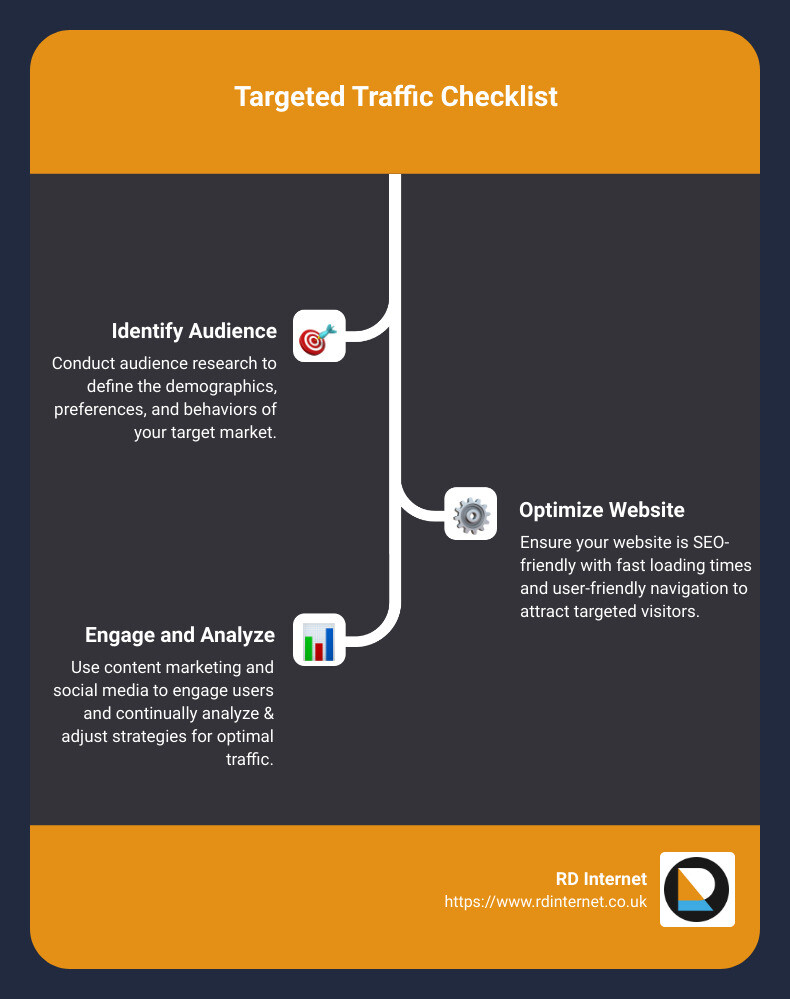
✦ Targeted Traffic Checklist:
– Identify your target audience
– Optimize your website for SEO
– Leverage content marketing and social media
– Implement paid advertising strategies
– Monitor and adjust your strategies
As RD Internet, our aim with this article is to help you navigate through the often complex, fast-paced world of digital marketing. Whether your primary struggle is boosting online visibility, driving more traffic to your website, or simply understanding the nuances of digital marketing strategies, we’ve got your back. In the next sections, we will outline a detailed 5-step strategy to skyrocket your digital marketing traffic.
Let’s dive in!
Understanding the Importance of Targeted Traffic in Digital Marketing
What is Targeted Traffic in Digital Marketing?
In the vast digital landscape, it’s easy for your business to get lost in the crowd. That’s where the concept of targeted traffic comes into play. Targeted traffic is a specific group of online visitors who intentionally visit your website because they believe it can satisfy their needs or interests. Unlike random internet users, these visitors have a purpose and are actively looking for the solutions, answers, or products that you offer.
Imagine your website as a party. Would you prefer a house full of random people with no interest in the event, or a select group genuinely excited about the occasion? The same principle applies to your website traffic. The more targeted your visitors are, the more likely they are to engage with your content and convert into customers.
Why is Targeted Traffic Valuable for Your Business?
Targeted traffic is the lifeblood of your digital presence. It’s the equivalent of having a storefront full of potential customers who are specifically interested in what you sell. They’re not just window shopping; they’re actively looking for your products and services. This increases your chances of converting them into leads or customers, making targeted traffic crucial to the success of your online business.
The importance of targeted traffic for your business cannot be understated. Not only does it serve as a gauge of your online visibility, but it also provides invaluable insights into the effectiveness of your marketing strategies. More importantly, higher targeted traffic correlates with increased opportunities for lead generation, conversion, and ultimately, revenue growth.
The Role of Targeted Traffic in Increasing Conversions and Sales
In the grand scheme of things, attracting targeted traffic plays a pivotal role in increasing conversions and sales. These visitors have a higher chance of finding what they are looking for on your website, leading to a higher likelihood of conversions.
By understanding your target audience’s needs and preferences, and tailoring your marketing efforts towards them, you can increase visibility and attract more targeted traffic. This will not only boost your online reputation but also bring you higher opportunities for conversion.
To sum it up, targeted traffic is not just about getting more people to visit your site; it’s about attracting the right people who are likely to engage with your content, products, or services and convert into customers. So, are you ready to unlock the potential of targeted traffic for your business? Let’s get started!
Step 1: Identifying Your Target Audience
As a small business owner, understanding your target audience is the foundation for any successful marketing strategy, especially when your goal is bringing targeted traffic in digital marketing. It’s like knowing exactly where to cast your fishing net in an ocean teeming with fish.
The Importance of Audience Research in Digital Marketing
Knowing who your audience is and what they need or want is crucial. Without this insight, your digital marketing efforts might lack focus, resulting in wasted time, energy, and resources. For instance, you wouldn’t want to spend your resources trying to sell skateboards to senior citizens, would you? By conducting comprehensive audience research, you can ensure your marketing efforts are directed towards the people most likely to be interested in your products or services.
Using Keyword Analytical Tools for Audience Research
One effective way to identify your target audience is by using keyword analytical tools. These tools, such as Google Keyword Planner, can provide valuable insights into what your potential customers are searching for online. By analyzing the search terms related to your products or services, you can better understand the needs, interests, and behavior of your target audience.
Let’s imagine you’re selling eco-friendly kitchenware. By using keyword analytical tools, you might discover that your potential customers are searching for phrases like “sustainable cooking utensils” or “biodegradable kitchen gadgets”. This information can help guide your content creation and SEO strategies, making your website more visible to your target audience.
Utilizing Facebook Audience Insight Tools for Better Targeting
Social media platforms can also provide valuable insights into your target audience. Take Facebook Audience Insights, for example. This tool provides aggregated information about the demographics, interests, and behaviors of your Facebook followers. With this information, you can create targeted content and advertisements that resonate with your audience, increasing the likelihood of driving traffic to your website.
At RD Internet, we understand that identifying your target audience can be a complex process. That’s why we offer expert services to help you navigate this crucial step. With our help, you can streamline your digital marketing efforts, ensuring that your message reaches the people who are most likely to be interested in what you offer. By doing so, you’ll be on your way to bringing targeted traffic in digital marketing to your business.
In the next section, we’ll discuss how to optimize your website to attract and retain this targeted traffic.
Step 2: Optimizing Your Website for Targeted Traffic
Now that you have a clear picture of your target audience, it’s time to make your website a magnet for them. This is where website optimization plays a crucial role. It’s all about making your site as attractive as possible to both your target audience and search engines. Let’s delve into the crucial elements.
The Role of On-Page SEO in Attracting Targeted Traffic
On-Page SEO is about aligning your website’s content and structure with what search engines and users are looking for. It involves strategically placing your target keywords in your content, including the title tag, H1 heading, and image alt text. It’s not about stuffing keywords into your content, but making sure it reads naturally and provides value to your readers.
Effective on-page SEO also requires you to create SEO-friendly content that search engines can understand. This is achieved by sending various signals through your content. A well-optimized website will appear high in the Search Engine Result Pages (SERPs) for keywords that matter for your business.
The Importance of User-Friendly Navigation and Fast Loading Speed
User experience is a key factor in attracting and retaining targeted traffic. A website that is easy to navigate and loads quickly is more likely to keep visitors engaged, reducing bounce rates, and increasing the chances of conversions.
Google and other search engines prioritize websites that offer a superior user experience. Therefore, enhancing your website’s performance and responsiveness is a vital part of your optimization strategy.
How Quality Backlinks Contribute to Targeted Traffic
Backlinks are hyperlinks from other websites to yours. They are considered as ‘votes of confidence’ from the digital community. Quality backlinks from high-authority sites can significantly boost your website’s credibility and SERP ranking.
Achieving quality backlinks is known as off-page SEO. It involves getting references from other related websites on the Internet. This can positively influence the position your website appears in the SERPs for a given keyword.
At RD Internet, we understand the importance of these factors in bringing targeted traffic in digital marketing. We strive to provide a user-friendly website with the right on-page SEO practices, fast loading speed, and quality backlinks to attract and retain the right traffic for your business.
In the next step, we’ll explore how to leverage content marketing and social media to further enhance your targeted traffic.
Step 3: Leveraging Content Marketing and Social Media
Once you have your audience defined and your website optimized, the next step in bringing targeted traffic in digital marketing is leveraging the power of content marketing and social media.
Creating High-Quality Content that Resonates with Your Audience
At RD Internet, we firmly believe that quality content is the backbone of any successful content marketing strategy. It’s crucial to create content that is original, informative, engaging, and tailored to your audience’s interests and needs. This type of content should solve problems, answer questions, and provide value.
Consider creating evergreen content – the kind that remains relevant and valuable over time. This type of content will continue to drive traffic to your site year after year. But remember, it’s not just about the words you write. Incorporating visuals and videos can play a vital role in enhancing user engagement and making your content more digestible.
Writing a blog post that attracts the right visitors to your website involves understanding your buyer persona and creating content that addresses their needs, questions, and pain points. Remember to promote your content on platforms like social media and email newsletters to further increase its reach and visibility.
The Power of Social Media in Driving Targeted Traffic
Social media platforms can be a powerful tool for driving targeted traffic to your website. By strategically promoting your content, engaging authentically with your audience, and utilizing paid social media ads, you can significantly increase your website traffic and build a loyal online community around your brand.
Each social media platform has its own unique audience and advantages. Platforms like Facebook offer comprehensive advertising options, allowing you to target users based on their interests, behaviour, location, and more. This increases the chances of driving more relevant traffic to your website, thereby enhancing the effectiveness of your digital marketing efforts.
Engaging with Your Online Community to Increase Website Traffic
Engaging with your online community is another effective strategy for increasing website traffic. This involves interacting with your audience, responding to comments, answering questions, and providing value through your responses. Be proactive in starting conversations, participating in discussions, and being a part of your community. This not only increases your visibility but also builds trust and strengthens the relationship with your audience.
By leveraging content marketing and social media, you can significantly enhance your ability to attract targeted traffic in digital marketing. In the next step, we’ll delve into the power of paid advertising strategies to further boost your website’s visibility.
Step 4: Implementing Paid Advertising Strategies
In addition to organic traffic, paid advertising can be a powerful strategy for bringing targeted traffic in digital marketing. These strategies can help you reach a wider audience and attract visitors who are likely to convert into customers.
The Benefits of Google Ads and Social Media Ads
Google Ads is a potent tool that provides you with the opportunity to pay for prime spots on search engine results pages (SERPs). Leveraging Google Ads helps you buy visits to your site, with the platform operating on a pay-per-click (PPC) model. This means you only pay when someone clicks on your ad. An effective use of Google Ads can offer instant exposure and drive high-quality traffic to your site.
Meanwhile, social media ads are digital goldmines with billions of active users. Platforms like Facebook, Instagram, and LinkedIn provide robust advertising options that allow you to target users on the basis of their interests, behaviour, location, and more. Paid social media ad campaigns amplify your message, attract relevant traffic to your site, and boost your online visibility.
How to Use Platforms like PropellerAds for Targeted Traffic
Platforms like PropellerAds offer an incredible opportunity to buy highly targeted traffic from verified sources. The platform provides demographic and psychographic targeting options, allowing you to refine your audience by specific interests, age, and gender. Plus, they have fraud detection tools to ensure that the traffic you get is safe and relevant. The best part? PropellerAds offers advanced targeting capabilities, just like Google and Facebook, without compromising on cost, quality, or technology.
Why You Should Avoid Instant Traffic Generators and Cheap Traffic Sellers
While paid advertising strategies can significantly increase your website traffic, it’s important to tread carefully. Avoid options that seem too good to be true, like instant traffic generators and cheap traffic sellers on online marketplaces. These services usually promise a surge in traffic at low costs but often employ dubious methods such as using bots. The traffic they deliver tends to be of poor quality and lacks the relevance needed for conversion. Plus, they can be risky and potentially damage your site’s reputation.
In conclusion, while implementing paid advertising strategies, you should focus on quality over quantity. It’s not just about driving traffic to your website, but about attracting the right kind of audience that’s more likely to convert into customers. In the next step, we’ll discuss how to monitor and adjust your strategies to optimize your traffic.
Step 5: Monitoring and Adjusting Your Strategies
At RD Internet, we understand that bringing targeted traffic in digital marketing isn’t a ‘set it and forget it’ type of process. It’s essential to continuously monitor your strategies, analyze the results, and make necessary adjustments to ensure optimal performance. Let’s delve into these aspects in more depth.
The Importance of Website Analysis in Digital Marketing
Website analysis is a vital part of your digital marketing strategy. It offers insights into your website’s performance, helping you understand where you’re gaining or losing visitors. For instance, tools like Crazy Egg can reveal which parts of your website visitors engage with the most. By understanding these patterns, we can optimize your website to enhance the user experience and increase conversions.
How to Use SEO Tools for Traffic Monitoring and Adjustment
Monitoring your website’s organic traffic is an essential step in identifying what’s working and what needs improvement. Tools like Google Analytics, Google Search Console, and Semrush’s Organic Research Tool offer invaluable insights to help you fine-tune your SEO strategy for increased website traffic.
For instance, Google Analytics can uncover which topics resonate most with your visitors, and Google Search Console can reveal which search queries direct people to your site. Semrush’s Organic Research Tool can even help you keep an eye on your competitors and adjust your SEO strategy accordingly.
At RD Internet, we use these tools to make data-driven decisions, ensuring your website is always optimized for the best results.
The Role of A/B Testing in Optimizing Your Traffic Strategies
A/B testing plays a crucial role in optimizing your traffic strategies. It involves comparing two versions of a webpage or other marketing assets to see which one performs better.
For example, you might test two different headlines for a blog post to see which one attracts more clicks, or two different calls-to-action to see which one yields higher conversions. By systematically testing different elements, you can continually refine your strategies and improve your results.
In conclusion, bringing targeted traffic in digital marketing involves a continuous process of monitoring, analyzing, and adjusting your strategies. At RD Internet, we specialize in navigating this complex process, ensuring your digital marketing strategy is always optimized for the best results.
The digital marketing landscape is constantly evolving. What works today may not produce the same results tomorrow. That’s why it’s crucial to stay on top of current trends and continually optimize your strategies for better outcomes.
In the words of Henry Ford, “Failure is simply the opportunity to begin again, this time more intelligently.” So don’t be afraid to experiment, adjust, and try again. Your consistent efforts will eventually pay off, leading to a significant increase in your website’s targeted traffic.
Conclusion
Recap of the Steps to Skyrocket Your Digital Marketing Traffic
Bringing targeted traffic in digital marketing is a multidimensional process that requires a strategic approach. Throughout this guide, we’ve explored five key steps to skyrocket your digital marketing traffic:
- Identifying your target audience using tools like keyword analytical tools and Facebook audience insight tools
- Optimizing your website for targeted traffic through on-page SEO, user-friendly navigation, fast loading speed, and quality backlinks
- Leveraging content marketing and social media to engage your audience and build an online community
- Implementing paid advertising strategies using platforms like Google Ads and social media ads
- Monitoring and adjusting your strategies through website analysis, SEO tools, and A/B testing.
These steps, when implemented consistently, can help you attract the right kind of traffic—visitors who are genuinely interested in your products or services and are more likely to convert.
The Long-Term Benefits of Bringing Targeted Traffic in Digital Marketing
The value of targeted traffic in digital marketing cannot be overstated. Unlike generic traffic, targeted visitors are more likely to engage with your content, subscribe to your newsletter, make a purchase, or otherwise convert. They’re the ones who will drive your business growth in the long run. As Content Marketing Institute research shows, content strategy is one of the top drivers of website traffic, and targeted traffic is the most valuable form of traffic you can get.
Final Thoughts on the Importance of Consistency and Adaptability in Digital Marketing
As we’ve learned from RD Internet’s insightful article, the secrets to building organic traffic to your website revolve around consistency, quality, and patience. It’s not just about getting more traffic—it’s about getting the right kind of traffic. With consistent effort and a willingness to adapt, you can significantly enhance your digital marketing traffic.
But remember, success doesn’t happen overnight. Each step requires time, effort, and patience. But with persistence and a focused approach, you’ll see your website traffic—and your business—grow.
For more insights on digital marketing strategies and how to further improve your online presence, check out our articles on how to build organic traffic to your website and boosting your website’s SEO. Let us be your partner in your digital success. Together, we can unlock the full potential of your online presence.
Recent Comments