

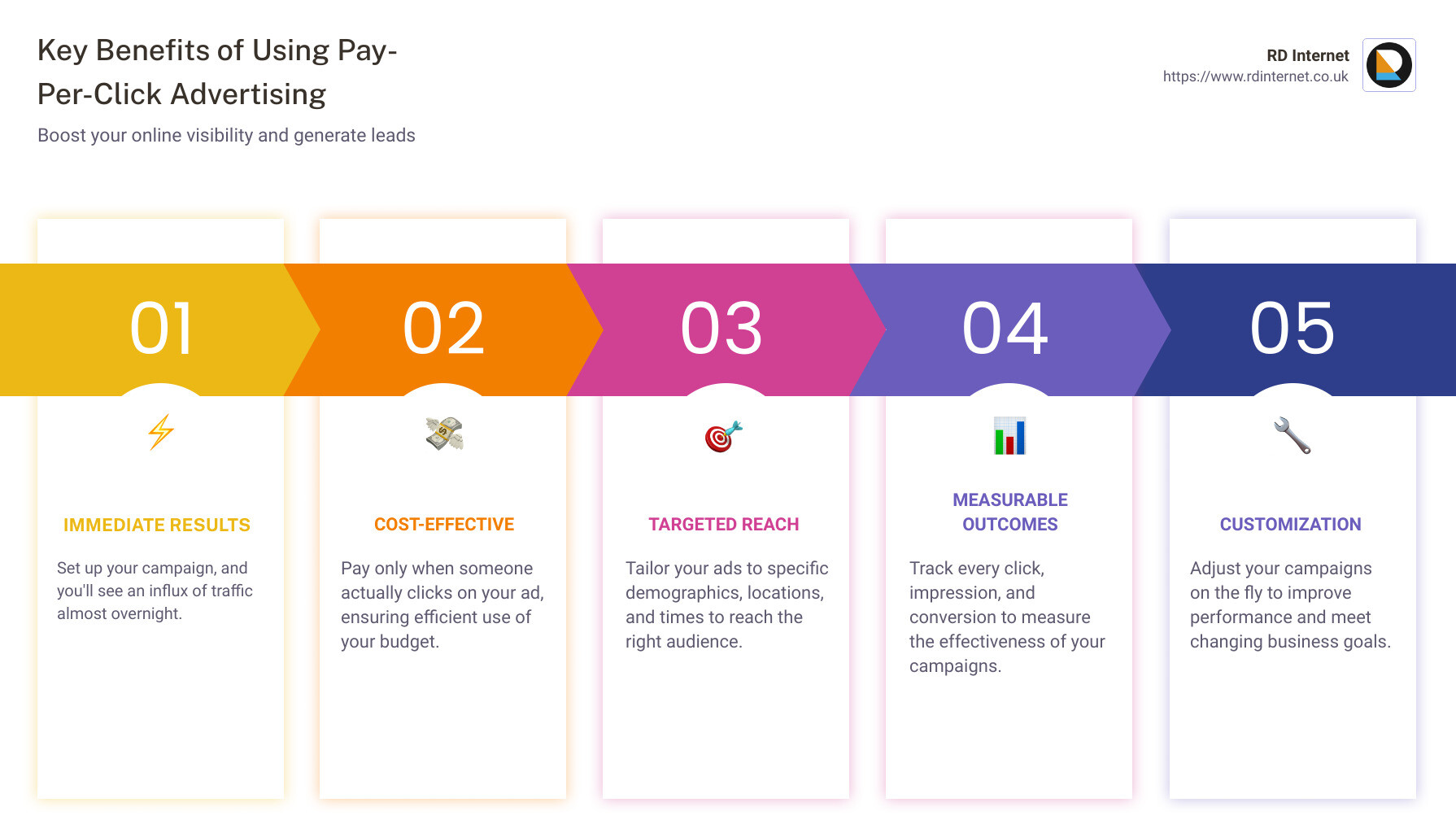
What are the benefits of using pay-per-click advertising? Here are some key advantages:
- Immediate Results: Set up your campaign, and you’ll see an influx of traffic almost overnight.
- Cost-Effective: Pay only when someone actually clicks on your ad.
- Targeted Reach: Tailor your ads to specific demographics, locations, and times.
- Measurable Outcomes: Track every click, impression, and conversion.
- Customization: Adjust your campaigns on the fly to improve performance.
Diving into digital marketing, you’ll quickly come across pay-per-click (PPC) advertising—a powerful tool that can boost your online presence. Unlike organic marketing tactics, which take time to bear fruit, PPC offers near-instant visibility by placing your ads at the forefront of search results.
At RD Internet, we harness the potential of PPC to help small business owners in Cardiff stand out from their competitors. Whether you’re struggling with online visibility or low website traffic, PPC can be a game-changer by driving targeted traffic and generating qualified leads all while keeping strict control over your budget.
In the following sections, we’ll dig deeper into the transformative benefits of PPC advertising, outlining why it’s an essential component of a robust digital marketing strategy.
Simple guide to what are the benefits of using pay-per-click advertising terms:
– Advanced PPC strategies
– PPC bid strategies
– ppc advertising strategies
What are the Benefits of Using Pay-Per-Click Advertising?
Cost-Effective
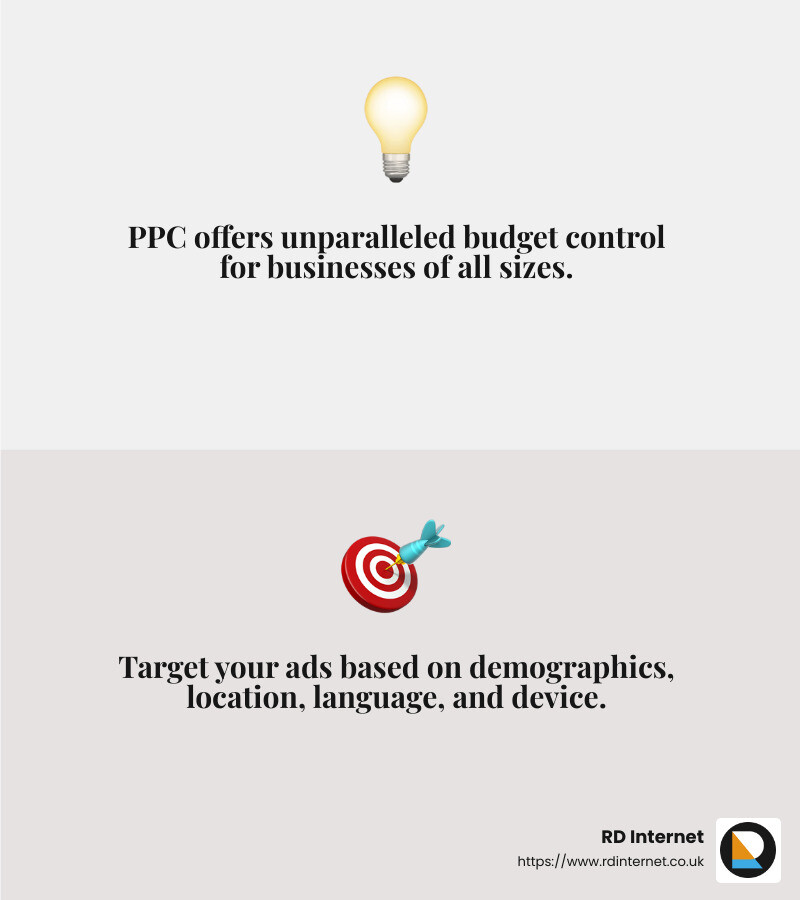
One of the standout benefits of using pay-per-click (PPC) advertising is its cost-effectiveness. Unlike traditional advertising methods, you only pay when someone clicks on your ad. This model ensures that every dollar spent directly contributes to driving traffic to your site. Return on Ad Spend (ROAS) is a critical metric here, helping you gauge the effectiveness of your campaigns. Additionally, PPC offers unparalleled budget control. Whether you’re a small business or a large enterprise, you can set your daily and monthly budgets to align with your financial goals.
Targeted Reach
PPC allows you to target your ads with surgical precision. You can tailor your campaigns based on demographics, location, language, and even device type. This means your ads will reach the audience most likely to convert, increasing your chances of success. For example, if you’re a local business in Cardiff, you can target users within your geographical area, ensuring that your ads are seen by potential customers nearby.
Measurable Results
One of the most compelling benefits of PPC is its measurability. With tools like Google Analytics, you can track every click, impression, and conversion. This data-rich environment allows you to assess keyword performance and measure the success of your campaigns with precision. Conversion tracking helps you understand how users interact with your ads and what actions they take on your site, providing invaluable insights for future campaign optimization.
Customizable Campaigns
PPC advertising offers a high degree of customization. You can make adjustments to your campaigns in real-time, allowing for continuous improvement. A/B testing is a powerful feature that lets you test different ad variations to see which performs better. This flexibility ensures that your campaigns are always optimized for maximum effectiveness. Whether it’s tweaking ad copy or adjusting your targeting parameters, PPC allows for quick and easy modifications.
Fast Results
Unlike SEO, which can take months to show results, PPC provides immediate impact. Once your campaign is set up, your ads can go live almost instantly, delivering quick results. This instant visibility is crucial for businesses looking to make a rapid impact, whether it’s a new product launch or a time-sensitive promotion. The ability to see immediate results allows you to quickly gauge the effectiveness of your campaigns and make necessary adjustments.
At RD Internet, we leverage the power of PPC to help businesses achieve their digital marketing goals. Our expert team ensures that every campaign is custom to meet your specific needs, driving targeted traffic and maximizing your return on investment. Ready to see the benefits of PPC for yourself? Stay tuned as we dive deeper into the advantages of pay-per-click advertising in the next section.
Advantages of Pay-Per-Click Advertising
Boosts Brand Awareness
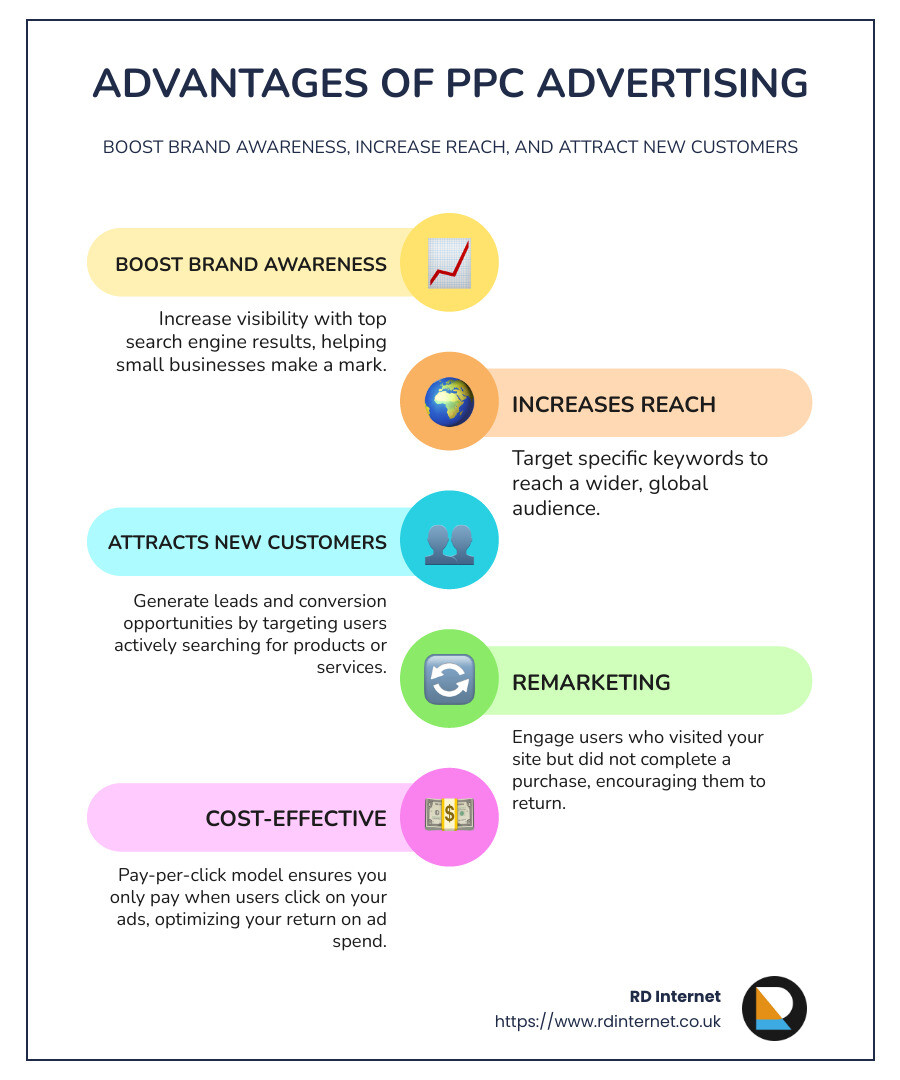
One of the biggest advantages of PPC advertising is its ability to boost brand awareness. When your ads appear at the top of search engine results, your brand gains immediate visibility. This is particularly beneficial for new or small businesses looking to make a mark. Even if users don’t click on your ad, they still see your brand name, which can increase recognition over time.
Increases Reach
PPC advertising allows you to increase your reach significantly. By targeting specific keywords, your ads can appear in front of a much wider audience. This means your business isn’t limited to local exposure; you can reach potential customers globally. With PPC, every ad impression counts, expanding your brand’s footprint across various markets.
Attracts New Customers
PPC is a powerful tool for attracting new customers. Through lead generation strategies, you can capture the interest of potential customers who are actively searching for products or services like yours. PPC offers numerous conversion opportunities, from form submissions to phone calls and online purchases. Remarketing also plays a crucial role by targeting users who have previously visited your site but didn’t make a purchase, encouraging them to return and complete the transaction.
By leveraging these advantages, PPC can be a game-changer for your business. It not only drives traffic but also ensures that your marketing efforts are seen by the right audience, leading to higher conversion rates and better ROI. Stay tuned as we explore the potential downsides of PPC advertising in the next section.
Disadvantages of Pay-Per-Click Advertising
Time Investment
PPC advertising isn’t a “set it and forget it” strategy. It demands ongoing management and campaign monitoring to ensure success. You need to constantly check how your ads are performing, tweak keywords, and adjust bids. This can be time-consuming, especially for small businesses without a dedicated marketing team.
Optimization is key. Without regular updates and improvements, your PPC campaigns can quickly become ineffective. This means you need to invest time not just in setting up the ads, but also in refining them.
Skills Required
Running a successful PPC campaign requires specialist knowledge. While platforms like Google Ads are user-friendly, there’s a big difference between setting up an ad and optimizing it for the best results.
There’s a learning curve involved. You need to understand keyword research, audience targeting, and how to analyze data from tools like Google Analytics. Many businesses find it beneficial to hire an agency or a PPC specialist to manage their campaigns. However, this adds to the cost and complexity.
Cost Management
A challenge of PPC is cost management. Without careful monitoring, costs can quickly spiral out of control. You need to allocate your budget wisely and keep an eye on your cost per click (CPC) to ensure you’re getting a good return on investment (ROI).
Budget allocation is crucial. If you bid too high on popular keywords, you might exhaust your budget without seeing a significant return. Conversely, if you bid too low, your ads might not appear at all. Balancing these factors requires constant attention and adjustment.
Campaign Monitoring
Effective PPC campaigns require continuous campaign monitoring. This means checking performance metrics daily or weekly to ensure your ads are meeting their goals. If you neglect this, you risk wasting money on underperforming ads.
Optimization is an ongoing process. You need to test different ad copies, landing pages, and keywords to find what works best. This requires a commitment to data analysis and a willingness to make regular adjustments.
Ongoing Management
PPC isn’t a one-time effort. It requires ongoing management to adapt to market changes, competitive actions, and shifts in consumer behavior. This can be a significant time and resource investment.
For many businesses, hiring a specialized agency can help manage these tasks. However, this comes with its own set of challenges, including finding a trustworthy agency and managing that relationship effectively.
Understanding these disadvantages can help you better prepare for the challenges of PPC advertising. In the next section, we’ll answer some frequently asked questions about PPC to help you make an informed decision.
Frequently Asked Questions about Pay-Per-Click Advertising
What is the advantage of pay-per-click advertising?
Spend Control: One of the biggest advantages of PPC advertising is the control it gives you over your budget. You only pay when someone clicks on your ad, ensuring that your money is spent on engaged users. This makes it easier to manage and optimize your return on ad spend (ROAS).
Targeted Audience: PPC allows you to target your ads to specific demographics, locations, languages, and even devices. This means your ads reach the people most likely to be interested in your product or service, increasing the chances of conversion.
Measurable Effectiveness: With PPC, you get detailed data on how your ads are performing. Metrics like click-through rates (CTR), conversion rates, and cost-per-click (CPC) help you measure the effectiveness of your campaigns and make data-driven decisions.
Why is pay-per-click effective?
Site Visibility: PPC ads appear at the top of search engine results pages (SERPs), giving your website immediate visibility. This is especially beneficial for new or small businesses that might struggle to rank organically.
Increased Traffic: Because your ads are highly visible and targeted, they can drive a significant amount of traffic to your website. This is crucial for generating leads and sales.
Conversion Opportunities: PPC ads are designed to attract users who are already searching for products or services like yours. This means they are more likely to convert into customers, providing a higher return on investment.
What are the pros and cons of PPC?
Pros:
- Immediate Visibility: Your ads can start showing up almost instantly after you set up your campaign, giving you quick access to potential customers.
- Targeted Reach: You can precisely target your audience based on various criteria, ensuring your ads reach the right people.
- Measurable Results: PPC provides detailed analytics, allowing you to track performance and optimize your campaigns for better results.
Cons:
- Cost: Without careful management, PPC costs can add up quickly. You need to constantly monitor your campaigns to ensure you’re getting a good return on investment.
- Complexity: Running a successful PPC campaign requires specialist knowledge and ongoing management. There is a learning curve involved, and many businesses find it beneficial to hire a PPC specialist or agency.
Understanding these frequently asked questions can help you better grasp the benefits and challenges of PPC advertising. Next, we’ll dig into how to make the most out of your PPC campaigns.
Conclusion
At RD Internet, we believe that a well-crafted PPC strategy can be a game-changer for your business. By leveraging the unique advantages of pay-per-click advertising, you can significantly improve your online visibility and drive increased revenue.
PPC advertising offers immediate benefits. With PPC, your ads appear at the top of search engine results almost instantly, giving your brand the visibility it needs to attract potential customers. This is especially crucial for new or small businesses that might struggle to rank organically.
Moreover, PPC is highly cost-effective. You only pay when someone clicks on your ad, ensuring that your budget is spent on engaged users. This pay-per-click model allows for precise budget control and helps you maximize your return on ad spend (ROAS).
One of the standout features of PPC is its ability to target specific audiences. You can tailor your campaigns based on demographics, location, language, and even device. This targeted approach ensures that your ads reach the people most likely to be interested in your products or services, leading to higher conversion rates.
Additionally, PPC provides measurable results. With detailed data on metrics like click-through rates (CTR), conversion rates, and cost-per-click (CPC), you can track the performance of your campaigns and make data-driven decisions to optimize them.
In conclusion, integrating PPC into your digital marketing strategy can provide immediate visibility, targeted reach, and measurable outcomes. If you’re looking to boost your online presence and drive more revenue, PPC is an invaluable tool.
Ready to take your digital marketing to the next level? Contact RD Internet today to create a PPC plan custom to your business’s needs.
By understanding and leveraging the benefits of PPC, you can transform your online marketing efforts and achieve your business goals.
Recent Comments