

Are you struggling to drive traffic to your website from your social media profiles? As a small business owner, it is not enough to have an online presence; you also need to know how to effectively lead social media users to your website. Learning how to drive traffic to your website from social media can seem daunting, but it’s not as complicated as you might think.
Here at RD Internet, our goal is to make the process as simple as possible for you. We understand that increasing website traffic is a pressing concern for many businesses today and social media platforms are undeniable powerhouses when it comes to attracting and engaging with potential online visitors.
You don’t need to become a digital marketing guru to start generating more traffic. We have broken down the process into five easy-to-understand steps. As we take you through this guide, you’ll realise that with a little consistency, creativity, and strategy, you can get your target audience to engage with your social media posts and ultimately visit your website.
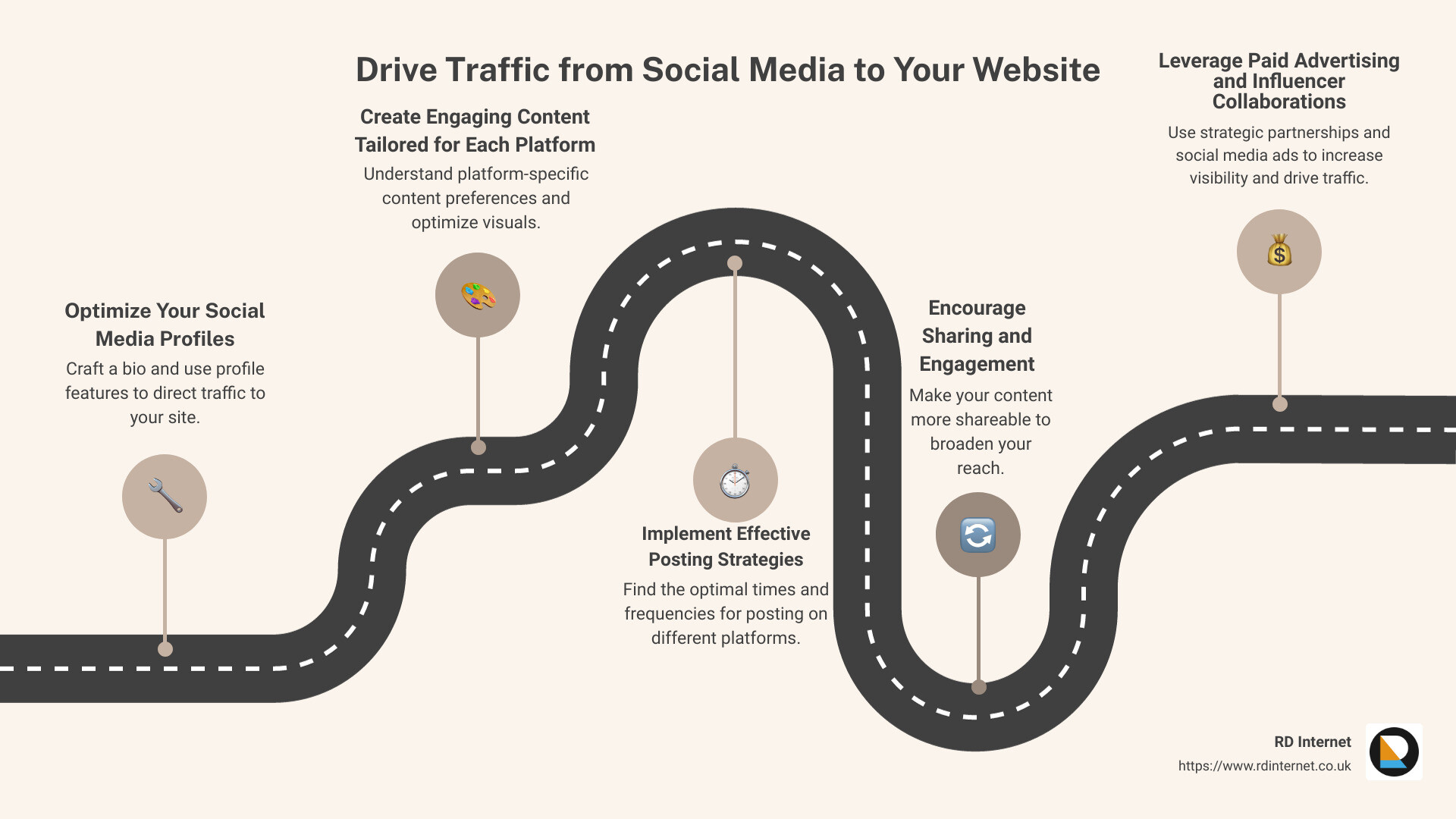
To quickly summarize, here’s what you can expect from this article:
- Optimize Your Social Media Profiles: Learn how a well-crafted bio and the strategic use of profile features can direct more traffic to your site.
- Create Engaging Content Tailored for Each Platform: Improve your understanding of platform-specific content preferences and make your visuals work for you.
- Implement Effective Posting Strategies: Discover the optimal times and frequencies for posting content on different platforms.
- Encourage Sharing and Engagement: Understand how to make your content more shareable to broaden your reach.
- Leverage Paid Advertising and Influencer Collaborations: Learn how strategic partnerships and social media ads can increase your online visibility and drive more traffic to your site.
Step 1: Optimize Your Social Media Profiles
To successfully drive traffic to your website from social media, the first crucial step is to thoroughly optimize your social media profiles. This process involves creating a well-crafted bio, adding website links to your profile, and utilizing social media profile features for promotion.
Importance of a Well-Crafted Bio
Your social media bio is the first thing users see when they land on your profile. It serves as a brief introduction to who you are, what you do, and what you offer. Consequently, it’s a potent marketing tool that, when optimized correctly, can significantly increase the likelihood of converting casual visitors into potential customers.
To make your bio effective, ensure it contains relevant keywords related to your business and a clear call to action. Each social media platform caters to a different audience, so it’s crucial to tailor your bio accordingly. For example, LinkedIn, being a professional network, should reflect your business’s professional side. In contrast, Instagram, which caters more to a younger audience, could showcase your brand’s creative side.
Adding Website Links to Your Profile
Adding website links to your social media profiles is a simple yet effective way to drive traffic to your site. On most platforms, you can add more than one link in your bio, offering your followers a variety of options and reducing any friction in their journey to find more information about your business.
If a platform only allows you to add one link, consider linking to a dedicated landing page on your website where you can list several useful links. Services like Linktree and Linkin.bio offer this feature, or you can simply create your own landing page on your website.
Utilizing Social Media Profile Features for Promotion
Various social media platforms offer different features that you can utilize to promote your website. For instance, Instagram offers the “link in bio” feature, which has proven to be an effective way to drive traffic to websites. According to Kevin Young, the Head of Audience at The Economist, their link in bio feature has driven “several million referrals to our website and a marked uplift in subscriptions and registrations.”
In conclusion, optimizing your social media profiles is a vital step in learning how to drive traffic to your website from social media. By crafting a compelling bio, adding website links to your profile, and utilizing platform-specific promotional features, you’re setting the foundation for a successful social media strategy that will increase your online visibility and drive more traffic to your site.
Step 2: Create Engaging Content Tailored for Each Platform
After setting up your social media profiles, the next step in driving website traffic from social media is creating engaging content that resonates with your audience. Content that works on one platform may not work on another. So, it is essential to understand the unique preferences of each platform’s users.
Understanding Platform-Specific Content Preferences
Each social media platform has its own unique content preferences. For example, Instagram is a visual platform, making it perfect for sharing high-quality images and videos of your products or services. On the other hand, Twitter is ideal for sharing quick updates, news, and engaging in real-time conversations. Platforms like LinkedIn are professional networks where you can post industry-related articles, company updates, and job postings.
Remember to tailor your content to suit the platform. This means not only changing the format but also the tone and messaging to match the platform’s user base. You can observe the popular content types in your industry on each platform and adapt accordingly.
Using Visuals to Capture Attention
Never underestimate the power of visuals. Images, infographics, and short videos significantly enhance user engagement on your site. They make your content more digestible and offer a break from text-heavy posts. Platforms like Pinterest and Instagram, which are visually oriented, can be especially effective in this regard.
For example, Skyram Technologies generates traffic by pinning blog posts with engaging visuals to Pinterest. You can use your own images or infographics, but if you don’t have those, stock photos can work too.

The Power of Memes and Engaging Content
Memes, GIFs, and other forms of interactive content can also be effective at driving engagement. They’re fun, relatable, and shareable, which can help your content reach a wider audience. However, it’s important to use them appropriately and in line with your brand image.
Avoiding Clickbait and Delivering on Promises
While it’s important to create engaging and enticing headlines, avoid falling into the trap of clickbait. Users appreciate transparency and honesty. If your content does not deliver what the headline promises, it could harm your credibility and deter users from visiting your site in the future.
The ultimate goal is not just to get users to click on your social media post, but to provide valuable content that resonates with them and encourages them to visit your website. This will not only increase your website traffic but also build a loyal audience that values what your brand has to offer.
In the next step, we’ll discuss effective posting strategies on social media to ensure your well-crafted content gets the attention it deserves.
Step 3: Implement Effective Posting Strategies
Having optimized your profiles and created engaging content, the next crucial step on how to drive traffic to your website from social media is to refine your posting strategies. Just as a well-timed joke can spark laughter, a well-timed post can spark engagement and traffic.
Timing Your Posts for Maximum Engagement
The best time to post on social media can vary based on factors like your target audience, their time zone, and their social media habits. While several studies suggest optimal posting times, we at RD Internet believe there’s no one-size-fits-all solution. The key to figuring out the best timing lies in trial and error.
By using post scheduling tools, you can post content at different times of the day and track which times garner the most engagement. This will help you identify the best times to post for your specific audience. For instance, some online studies suggest that Thursdays and Fridays can have 18% higher engagement.
Regular Posting and Consistency
Consistency is crucial in social media marketing. Regularly posting content not only keeps your audience engaged but also signals to social media algorithms that your profile is active, potentially boosting your visibility.
To maintain a consistent posting schedule, we recommend creating a content calendar. This tool outlines what and when you’ll post, helping you plan ahead and ensuring you never miss a beat in your social media interactions.
Customizing Post Frequency for Each Platform
Each social media platform has its own rhythm, and tune into this when determining how often to post. While it’s beneficial to share your content more than once, especially considering how quickly social media feeds can move, it’s also vital not to overwhelm your audience.
For instance, on Twitter, it’s acceptable to post multiple times a day due to the platform’s fast-paced nature. On the other hand, on a platform like Facebook or LinkedIn, a few times per week might be more appropriate.
The goal is to share valuable content that your audience will appreciate and engage with, not to fill their feed with so many posts that they feel spammed and unfollow you.
By implementing effective posting strategies, you can ensure your content reaches your audience at the right time, in the right way, and on the right platform. This is a critical step on the journey of driving more traffic to your website from social media.
In the next step, we’ll explore ways to encourage sharing and engagement, further amplifying your reach and driving potential customers to your website. Stick around!
Step 4: Encourage Sharing and Engagement
The fourth step in learning how to drive traffic to your website from social media is all about encouraging sharing and engagement. Social media isn’t a one-way street – it’s a space for interaction, conversation, and community. By fostering engagement, you’re not only boosting your brand’s visibility but also creating opportunities for your content to reach new audiences.
Making Share Buttons Obvious
One simple yet effective way to increase website traffic is by making sharing your content as easy as possible. Place share buttons close to your content so that they’re easily visible and accessible. You can also incorporate a count on your share buttons to show the number of shares to date. This serves as social proof that others find your content worth sharing too.
Encouraging Audience Interaction
Encouraging interaction is another key to driving engagement. This could be as simple as asking open-ended questions, hosting a poll, or even organizing interactive quizzes and awarding prizes for winners. These activities are not only fun for your audience but also incentivize them to engage with your content and visit your website.
Building Relationships through Responsiveness
Building relationships with your audience is about more than just broadcasting content. It’s about being responsive, engaging, and genuinely building relationships. Make an effort to reply to every comment on your posts; this makes your audience feel valued and foster a sense of community. People are more likely to share content from brands they have a personal connection with.
Promoting Content Sharing Among Followers
Finally, don’t be shy about asking your followers to share your content. Whether it’s a call-to-action at the end of a blog post, or a request in a social media update, encouraging your followers to share your content can significantly increase its reach. And the more people who see your content, the more potential traffic for your website.
By focusing on these strategies, you’re not just learning how to drive traffic to your website from social media, you’re also fostering a community around your brand. In the next step, we’ll delve into leveraging paid advertising and influencer collaborations to further amplify your reach.
Step 5: Leverage Paid Advertising and Influencer Collaborations
Navigating the vast ocean of organic content can be challenging. However, by leveraging paid advertising and influencer collaborations, you can significantly increase your online visibility and drive more traffic to your site.
Boosting Posts and Running Ads on Social Media
Paid social media ads can act as your lighthouse, guiding more traffic to your website. With these ads, you can reach a larger and more specific audience, thereby increasing the chances of conversions. Platforms like Facebook offer comprehensive advertising options, allowing you to target users based on their interests, behaviour, location, and more. By doing so, you can ensure that you’re driving the most relevant traffic to your website (RD Internet).
Effectively using paid social media ads requires careful planning and strategy. You need to identify your audience, set clear objectives for your campaigns, and tailor your ads to meet these goals. Constantly analyzing and tweaking your ads based on performance metrics can help you optimize your ad campaigns for maximum efficiency.
Collaborating with Influencers for Wider Reach
Influencer marketing is an excellent way to tap into new audiences and drive more traffic to your site. By collaborating with influencers who resonate with your brand and audience, you can showcase your products or services to a larger audience (RD Internet).
Start by identifying influencers who align with your brand values and have a following that matches your target audience. Engage them in various ways such as asking for product reviews, hosting giveaways, or offering discount codes to their followers. The key to successful influencer collaboration is authenticity. Ensure that the influencers you choose genuinely align with your brand and can present your offerings in a way that feels organic to their usual content.
Influencer collaborations can not only result in immediate traffic boosts but also help in building long-term relationships and enhancing your online reputation.
By combining paid advertising and influencer collaborations, you can significantly enhance your social media strategy and learn how to drive traffic to your website from social media more effectively. In the next section, we’ll look at how continuous improvement and experimentation can further boost your website traffic.
Conclusion
In the vast digital landscape, understanding how to drive traffic to your website from social media can feel like a daunting task. However, we hope that by following these simple steps, you feel more confident in leveraging your social media platforms to increase your website traffic.
To recap, start by optimizing your social media profiles. Use your bio to clearly communicate what your brand is about and don’t forget to include a link to your website. Next, craft engaging, platform-specific content that captures your audience’s attention and encourages interaction. Implement effective posting strategies, taking into account the best times to post and the importance of regular posting for each platform.
Encourage sharing and engagement by making share buttons obvious and actively interacting with your audience. Lastly, don’t shy away from paid advertising and influencer collaborations. These methods can significantly widen your reach and drive more relevant traffic to your site.
The journey to increase website traffic is a marathon, not a sprint. It requires patience, consistency, and continuous improvement. Stay tuned for our next section where we delve into the power of continuous improvement and experimentation in boosting your website’s visibility.
At RD Internet, we’re passionate about helping small business owners like you boost your online presence and drive more traffic to your site. Our team is always ready to assist you in developing and implementing an effective social media strategy. Check out our SEO services and social media marketing strategies for more information.
The digital world is always evolving, and so should your strategies. Keep testing, learning, and adapting to stay ahead of the curve and make the most of your social media platforms.
Bonus: Continuous Improvement and Experimentation
After implementing these steps on how to drive traffic to your website from social media, it’s crucial to remember that the digital landscape is ever-changing. Therefore, constant evaluation and adaptation of your strategies are essential for sustained growth and success.
Using Analytics to Understand What Works
In social media marketing, data is king. Platforms like Facebook, Instagram, Twitter, and LinkedIn offer in-depth analytics that can provide invaluable insights into your audience’s behaviour and the performance of your content. These analytics can help you identify which strategies are driving traffic and which ones might need refinement.
Additionally, tools like Google Analytics can give you a more comprehensive understanding of your website’s performance, such as the number of users, pageviews, sessions, bounce rate, and session duration. By understanding these metrics, you can tailor your content and social media strategies to increase traffic and improve engagement rates.
A/B Testing for Optimized Results
A/B testing, or split testing, is a powerful tool for optimizing your social media strategies. This method involves comparing two versions of a webpage, ad, or post to see which performs better. This could mean testing two different headlines for a blog post, two different images for an Instagram post, or two different CTAs in an email newsletter. By continuously testing and refining your strategies based on data, you can improve user experience, reduce bounce rates, and ultimately drive more traffic to your site.
Adapting and Evolving Your Social Media Strategy
Due to the dynamic nature of social media, what worked yesterday might not work tomorrow. Stay informed about the latest trends and updates on social media platforms, and be ready to adapt your strategies accordingly. This might mean experimenting with new types of content, trying out new features (like Instagram Reels or LinkedIn Stories), or even venturing into new platforms.
The key is to stay flexible and open to change. Regularly review your performance, learn from your successes and failures, and continually strive to improve.
In summary, while understanding how to drive traffic to your website from social media is crucial, it’s equally important to keep refining and adapting your strategies. Stay data-driven, keep experimenting, and keep learning. For more insights on how to boost your website’s performance, check out our articles on proven strategies to improve site engagement and how to unlock the potential of your website.

At RD Internet, we’re committed to helping you navigate the digital landscape and achieve your business goals. Contact us today to learn how we can help you enhance your online visibility, increase your website traffic, and grow your business.
Recent Comments