

How does pay per click advertising work?
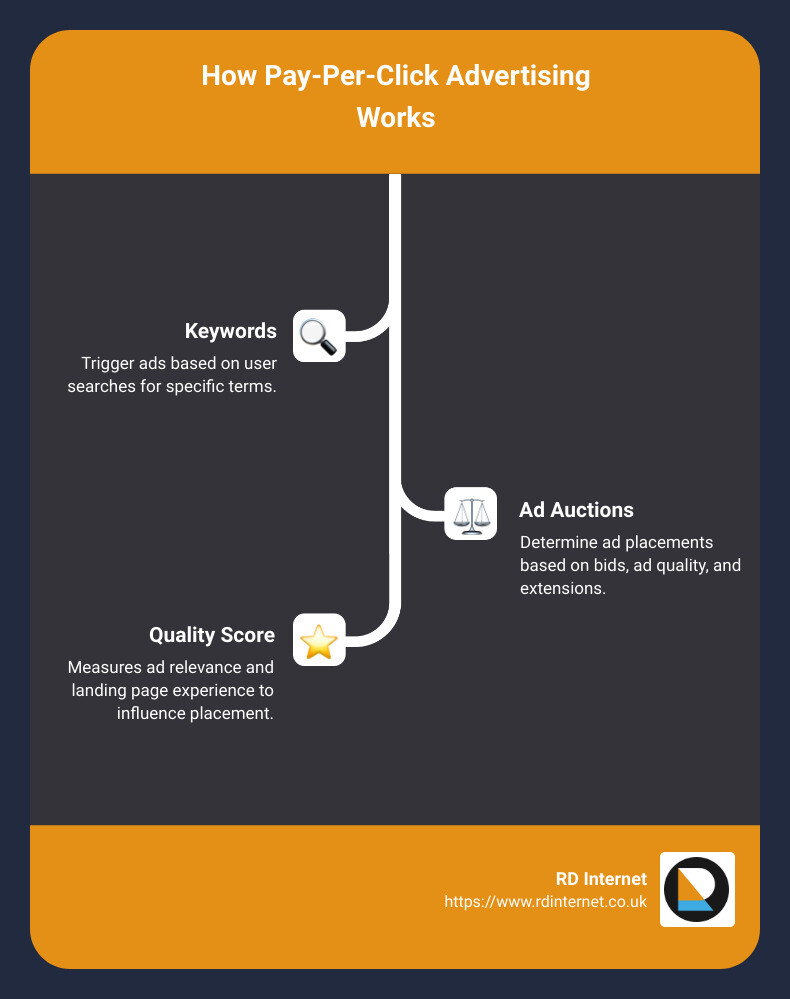
- Pay-Per-Click (PPC): Advertisers pay each time their ad is clicked.
- Keywords: Trigger ads based on searches.
- Ad Auctions: Determine ad placements based on bids, ad quality, and extensions.
- Quality Score: Measures ad relevance and landing page experience.
Understanding Pay-Per-Click (PPC) Advertising: How it Works and Why It Matters
In the field of digital marketing, the question how does pay per click advertising work is pivotal for small business owners seeking to improve their online visibility. At its core, PPC is an online advertising model where advertisers pay a fee each time their ad is clicked. It’s a way of buying visits to your site rather than earning them organically.
What makes PPC advertising essential? It’s the ability to target specific keywords, accurately measure results, and adjust strategies in real-time. Simple yet powerful, PPC lets you reach potential customers actively searching for your products or services.
By mastering PPC, you can outshine your competition, drive targeted traffic to your website, and ultimately increase revenue. Dive into PPC to see how you can transform your business’s digital presence.
How does pay per click advertising work terms simplified:
– Advanced PPC strategies
– PPC bid strategies
– what are the benefits of using pay-per-click advertising
What is Pay-Per-Click (PPC) Advertising?
Pay-Per-Click (PPC) advertising is a form of online marketing where advertisers pay a fee each time their ad is clicked. Instead of earning visits organically, you buy them through targeted ads.
Cost-Per-Click (CPC)
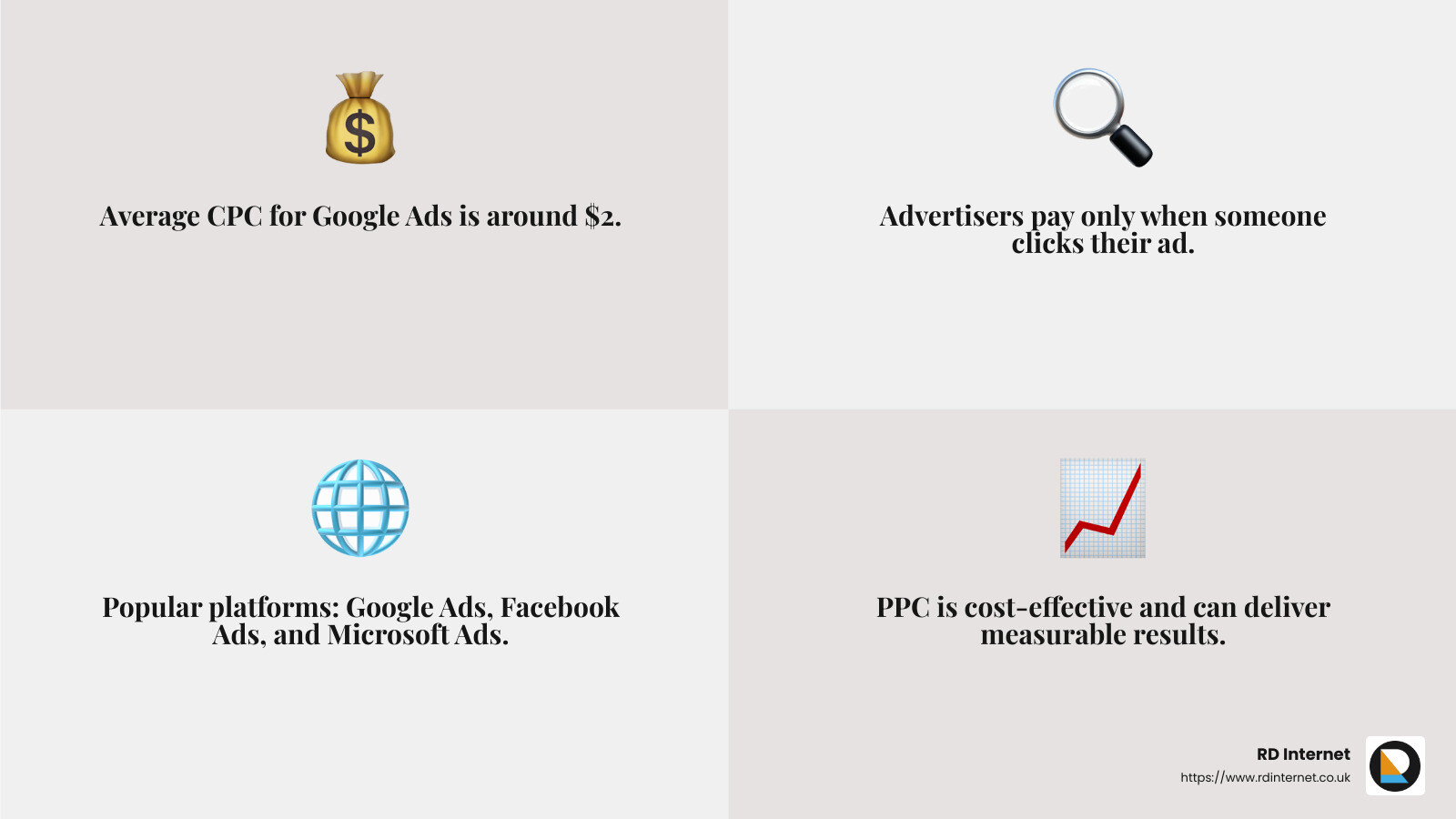
In PPC, the cost-per-click (CPC) is the price you pay for each click on your ad. This cost can vary widely based on factors like keyword competitiveness, industry, and ad quality. For instance, the average CPC for Google Ads is around $2, but it can range from $1 to over $30 per click.
How Advertisers Pay
The beauty of PPC is its simplicity: you only pay when someone clicks on your ad. This makes it a cost-effective method for driving traffic to your website, especially if you have a solid strategy in place.
Popular PPC Platforms
Several platforms offer PPC advertising, each with unique features and benefits:
- Google Ads: The most popular PPC platform. It allows you to place ads on Google’s search engine results pages (SERPs) and its network of partner sites.
- Facebook Ads: Ideal for targeting specific demographics and interests. Ads appear in users’ feeds, stories, and even Messenger.
- Microsoft Ads: Similar to Google Ads but for Bing’s search engine. Often overlooked, but it can be cost-effective due to less competition.
Using these platforms, you can create highly targeted campaigns to reach your ideal audience.
PPC advertising is not just about placing ads; it’s about placing the right ads in front of the right people at the right time. By leveraging these platforms and understanding the cost dynamics, you can craft campaigns that deliver measurable results.
Next, we’ll dig into the mechanics of how does pay per click advertising work to help you get the most out of your PPC campaigns.
How Does Pay Per Click Advertising Work?
So, how does pay per click advertising work? Let’s break it down into three key areas: keyword research, ad auctions and bidding, and ad placement and cost.
Keyword Research
Keywords are the backbone of PPC advertising. When someone types a search query into Google or Bing, the search engine matches the query with relevant ads based on the keywords in those ads.
Why is keyword research crucial?
- Relevance: Your ads need to match what people are searching for.
- Cost: Keywords have different costs. Popular ones are more expensive.
- Effectiveness: Keywords with a high click-through rate (CTR) bring more traffic.
Long-tail keywords are especially useful. They are specific phrases like “best sushi restaurant in New York” rather than just “sushi.” Long-tail keywords make up 70% of all search traffic and are often less competitive and cheaper.
Tools for keyword research:
– Google Keyword Planner
– Microsoft Advertising Intelligence
– SEMrush
Ad Auctions and Bidding
Every time someone searches for something, an ad auction happens. This auction decides which ads will appear and in what order.
Two main models exist:
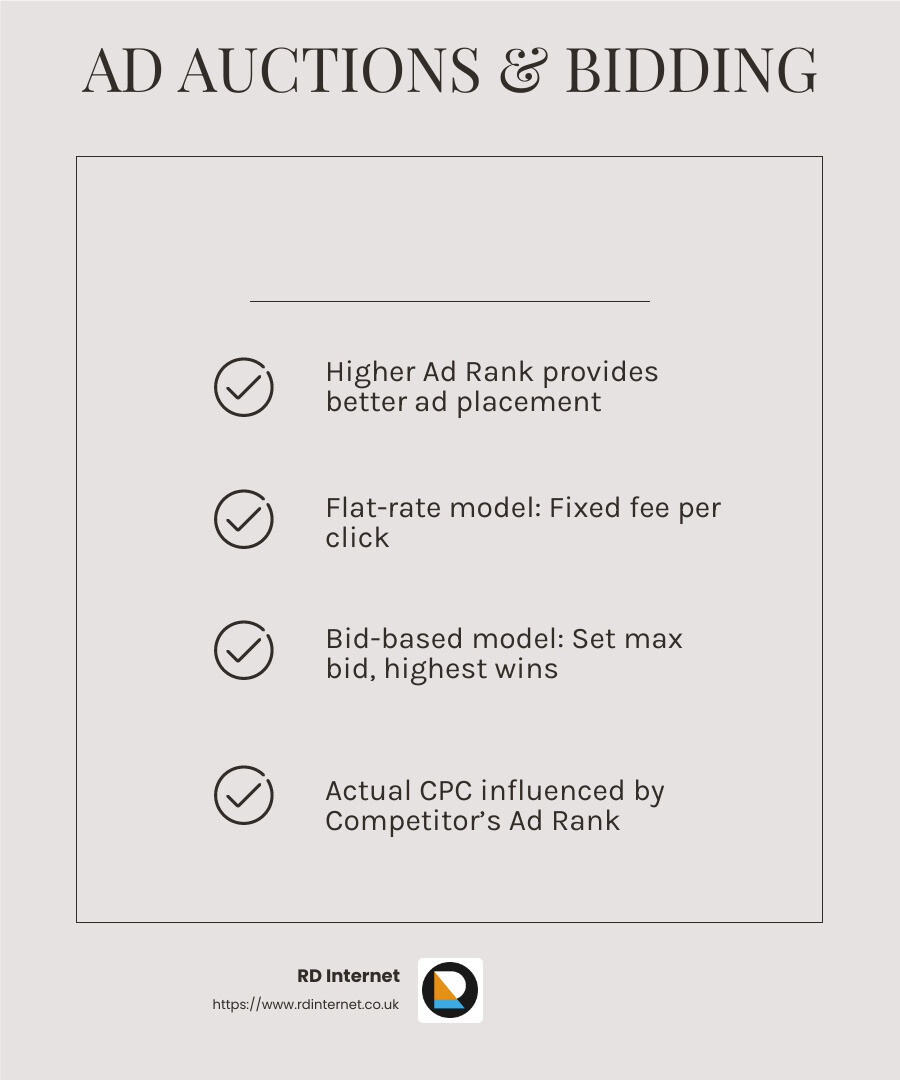
– Flat-rate model: You pay a fixed fee per click.
– Bid-based model: You set a maximum bid, and the highest bidder wins, but relevance also matters.
Ad Rank is determined by:
– Maximum Bid: The highest amount you’re willing to pay.
– Quality Score: Google’s rating of your ad’s relevance and quality.
Formula for Ad Rank:
[ \text{Ad Rank} = \text{Maximum Bid} \times \text{Quality Score} ]
Quality Score factors:
– Click-Through Rate (CTR): How often people click your ad.
– Ad Relevance: How closely your ad matches the search query.
– Landing Page Experience: How useful and relevant your landing page is.
Ad Placement and Cost
Ad placement refers to where your ad appears on the search results page. Higher ad ranks get better positions, often at the top of the page.
Cost-Per-Click (CPC): This is the actual price you pay for a click. It’s determined by:
[ \text{Actual CPC} = \left( \frac{\text{Competitor’s Ad Rank}}{\text{Your Quality Score}} \right) + 0.01 ]
Ad Quality and Relevance: Higher quality and more relevant ads often cost less per click. Google rewards ads that provide a good user experience.
Why does this matter? Better ad placement and lower costs mean more traffic and higher returns on your investment.
Next, we’ll explore the benefits of pay-per-click advertising and how you can leverage them for your business.
Benefits of Pay-Per-Click Advertising
PPC advertising offers a range of benefits that can help businesses of all sizes achieve their marketing goals. Let’s explore some of the key advantages:
Budget Flexibility
One of the standout features of PPC advertising is its budget flexibility. You have complete control over how much you want to spend on your campaigns. Here’s how it works:
- Scaling Ad Spend: If your campaign is performing well, you can quickly increase your budget to capitalize on the momentum.
- Pausing Campaigns: Not seeing the results you want? You can pause your campaigns at any time without any penalties.
- Budget Allocation: Allocate your budget across different campaigns or ad groups based on performance and goals.
This flexibility ensures you can adapt your spending to match your business needs and market conditions.
Measurable and Trackable Results
PPC advertising is measurable and trackable, making it easier to understand your return on investment (ROI). Tools like Google Analytics provide real-time data on:
- Clicks: The total number of clicks your ads receive.
- Conversions: The number of users who complete a desired action, like making a purchase or filling out a form.
- Impressions: How many times your ad is viewed.
By analyzing these metrics, you can make data-driven decisions to optimize your campaigns for better performance.
Targeting Options
PPC allows for highly targeted advertising, ensuring your ads reach the right audience. You can target users based on:
- Demographics: Age, gender, income level, etc.
- Search Behavior: Keywords and search queries.
- Browsing History: Previous websites visited.
- Specific Audiences: Custom lists like past customers or email subscribers.
For example, Google’s In-Market Audiences lets you target users actively searching for products or services similar to yours. This precision targeting increases the likelihood of conversions and maximizes your ad spend.
Quick Results
Unlike organic search strategies that can take months to show results, PPC ads can deliver quick results. Once your ad is live, it can start appearing in search results almost immediately, driving traffic to your site right away.
Stewart Dunlop, founder of PPC.io, notes, “For businesses who want to accelerate their sales and growth fast, there truly is no better alternative to PPC marketing.”
This speed is invaluable for startups and small businesses looking to make an immediate impact.
Conclusion
With its budget flexibility, measurable results, precise targeting, and quick outcomes, PPC advertising is a powerful tool for any business looking to improve its online presence.
Next, we’ll explore the key components of a successful PPC campaign and how you can leverage them for your business.
Key Components of a Successful PPC Campaign
To make the most of your PPC campaigns, you need to focus on several key components. Let’s break them down.
Ad Groups and Ad Copy
Ad Groups are essential for organizing your PPC efforts. Think of them as folders that house related keywords, landing pages, and text ads. This structure helps you deliver a consistent message to your audience.
For example, if you run a sushi restaurant in New York, you might create an ad group for “sushi NYC” keywords. This group would include ads and landing pages specifically custom to those searching for sushi in New York.
Ad Copy is the text that appears in your PPC ads. It needs to be compelling and relevant to the keywords you’re targeting. Here are some tips:
- Speak directly to your target persona: Use language that resonates with your audience.
- Include the main keyword: Make sure the keyword you’re bidding on appears in your ad.
- Provide an actionable CTA: Tell the searcher what to do next, like “Order Now” or “Book a Table.”
- Make the offer appealing: Highlight what makes your offer special.
- Match your landing page copy: Ensure the language in your ad aligns with your landing page to create a seamless experience.
Landing Pages
Your landing page is where users go after clicking your ad. It needs to be highly relevant and deliver on the promise made in your ad. A well-crafted landing page can significantly improve your conversion rates and Quality Score.
Here’s what to include:
- A strong headline: This should mirror your ad to maintain consistency.
- Clean design and layout: Make it easy for visitors to find what they’re looking for.
- Responsive form with a standout CTA button: Ensure the form is easy to use and the CTA button is prominent.
- Relevant copy: The text should be specific to the keywords and ads that led users to your page.
- The promised offer: Deliver what your ad promised, whether it’s a discount, a free trial, or more information.
- A/B testing: Test different versions of your landing page to see which one performs better.
Ad Extensions
Ad extensions are additional pieces of information you can include in your ads to make them more appealing. These can increase your click-through rate and improve your ad rank. Here are some common types of ad extensions:
- Location: Show your business address to attract local customers.
- Contact number: Make it easy for users to call you directly from the ad.
- App: Link to your mobile app if you have one.
- Promotions: Highlight any special offers or discounts.
These elements not only make your ads more informative but also improve their performance by providing more ways for users to engage with your business.
By focusing on these key components—ad groups, ad copy, landing pages, and ad extensions—you can create a cohesive and effective PPC campaign that drives results. Next, we’ll look at how to optimize your PPC campaigns to ensure they continue to perform well.
How to Optimize PPC Campaigns
Monitoring and Analyzing Performance
To get the best results from your PPC campaigns, you need to continuously monitor and analyze their performance. This helps you understand what’s working and what needs improvement.
Google Ads is a powerful tool for this. It provides various performance metrics, such as:
- Click-through rate (CTR): This shows the percentage of people who clicked on your ad after seeing it. A high CTR indicates that your ad is relevant and engaging.
- Cost-per-click (CPC): This metric tells you how much you’re paying for each click on your ad. Lowering your CPC can help you get more clicks for your budget.
- Conversion rate: This shows the percentage of clicks that result in a desired action, like a purchase or sign-up. A high conversion rate means your landing page and offer are compelling.
- Impressions: This is the number of times your ad was shown. While impressions alone don’t tell the whole story, they help you understand your ad’s reach.
Regularly reviewing these metrics can help you identify trends and areas for improvement.
Refining Keywords and Ad Quality
Keywords are the backbone of your PPC campaigns. Refining them ensures you’re targeting the right audience. Here are some steps to optimize your keywords:
- Use negative keywords: These are terms for which you don’t want your ads to appear. For example, if you sell luxury watches, you might add “cheap” as a negative keyword to avoid attracting bargain hunters. This helps you spend your budget more effectively.
- Add long-tail keywords: These are more specific phrases that often have lower competition and higher conversion rates. For instance, instead of just “watches,” you could target “luxury men’s watches with leather straps.”
Ad relevance is also crucial. Your ad should closely match the keywords you’re targeting and the user’s search intent. Here’s how to improve it:
- Match ad copy to keywords: Ensure the main keyword appears in your ad text. This makes your ad more relevant to searchers.
- Update ad copy regularly: Keep your ads fresh by testing new headlines and descriptions. Google Ads can automatically test different combinations to find the best-performing ones.
Landing page experience is another key factor. If your landing page isn’t relevant or user-friendly, visitors will leave quickly, hurting your conversion rate and Quality Score. Here’s what to focus on:
- Relevance: Make sure the content on your landing page matches the ad that brought users there. If your ad promises a discount, the landing page should highlight that discount prominently.
- User experience: Ensure your landing page loads quickly and is easy to steer. A slow or confusing page can drive visitors away.
- Calls to action (CTAs): Make sure your CTAs are clear and compelling. Use action-oriented language like “Buy Now” or “Get Started.”
By continually monitoring and refining these elements, you can improve your PPC campaign’s performance and get more value from your ad spend.
Next, let’s explore the benefits of pay-per-click advertising to understand why it’s a powerful tool for your business.
Frequently Asked Questions about PPC
What is PPC?
Pay-per-click (PPC) is a type of online advertising where advertisers pay a fee each time someone clicks on their ad. It’s a way to buy visits to your site, rather than earning them organically. PPC ads can be found on search engines like Google and Bing, as well as on social media platforms such as Facebook and Instagram.
In a PPC campaign, you bid on keywords that are relevant to your business. When someone searches for those keywords, your ad may appear in the search results. The cost-per-click (CPC) is the amount you pay each time someone clicks on your ad, which can vary based on your bid and the competition for that keyword.
How Do I Get Good at PPC?
Getting good at PPC involves mastering several key components. Here’s a quick guide:
-
Keyword Research: Use tools like Google Keyword Planner to find high-performing keywords. Focus on long-tail keywords, which are more specific and often less competitive.
-
Ad Groups: Organize your keywords into ad groups. Each ad group should contain related keywords and corresponding ads. This helps ensure your ads are relevant to the search queries.
-
Ad Auctions: Understand how the ad auction works. Google considers your bid amount, ad quality, and relevance to determine your ad’s position. A higher Quality Score can lower your CPC and improve your ad rank.
-
Quality Score: Improve your Quality Score by making sure your ads are relevant, have a high click-through rate (CTR), and lead to a good landing page experience.
What is the Difference Between Paid Search and Paid Social?
Paid Search and Paid Social are two different PPC strategies:
-
Paid Search: This involves placing ads on search engine results pages (SERPs) like Google or Bing. It targets users based on keywords they type into the search bar. This is great for reaching users who are actively searching for information or products related to your business.
-
Paid Social: This involves placing ads on social media platforms like Facebook, Instagram, and LinkedIn. It targets users based on their demographics, interests, and browsing behavior. This is effective for reaching users who may not be actively searching for your product but fit your target audience profile.
Paid Search is keyword-driven, while Paid Social is audience-driven. Both have their own advantages and can be used together for a comprehensive PPC strategy.
Next, let’s explore the benefits of pay-per-click advertising to understand why it’s a powerful tool for your business.
Conclusion
In summary, pay-per-click (PPC) advertising is a powerful tool for driving targeted traffic to your website. By understanding how PPC works, including keyword research, ad auctions, and ad placement, you can create effective campaigns that not only attract clicks but also convert visitors into customers.
Benefits of PPC Advertising
PPC offers several benefits:
- Cost-Effective: You only pay when someone clicks on your ad, ensuring your budget is spent on interested visitors.
- Measurable and Trackable: With PPC, you can easily track performance metrics like click-through rate (CTR) and cost-per-click (CPC), allowing for real-time adjustments.
- Quick Results: Unlike organic strategies, PPC can deliver immediate visibility and traffic.
- Targeting Options: You can target specific demographics, search behaviors, and even retarget previous visitors.
Why Choose RD Internet?
At RD Internet, we specialize in helping businesses improve their search engine rankings and online visibility through effective PPC campaigns. Based in Cardiff, our team of experts is dedicated to crafting custom PPC strategies that align with your business goals.
By partnering with us, you gain access to:
- Expertise in Keyword Research: We identify high-performing keywords to ensure your ads reach the right audience.
- Optimized Ad Copy and Design: Our team creates compelling ad copy and eye-catching designs that resonate with your target market.
- Comprehensive Analytics: We continuously monitor and analyze your campaigns, making data-driven adjustments to maximize ROI.
Our goal is to help you increase revenue by driving high-quality traffic to your site. With our proven strategies, you can achieve better ad placements, lower costs, and higher conversion rates.
Ready to take your online advertising to the next level? Visit our Pay-Per-Click Advertising service page to learn more and get started today.
By leveraging the power of PPC advertising, you can stay ahead of the competition and achieve your business objectives more efficiently. Whether you are new to PPC or looking to optimize your existing campaigns, RD Internet is here to help you succeed.
Recent Comments