

Choosing the right social media platform can seem like finding a needle in a digital haystack. Whether you’re a small business owner in Cardiff looking to stand out, enhance your online presence, or simply boost your revenue through digital channels, understanding the landscape of social media is critical. Let’s make it simple.
Social media has evolved from simple online communities to complex ecosystems that impact global commerce, communication, and culture. These platforms offer unique features that cater to various content types— from text and images to videos and live streams. Each has its own audience, making some platforms more suitable for certain brands than others.
With billions of users worldwide, social media platforms present an unparalleled opportunity for businesses to reach a vast audience. However, the blueprint for success involves more than just showing up; it’s about choosing platforms where your target customers are most active and engaged.
To get you started on the right foot, here’s a quick glance at what you need to consider:
- Where is your audience? Identify the platforms your target customers use the most.
- What type of content do you create? Align your content with the platform’s strengths.
- What are your marketing goals? Choose platforms that can help you achieve them.
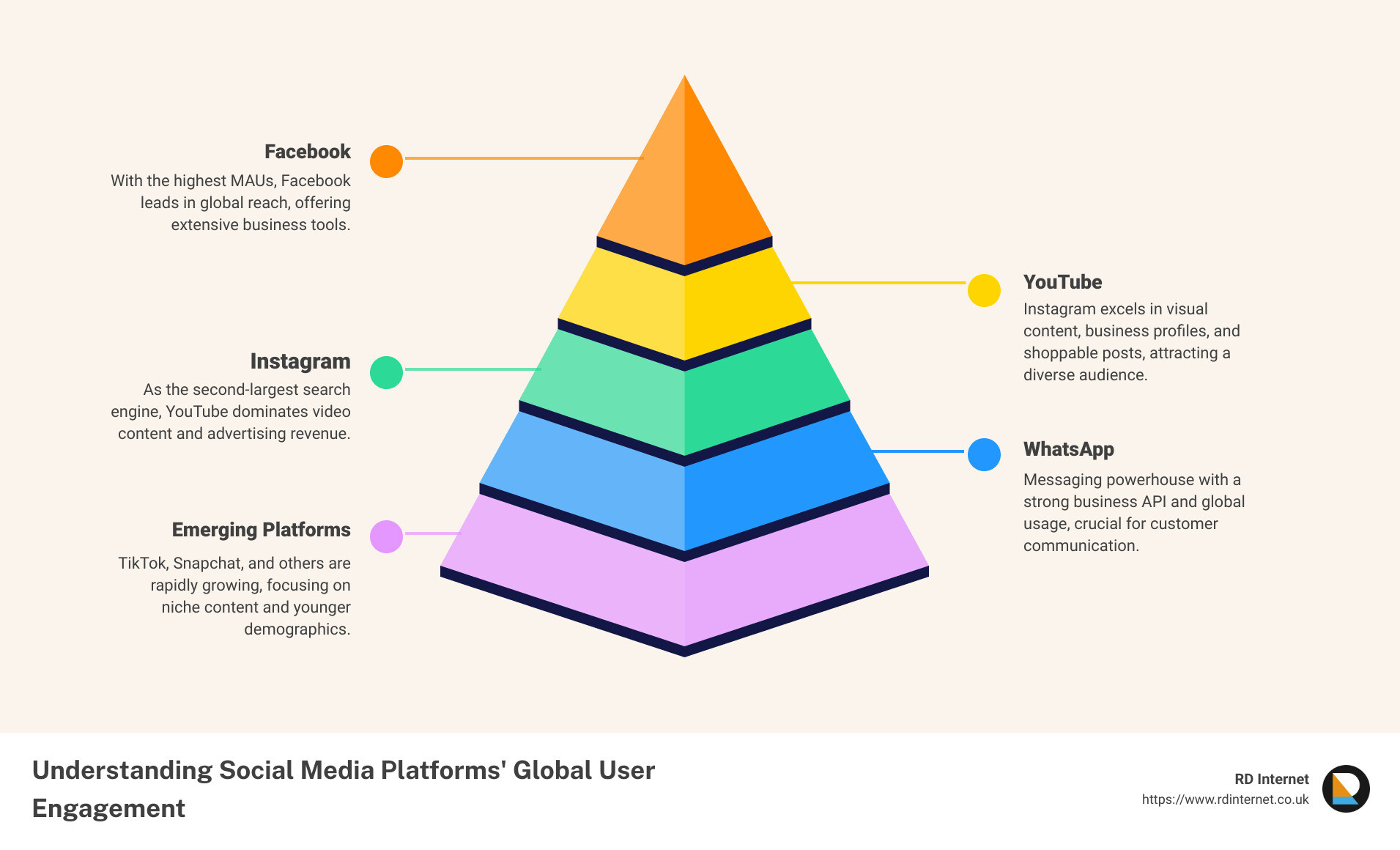
Our guide, ’23 Top Social Media Sites for Your Brand in 2024′, dives deep into each platform’s evolution, impact, and global reach, tailor-made for small business owners aiming for digital excellence.
The Rise of Social Media Platforms
Social media platforms have transformed how we create, share, and interact with content online. These platforms are built on the pillars of user-generated content, engagement, and real-time updates. Let’s explore each of these key aspects.
User-generated Content
At the heart of every social media platform is user-generated content. This is where users like you and me create and share our own content. Whether it’s a blog post, a photo, a video, or just a simple tweet, this content is what keeps the social media world spinning.
The beauty of user-generated content is its authenticity. It’s real people sharing real moments. This authenticity is what attracts more users and keeps them engaged. For brands, it’s a goldmine of raw, genuine content that can help them connect with their audience on a personal level.
Engagement
Engagement is the lifeblood of social media platforms. It’s not just about posting content; it’s about starting conversations, creating relationships, and building communities. Engagement can take many forms – likes, comments, shares, and even direct messages.
High engagement rates show that your content resonates with your audience. For businesses, engagement is a key metric to measure the effectiveness of their social media strategy. It’s also a powerful way to amplify their message and reach a wider audience.
Real-time Updates
The pace at which information spreads on social media is staggering. Thanks to real-time updates, users can stay informed about the latest news, trends, and topics of interest as they happen. This immediacy is what makes social media platforms so compelling and addictive.
For brands, the ability to post real-time updates means they can stay relevant and top-of-mind with their audience. Whether it’s a live video, a timely tweet, or a quick story update, brands can use real-time content to engage their audience in the moment.
As we dive into the top 23 social media platforms for brands in 2024, keep these three pillars in mind. Understanding the role of user-generated content, engagement, and real-time updates will help you leverage the power of social media for your brand’s growth.
Top 23 Social Media Platforms for Brands in 2024
- MAUs: 3.05 billion. The giant of social media, offering global reach unmatched by most platforms.
- Business Tools: Extensive, including advertising, insights, and community management tools.
- Global Reach: Almost every country uses Facebook, making it a prime choice for brands looking to expand internationally.
YouTube
- Video Content: The leading platform for video content, from tutorials to advertisements.
- Second-Largest Search Engine: After Google, making it essential for content discovery.
- Advertising Revenue: Offers monetization options for brands through ads and sponsorships.
- Messaging: Popular for personal and business messaging globally.
- Business API: Allows for customer service and automated messaging at scale.
- Global Usage: With 2.78 billion MAUs, it’s a key platform for international communication.
- Visual Content: Ideal for brands with strong visual appeal.
- Business Profile: Provides tools for selling and insights into post-performance.
- Shoppable Posts: Makes e-commerce integration seamless for users and brands.
- All-in-One Platform: Messaging, social media, and e-commerce in one app.
- China’s Dominance: Essential for brands looking to enter or expand in the Chinese market.
- E-commerce Integration: Offers advanced features for shopping and transactions.
TikTok
- Short-Form Video: Dominates in engaging younger demographics with viral content.
- Viral Trends: A launchpad for global trends, crucial for brand visibility.
- Young Demographic: Ideal for brands targeting a younger audience.
Telegram
- End-to-End Encryption: Appeals to users valuing privacy.
- Channels: For broadcasting messages to large audiences.
- Growing User Base: Rapidly expanding, offering new opportunities for engagement.
Snapchat
- Ephemeral Content: Content that disappears, appealing to a younger audience.
- Young Audience: Most popular among teens and young adults.
- Sponsored Lenses: Unique ad format that encourages user interaction.
Kuaishou
- Chinese Market: A leading video-sharing platform in China.
- Video Sharing: Focuses on real-life content, appealing to a broad audience.
- E-commerce Features: Strong integration with online shopping capabilities.
Sina Weibo
- Microblogging: China’s answer to Twitter, with a vast user base.
- Viral Content: A platform where posts can quickly go viral.
- Business Accounts: Offers verified accounts for brands to engage with followers.
- Messaging: Popular among younger demographics in China.
- Young Users: Appeals to school-aged users without mobile phones.
- Diverse Functionalities: More than messaging – includes games, music, and shopping.
X (formerly Twitter)
- Real-Time Information: Fast-paced platform for news and trends.
- Customer Service: A direct line to consumers for feedback and support.
- Engagement Strategies: Ideal for brands looking to engage in public conversations.
- Visual Inspiration: A go-to for ideas and planning, from home decor to weddings.
- Product Discovery: Users come with intent to find and purchase products.
- SEO Optimization: Pins can rank in search engines, driving additional traffic.
- Community Discussions: Diverse forums for every niche imaginable.
- Niche Interests: A place to engage deeply with specific communities.
- Engagement with Audiences: Direct interaction with passionate users.
- Professional Networking: The leading platform for B2B marketing and networking.
- B2B Marketing: Ideal for reaching professionals and decision-makers.
- Thought Leadership: A venue for sharing industry insights and building authority.
Quora
- Q&A Platform: Where users ask questions and get expert answers.
- Thought Leadership: An opportunity to showcase expertise in your field.
- Audience Engagement: Engage with users actively seeking knowledge.
Discord
- Gaming Community: Originally for gamers but expanding beyond.
- Real-Time Communication: Offers voice, video, and text chat.
- Expanding Beyond Gaming: Growing into communities for a variety of interests.
Twitch
- Live Streaming: Dominant in gaming but expanding to other live broadcasts.
- Gaming Content: Still the king of live-streamed gaming content.
- Community Engagement: Interact with viewers in real-time via chat.
Tumblr
- Microblogging: A platform for personal expression through text, images, and more.
- Customizable Blogs: Users can personalize their space extensively.
- Diverse Communities: Home to a wide array of niche interests and fandoms.
Threads by Instagram
- Text-Based Interaction: Focuses on conversations stemming from Instagram.
- Instagram Integration: Seamlessly connects with Instagram accounts.
- Community Building: Encourages deeper engagement among followers.
Mastodon
- Decentralized: A network of independently run servers.
- Open-Source: Allows for transparency and customization.
- Growing User Base: Attracting users seeking an alternative to mainstream platforms.
Bluesky
- Decentralized: Promises a new approach to social networking.
- Invite-Only: Currently in a testing phase with a limited audience.
- Potential for Growth: Backed by notable industry figures, suggesting significant potential.
Each of these platforms offers unique opportunities and challenges. By carefully selecting the right mix of social media platforms, brands can effectively engage with their audience, build their brand presence, and drive growth in 2024.
Leveraging Social Media for Business Growth
In social media, finding your brand’s voice and reaching the right audience can feel like searching for a needle in a haystack. But with the right strategy, understanding your target audience, and creative content creation, leveraging social media for business growth becomes not just possible, but a game-changer.
Strategy
First things first, know your goals. Are you aiming to increase brand awareness, drive sales, or perhaps improve customer service? Your goals will dictate your strategy. For example, DataReportal’s Digital 2023 October Global Statshot Report highlights the importance of aligning your social media objectives with your overall business goals for a coherent strategy.
Next, choose your platforms wisely. Not all social media platforms will be right for your brand. For instance, if your target audience is young adults, TikTok’s 1.22 billion MAUs and its popularity among the 10-29 age group could be ideal for your brand. On the other hand, LinkedIn’s professional network might be better suited for B2B marketing.
Target Audience
Understanding your target audience is crucial. Different social media platforms cater to different demographics and interests. Instagram and Snapchat, with their visual content, appeal to a younger audience, while Facebook and LinkedIn have a broader age range.
Use social media statistics to your advantage. Knowing that 94.6% of internet users aged 16 to 64 visited a social networking site in the past month can help you understand the vast potential of social media marketing. Tailor your approach to where your audience spends their time and what kind of content they engage with.
Content Creation
Content is king in the realm of social media. Engaging, original content that resonates with your audience can set your brand apart. Each platform has its strengths and content preferences. Instagram and Pinterest thrive on high-quality images and videos, while X (formerly Twitter) and Facebook can be great for sharing news and short updates.
Be authentic. Social media users crave genuine interaction. Share stories behind your brand, showcase your team, and engage with your audience in real-time. Authenticity can foster a loyal community around your brand.
Utilize platform-specific features. Instagram Stories, LinkedIn Articles, and TikTok’s short-form videos offer unique ways to engage with your audience. For instance, Instagram’s business profile provides rich analytics, making it easier to track engagement and refine your strategy.
Stay flexible and ready to adapt. Social media trends change rapidly. What works today might not work tomorrow. Keep an eye on emerging trends and be ready to pivot your strategy as needed.
By focusing on a well-thought-out strategy, understanding your target audience, and creating compelling content, you can leverage the power of social media to grow your business. Social media marketing is not a one-size-fits-all approach. It’s about finding the right mix that aligns with your brand’s goals and resonates with your audience.
Navigating the Challenges of Social Media Marketing
In the changing landscape of social media, businesses face a trio of hurdles that can make or break their marketing efforts. Let’s dive into these challenges: algorithm changes, privacy concerns, and content saturation.
Algorithm Changes
Social media platforms are notorious for frequently changing their algorithms. These algorithms determine what content users see on their feeds. For brands, this means that a strategy that worked yesterday might not work today.
What can you do? Stay adaptable and keep an eye on your engagement metrics. When you notice a drop, it might be time to tweak your strategy. Diversify your content types (videos, images, polls) to see what performs best and adjust accordingly.
Privacy Concerns
With regulations like the GDPR and public outcry over data misuse, users are more privacy-conscious than ever. This impacts how businesses collect and use data for targeted advertising.
What can you do? Transparency is key. Be open about how you collect and use data. Also, explore targeting options that don’t rely on personal data. Engage your audience through quality content and community building rather than intrusive ads.
Content Saturation
Every minute, vast amounts of content are uploaded to social media. Standing out in this crowded space is a challenge for any brand.
What can you do? First, understand your audience deeply. What are their pain points, interests, and desires? Tailor your content to meet these needs. Use storytelling to connect on an emotional level. And don’t forget the power of user-generated content—it’s authentic and can help cut through the noise.

In conclusion, navigating the complexities of social media marketing requires a blend of adaptability, ethical practices, and a deep understanding of your audience. By focusing on these areas, you can overcome the hurdles and use social media platforms to their full potential, driving growth for your brand.
As we move into the next section, keep in mind that overcoming these challenges is not just about avoiding pitfalls, but about leveraging opportunities for meaningful engagement and growth.
Frequently Asked Questions about Social Media Platforms
What is the fastest growing social media platform?
TikTok has captured the world’s attention as the fastest-growing social media platform. With its short-form video format, it’s particularly popular among the younger demographic. TikTok’s unique algorithm, which curates content that users find engaging, has led to its rapid growth. It’s not just about entertainment; brands are finding innovative ways to engage with audiences and promote their products on this platform.
How can businesses measure ROI on social media?
Measuring ROI on social media involves looking beyond likes and shares. Here are a few steps businesses can take:
– Set clear objectives: Know what you want to achieve – increased brand awareness, more website traffic, or higher sales.
– Track conversions: Use tools to track how many users take the desired action after interacting with your social media content.
– Analyze engagement: Understand how users interact with your content. High engagement rates often lead to higher conversion rates.
– Calculate spend vs. return: Factor in the cost of social media marketing, including ads and manpower, against the revenue generated from these efforts.
Social media ROI is not just about immediate sales. Building brand loyalty and customer engagement can lead to long-term benefits.
What are the best practices for engaging with customers on social media?
Engaging with customers on social media is crucial for building relationships and fostering loyalty. Here are some best practices:
– Be responsive: Quickly respond to comments, questions, and concerns. This shows that you value your customers.
– Create valuable content: Share content that is interesting, informative, and relevant to your audience. It’s not just about selling but providing value.
– Be authentic: Show your brand’s personality. Authenticity builds trust and helps customers connect with your brand on a personal level.
– Use visuals: Posts with images or videos tend to get more engagement than text-only posts. They’re also more memorable.
– Encourage user-generated content: Share content created by your customers. It’s a form of social proof and encourages more engagement from your audience.
By focusing on these areas, businesses can create a strong presence on social media platforms, driving engagement and ultimately, growth.
As we conclude this section, it’s clear that understanding the dynamics of social media platforms is essential for leveraging them effectively. Whether it’s keeping up with the fastest growing platforms like TikTok, measuring ROI to ensure your efforts are paying off, or engaging with customers in meaningful ways, there’s always more to learn and more strategies to implement.
Conclusion
In the changing world of social media, adaptation is not just beneficial; it’s essential. As we’ve explored the top social media platforms for brands in 2024, it’s clear that staying informed and agile in our strategies is crucial. From the rise of visual content on platforms like Instagram and TikTok to the professional networking opportunities on LinkedIn, each social media platform offers unique advantages for businesses willing to dive in and engage with their audience.
At RD Internet, we understand the importance of not just keeping pace with these changes but staying ahead of them. Our approach to social media management is rooted in deep industry knowledge and a forward-thinking mindset, ensuring your brand not only adapts but thrives in the digital landscape.
Future Trends
Looking ahead, we anticipate several key trends that will shape the future of social media for brands:
-
Augmented Reality (AR) and Virtual Reality (VR): These technologies will continue to merge the physical and digital worlds, offering immersive experiences that can elevate your brand’s engagement and storytelling.
-
Personalization at Scale: Advances in AI and machine learning will enable brands to deliver highly personalized content to users, improving engagement rates and customer satisfaction.
-
E-commerce Integration: Social media platforms will further streamline shopping experiences, making it easier for users to discover and purchase products without leaving the app.
-
Privacy and Transparency: With increasing scrutiny on data usage, platforms will need to balance personalized experiences with user privacy, likely leading to new features and controls for users.
-
Voice and Conversational Interfaces: As voice assistants become more prevalent, expect to see social media interactions extend into these platforms, offering new ways to connect with audiences.
In navigating these trends, the key will be flexibility and a willingness to experiment. Social media is a dynamic field, and what works today may not work tomorrow. That’s why at RD Internet, we’re committed to continuous learning and adaptation, ensuring that your social media strategy not only meets the current landscape but is poised to take advantage of future opportunities.
As we look to the future, let’s embrace the possibilities that social media holds for brand growth, community building, and meaningful engagement. With the right approach and a partner like RD Internet, the potential is limitless. Let’s navigate this ever-changing digital world together, crafting strategies that resonate with audiences and drive real business results.
Recent Comments