

Introduction
Have you ever wondered why ranking higher on Google is so crucial? As a small business owner in Cardiff, you are certainly not alone in this pursuit. More than just visibility, positioning your website in the upper echelon of Google’s search result pantheon, nicknamed by some as “the bubble,” can significantly bump up your traffic inflow, elevate your brand’s trust factor and, most importantly, contribute to increasing your bottom line.
Understanding the Importance of Google Ranking
Why does Google ranking matter? Statistics showcase that nearly 70% of all clicks occur within the first five organic results on a search engine result page (SERP). But more importantly, it’s about quality traffic. The users who engage with these top listings are genuinely interested, which often translates to higher conversion rates. But how can you secure a seat amidst these virtual VIPs? That’s what we’ll unpack in this article.
The Role of SEO in Google Ranking
SEO is not as complicated as it may sound. Think of it as a guiding lamp in the vast and complex digital landscape, helping your brand steer towards an audience that is genuinely interested in what you have to offer. It’s about communicating with Google’s distinct language – conveying what your business is about, why it’s valuable, and why it deserves to be ranked higher in search results. SEO is your digital beacon, illuminating your online visibility.
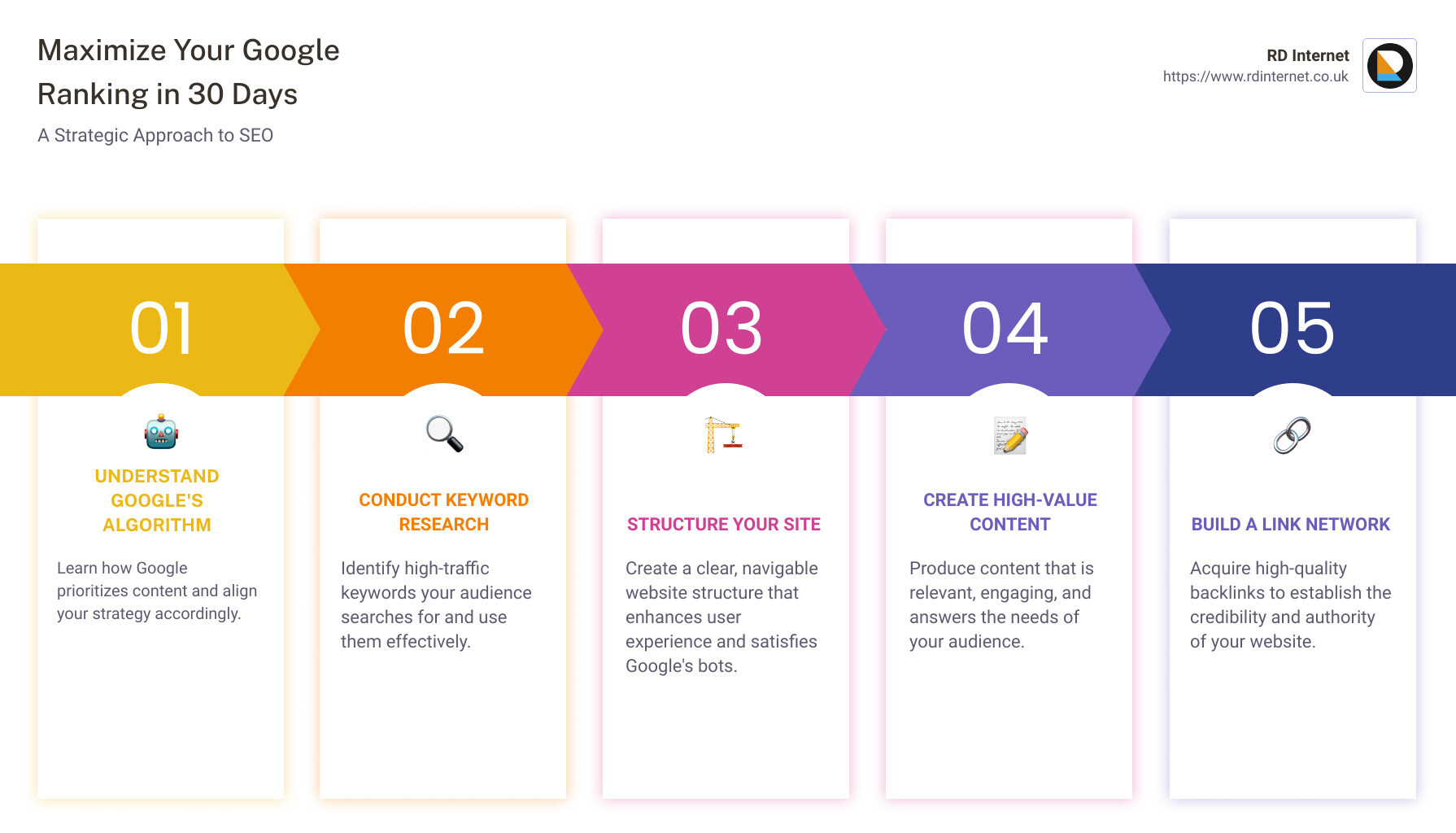
To give you an at-a-glance overview of our approach to mastering Google ranking, consider the following key steps:
- Understanding Google’s Ranking Algorithm: It’s not about hacking Google, but about understanding its priorities and aligning your website with them.
- Keyword Research: Discerning which phrases and questions your audience is searching for and incorporating them into your content strategy.
- Solid Site Structure: A well-arranged, clear and easy-to-navigate website is loved not just by your users, but also by Google.
- High-Value Content: Producing relevant, engaging, and helpful content that meets your audience’s needs.
- Link Network: The interconnected web of websites citing your content matters. Establishing high-quality backlinks is a testament to your content’s credibility.
- Mobile Optimization: With the increasingly dominant use of mobile devices for internet browsing, it’s crucial to ensure your website is mobile-friendly.
- Monitoring and Adjusting: SEO is a continual process. Adapt based on what’s working and what’s not via performance tracking.
Each of these steps, when done right, contributes to maximizing your Google ranking within 30 days.
Monitoring Your Google Ranking and Making Necessary Adjustments
To keep up with the dynamic nature of Google’s search algorithm, regularly monitor your website’s performance and make necessary adjustments. Let’s discuss how to do this effectively.
How to Use a Live Rank Checker to Monitor Your Google Ranking
One of the most effective ways to monitor your website’s ranking on Google is by using a live rank checker. This tool allows you to track your keyword rankings in real-time, giving you valuable insights into your SEO performance.
Here’s how it works:
- Enter your keyword: Input your target keyword or phrase into the live rank checker. This could be a single word or a group of words that are relevant to your content.
- Add your domain: Next, enter your website’s domain into the checker.
- Check ranking: Click on the “Check ranking” button to get your current ranking on Google for the entered keyword.
The live rank checker is an effective tool that not only shows you where your website stands in the search results but also provides insights into your keyword’s monthly search volume and Cost Per Click (CPC) for Google Ads.
At RD Internet, we understand the importance of keeping a close eye on your Google ranking. That’s why we offer a free keyword tool that can save you a lot of time in your daily SEO work.
Making Adjustments Based on Your Google Ranking
Once you’ve monitored your Google ranking, the next step is to make necessary adjustments based on your findings. These could include updating your content, improving your website’s structure, or building more backlinks.
Google’s aim is to provide the most relevant and useful results to its users. So, if your website is not ranking well, it could be because it’s not meeting these criteria. Look closely at your content and ask yourself: Is it high-quality? Is it authoritative? Is it meeting the needs of your audience?
Moreover, don’t forget to optimize your website for mobile devices. With the increasing use of smartphones for internet searches, Google now prioritizes mobile-friendly websites in its search results.
At RD Internet, we believe that the key to mastering ranking your website in Google is a continuous process of monitoring, analyzing, and adjusting. It’s not a one-time task, but a long-term commitment to providing valuable content and a great user experience.
In the next section, we will wrap up this guide and provide a recap of how to master ranking your website in Google in 30 days.
Understanding Google’s Ranking Algorithm
At RD Internet, we firmly believe that knowledge is power. As a small business owner in Cardiff, the more you understand about how Google’s ranking algorithm works, the better equipped you will be to make changes that can significantly improve your online visibility. So, let’s dive into how Google uses language models to understand search queries and the impact of spelling mistakes, synonyms, local intent, and trending keywords.
How Google Uses Language Models to Understand Search Queries
Google’s search engine is a complex machine, and at its core, it’s all about understanding what you’re looking for when you type in your search query. Google uses language models to decipher the intent behind your query, using the relatively few words you enter to match you with the most relevant content available.
This is crucial because understanding user intent allows Google to deliver the most appropriate and useful results for you. As a website owner, understanding this can help you create content that aligns with the intent of your potential customers’ search queries.
The Impact of Spelling Mistakes and Synonyms on Google Search Results
Google’s algorithm can recognise and correct spelling mistakes and even understand synonyms. This means that even if your content doesn’t contain the exact words a user searched for, Google can still find and present your page if it deems it relevant.
For instance, if a user searches for ‘change laptop brightness’, but your content uses the phrase ‘adjust laptop brightness’, Google understands that these terms are related and can still connect the user with your content. This understanding extends to your SEO keywords, so remember to include relevant synonyms in your content strategy.
The Role of Local Intent and Trending Keywords in Google Search Results
Google’s ranking system is smart enough to understand local intent and the importance of trending keywords. For example, if you search for ‘pizza’, Google will display results about nearby businesses that deliver.
It also keeps an eye on trending keywords, understanding that up-to-date information might be more useful than older pages. That’s why when you’re searching for sports scores or anything related that’s especially new, you’ll see the latest information.
As a small business owner, understanding these aspects of Google’s ranking algorithm can help you tailor your SEO strategy to ensure your website ranks higher in search results. By optimising for local intent and trending keywords, you can significantly increase your chances of appearing in front of potential customers.
In the next section, we’ll explore the importance of keyword research in Google ranking and how you can identify high-traffic keywords to boost your website’s visibility.
Building a Link Network to Boost Google Ranking
To reach the top positions in Google’s search results, your website needs to be seen as a credible and trustworthy source of information. One way to achieve this is by building a robust link network. In this section, we will delve into the role of backlinks in Google ranking and provide some tips on how to build a high-authority backlink network.
Understanding the Importance of Backlinks in Google Ranking
Backlinks, also known as inbound or external links, are hyperlinks from other websites to yours. Think of them as digital endorsements. They signal to search engines that your content is valuable, credible, and worth referencing. The more quality backlinks you have, the more authoritative your website appears to Google’s algorithm, which can significantly enhance your search rankings.
However, it’s important to remember that quality trumps quantity. A handful of backlinks from high-authority websites, like industry leaders or respected publications, can have a more significant impact on your SEO than numerous links from low-quality sites.
How to Build a High-Authority Backlink Network
Building a strong backlink profile requires strategic efforts and patience. But with the right strategies in place, you can significantly enhance your Google ranking. Here’s how we can do it:
1. Create High-Value Content: High-quality, engaging content acts like a magnet, naturally attracting backlinks because it provides value to readers. This could include infographics, case studies, original research, comprehensive guides, or any insightful content that others would want to link to.
2. Guest Posting: Guest posting is another effective way to build backlinks. By contributing valuable content to other sites in your niche, you can earn backlinks that improve your search rankings. Your guest posting strategy should not veer into a “link scheme,” which can be penalized by Google.
3. Fix Broken Links: Regularly fix any broken links on your site. Broken links can penalize your search engine results and disrupt the user experience. Tools like Dead Link Checker can check your entire site or certain pages for broken links.
4. Explore Resource Pages: Resource pages are pages that someone created to link to the best stuff on a given topic. If you have an outstanding resource about a relevant topic, it might be considered for addition to such pages, earning you a valuable backlink.
At RD Internet, we work closely with our clients to build a high-authority backlink network that can significantly improve their Google ranking. With our expertise and your vision, we can make your website stand out in the digital crowd.
In the next section, we’ll discuss the importance of mobile optimization for improved Google ranking.
The Importance of Keyword Research in Google Ranking
Keyword research is the cornerstone of a successful SEO strategy. It involves identifying the words and phrases your potential customers use when performing a search on Google. By understanding these keywords, you can optimize your website content to rank higher in Google’s search results.
How to Identify High-Traffic Keywords
Identifying high-traffic keywords is a crucial step in improving your website’s ranking on Google. These are the keywords that users frequently search for. While high-volume keywords may seem attractive, they are often broad and difficult to rank for due to high competition. Instead, it’s more beneficial to focus on long-tail keywords.
Long-tail keywords are more specific and have lower search volumes. However, they bring the most relevant traffic to your site and are easier to rank for. For example, rather than targeting the high-traffic keyword “SEO”, you might choose to target a more specific long-tail keyword like “SEO services in Cardiff” to attract a more targeted audience.
It’s not just about volume – relevance is key. The keywords you target should be closely related to your business and the services or products you offer.
The Role of Keywords in Google’s Ranking Algorithm
Keywords play a vital role in how Google’s algorithm ranks websites. When a user enters a search query, Google’s algorithm scans all indexed web pages for relevant keywords. It then determines the rank of your website based on the presence and relevance of these keywords, along with other factors like content quality, backlinks, and mobile-friendliness.
Including relevant keywords in your website content, meta tags, and headings can significantly improve your chances of ranking higher on Google’s SERP results. However, it’s important to create content that is valuable and informative for the user, rather than simply stuffing keywords into your content.
Using the Free Google Rank Checker Tool for Keyword Research
At RD Internet, we offer a free Google Rank Checker Tool that can help you identify high-traffic keywords. This tool provides a comprehensive list of your website’s keywords, along with their current rankings on Google.
Simply enter your website’s URL, and the tool will generate a report with your top-performing keywords. It also notifies you when a keyword’s ranking changes, helping you understand which keywords are driving traffic to your site and which ones may need to be replaced.
The Google Rank Checker Tool is a powerful resource in your SEO toolkit, allowing you to keep an eye on your keyword performance and make informed decisions about your SEO strategy.
In the next section, we’ll delve into building a solid site structure for improved Google ranking.
Optimizing Your Website for Mobile Devices
Mobile optimization is no longer optional; it’s a necessity. More and more people are using their smartphones to access the internet. Therefore, your website must work perfectly on every type of device to compete effectively in the digital space. Let’s delve into the nuances of mobile optimization and how it impacts your Google ranking.
The Impact of Mobile Optimization on Google Ranking
Google’s ranking algorithm prioritizes mobile-friendly websites. This means that if your website is not optimized for mobile devices, it could negatively impact your ranking on Google search results. On the other hand, a mobile-optimized site offers a seamless user experience, encouraging visitors to stay longer and engage more with your content. This increases your website’s dwell time, a key factor that Google takes into account when determining search rankings. Furthermore, a mobile-friendly website is more likely to gain social shares, enhancing your online presence and visibility.
How to Optimize Your Website for Mobile Devices
Optimizing your website for mobile users doesn’t have to be a complex task. With the right strategy, you can create a mobile-friendly site that’s easy to navigate and delivers a seamless user experience.
Choose a mobile-optimized template: Many Content Management Systems (CMS) offer mobile-optimized templates that can help you build a mobile-friendly site with ease.
Improve loading speed: If your site loads slowly on mobile devices, it could frustrate users and increase your bounce rate. Use Google’s Search Console’s Core Web Vitals report to check your site’s loading speed and identify any issues.
Test functionality on different devices: Ensure all features work properly on various devices and browsers. Pay attention to factors like navigation ease, content clarity, and loading speed.
Ensure touch screen friendliness: Clickable elements should not be too close together as it could hamper user experience.
At RD Internet, we understand the importance of mobile optimization and can help you implement these strategies to boost your Google ranking. We’re here to assist you in enhancing your website’s overall SEO, reaching a wider audience, and ultimately, improving your website’s visibility on Google.
The journey to ranking your website on Google doesn’t end here. In the next section, we’ll discuss how to monitor your Google ranking and make necessary adjustments.
Conclusion
Recap of How to Master Ranking Your Website in Google in 30 Days
In this guide, we’ve traversed the landscape of improving your Google ranking, providing you with effective and actionable steps to elevate your website’s visibility. We began by understanding the importance of Google rankings and the pivotal role of SEO. We then delved into the intricate workings of Google’s ranking algorithm and the necessity of comprehensive keyword research for optimal results.
We explored the significance of a well-structured website and the creation of high-value, engaging content that resonates with your audience and Google’s algorithm. Our journey continued with the development of a robust link network, underscoring the importance of backlinks in Google’s ranking criteria. We also discussed the impact of mobile optimization and the need to make your website user-friendly on all devices.
Finally, we emphasized the importance of monitoring your Google ranking regularly and making necessary adjustments to maintain and improve your position. Using tools like a live rank checker can provide valuable insights into your website’s performance and areas of improvement.
Encouragement to Continue Monitoring and Improving Your Google Ranking
Mastering the art of ranking a website in Google is not a one-time effort. It’s an ongoing process that requires consistent monitoring, analysis, and adjustments. SEO is not just about getting more clicks—it’s about attracting the right clicks.
At RD Internet, we’re committed to helping you navigate this journey and achieve sustainable growth in your online visibility. Our strategic solutions are tailored to align your website with Google’s standards and deliver long-term results.
Stay updated with Google’s guidelines and algorithm changes, and continuously refine your strategies. Embrace learning, adapt to changes, and don’t hesitate to seek professional assistance when needed.
The journey to the top of Google’s search results page is a marathon, not a sprint. Keep striving, keep growing, and let’s conquer the digital world together!
Building a Solid Site Structure for Improved Google Ranking
Just as a well-constructed building stands strong and tall, a well-structured website ranks high in Google’s search results. The structure of your website plays a crucial role in your SEO strategy, affecting both user experience and the ease with which search engines can crawl your site.
The Importance of a Well-Structured Website
A well-structured website is like a city with a well-planned infrastructure; it allows for easy and efficient navigation for its users. It also makes it easier for Google’s crawlers to index your site, helping improve your search engine rankings.
If your website’s structure is clear, logical, and easy to understand, it’s easier for Google to index it correctly. Conversely, if your website is a mishmash of published and unpublished pages, broken links, and unrelated content, it becomes much harder for Google to index it correctly. This may lead to your site languishing at the bottom of the search results page, or worse, on the second page.
How to Optimize Your Website Structure for Google Ranking
1. Keep it Simple: The first step to optimizing your website structure is to keep it as simple as possible. The hierarchy of your pages should be clear and understandable, with a logical chain of command.
2. Use Descriptive URLs: Short, descriptive URLs are not only good for SEO but also help reassure users that your page is the right fit for their search.
3. Leverage Internal Linking: Think of internal links as the roads connecting different parts of your city. These links help both users and search engines move from one part of your website to another, enhancing the user experience and boosting your SEO.
4. Regularly Fix Broken Links: Just like a city, your website could also have broken links that disrupt smooth navigation. Regularly running a crawl on your site using tools can help you spot and fix broken links, ensuring a smooth user experience and improving your site’s crawlability.
5. Optimize for Local Search: Your Google Business Profile acts as your business’s digital storefront, providing potential customers with essential information about your business. Regularly updating your profile and engaging with customer reviews can boost your online presence.
At RD Internet, we understand the importance of a well-structured website in ranking high in Google’s search results. We are here to help you navigate the complexities of website structure optimization, ensuring that your business gets the online visibility it deserves.
In the next section, we’ll dive into how to create high-value content for better Google ranking.
Creating High-Value Content for Better Google Ranking
Just like a gourmet dish requires top-notch ingredients, your website needs high-quality content to rank high on Google. This isn’t about stuffing your site with keywords but rather providing valuable, relevant, and comprehensive information that serves as a resource for users.
The Role of Quality Content in Google Ranking
Google’s algorithms prioritize websites that provide valuable and relevant content. It’s all about quality over quantity. High-quality content is like a magnet, attracting both your target audience and Google’s search engine algorithms. When your content resonates with your audience, they engage more with your site, sending positive signals to Google about your website’s relevance and value. This, in turn, boosts your website’s visibility and credibility, propelling your site up the Google ranking ladder.
Quality content helps in ranking website in Google by promoting user engagement and providing value. This is why at RD Internet, we focus on creating content that connects and engages with your audience.
How to Create Content that Ranks Well on Google
Creating content that ranks well on Google doesn’t happen by accident. It requires strategy, research, and a clear understanding of your audience’s needs. Here are some steps we recommend:
1. Understand Your Audience: It’s essential to know who your audience is and what they’re looking for. What are their pain points? What solutions are they seeking? This understanding will help you create content that resonates with them.
2. Do Keyword Research: Identify high-traffic keywords relevant to your business and incorporate them naturally into your content.
3. Write Long-Form Content: Long-form content tends to rank best in search engines. Aim for a minimum of 1800 words. However, quality should not be compromised for length.
4. Use Visuals: Add meaningful visuals to your content. Images that illustrate concepts, add value, and match the intent of the keyword can significantly enhance your content’s attractiveness and readability.
5. Make Your Content Skimmable: Break up your content into smaller sections with subheadings, bullet points, and numbered lists to make it easy for readers to skim.
6. Monitor and Adjust: Use Google Search Console to understand what queries are leading people to your page and make necessary adjustments.
Creating high-quality content that ranks well on Google is not an overnight process. It requires time, effort, and a deep understanding of SEO best practices. But with patience and persistence, you’ll see your website climbing the SERPs, attracting more organic traffic, and ultimately driving more business.
At RD Internet, we’re committed to helping small businesses improve their online presence and drive growth. Through our expertise in SEO and content marketing, we can help you create high-value content that not only ranks on Google but also resonates with your target audience. Let’s work together to boost your Google ranking and dominate the search results!
In the next section, we’ll explore the importance of building a robust link network to boost your Google ranking.
Recent Comments