

Key Information about Pay-per-click (PPC) Advertising:
– PPC is an online marketing model that involves advertisers paying a fee every time their ad gets clicked.
– It can be a cost-effective way to drive traffic to your website.
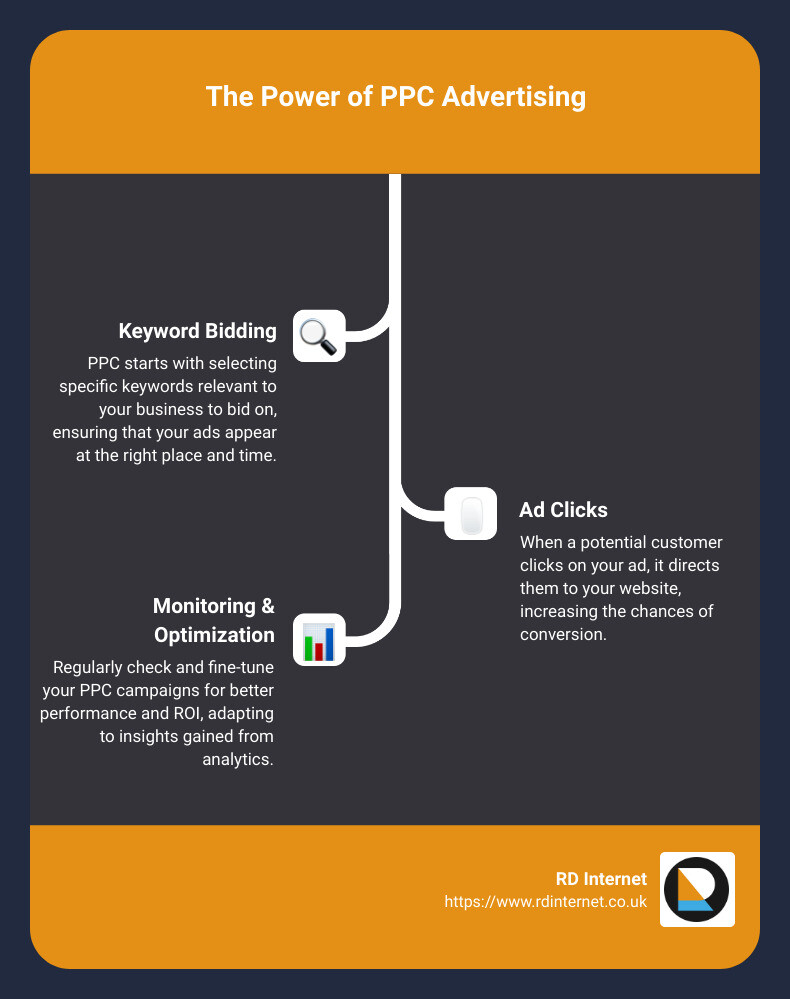
– The process involves bidding on keywords relevant to your business.
– Strategic PPC campaigns can achieve higher visibility and revenue.
– Regular monitoring and optimization of your PPC campaign is vital for success.
Does your business struggle to grab the attention of potential online customers? Are you baffled by phrases like ‘Pay-Per-Click’ or ‘Google Ads’? Well, rest assured, you’re not alone, and we at RD Internet are here to help break down these terms and illustrate how they can supercharge your digital presence.
Pay-per-click (PPC) advertising is a powerful digital marketing strategy that can help your business rise above the digital noise and effectively reach your target audience. But setting up and managing a PPC campaign can seem like a complex task, especially when your time and resources are already stretched thin.
In this guide, we’ll help you navigate the ins and outs of Pay-Per-Click advertising, even if you’re new to digital marketing. Our goal is to provide you with a clear understanding of what a PPC account is, how it works, and how to effectively manage it to achieve your business goals.
Whether you’re a digital marketing novice or simply need a refresher, let’s kick things off by breaking down what PPC advertising truly is and how it can act as a catalyst in growing your business online. Don’t worry, we’ve got your back every step of the way!
Understanding the Basics of a Pay-Per-Click Account
What is Pay-Per-Click Advertising?
Pay-Per-Click (PPC) advertising is a type of online marketing where advertisers pay a fee each time one of their ads is clicked. The term “Pay-Per-Click” refers to this model, where you literally pay for potential customers’ clicks on your ad. The PPC model is popular across various digital platforms, including search engines like Google and Bing, social media sites like Facebook and Instagram, YouTube, and even online marketplaces like Amazon.
But it’s not only about getting clicks. The real value of PPC comes from those clicks leading to conversions – whether that means a sale, a sign-up, a download, or any other action you want your website visitors to take.
How Does Pay-Per-Click Work?
The PPC process starts when you set up a campaign on a platform of your choice. You decide where your ads will be displayed, how much you’re willing to spend on each click, and what your total budget will be. You only pay when someone clicks on your ad, hence the name “pay-per-click”.
Each PPC platform offers different targeting options, so you can choose exactly who sees your ads. For example, you can target users based on demographics, keywords, topics, and even whether they’ve visited your website before. This is a technique known as remarketing or retargeting, which allows you to remind potential customers about your offerings and encourage them to return and convert.
Managing a PPC campaign is flexible and adaptable. You can easily set and change the maximum cost-per-click, allocate budgets, and adjust your strategy on the fly. This level of control enables you to optimize your campaign and adapt quickly if needed.
Why is Pay-Per-Click Important for Your Business?
PPC advertising is a powerful tool for reaching your exact target audience at the right time and in the right place. It can help boost your brand’s visibility, drive immediate traffic to your website, and importantly, increase conversions. Here’s why this digital marketing strategy is a game-changer for your business:
-
Effective Targeting: PPC allows you to reach specific audiences based on precise targeting criteria. This means your ad spend goes directly towards potential customers who are most likely to be interested in your products or services.
-
Fast Results: Unlike SEO, which can take months to start driving traffic, PPC can start generating results the same day you launch your campaign.
-
Cost-Effective: Since you only pay when someone clicks on your ad, and you control how much you’re willing to pay for each click, PPC can be a cost-effective way to reach your target audience.
-
Measurable and Trackable: PPC campaigns provide a wealth of data, making it easy to measure success and track performance. You can see exactly how many people clicked on your ad, what they did once they reached your website, and whether they converted.
-
Increases Brand Awareness: Even if users don’t click on your ads, they still see your brand and message. This helps increase your brand’s visibility online.
At RD Internet, we understand the intricacies of managing a pay-per-click account. Our goal is to help you navigate this world, ensuring you get the most out of your PPC campaigns. The key to a successful PPC campaign is thorough planning, continuous monitoring, and regular optimization. And that’s exactly what we’re here to help you achieve. So let’s get started!
Setting Up Your Pay-Per-Click Account
Now that you’re familiar with the basics of Pay-Per-Click advertising, it’s time to roll up your sleeves and set up your pay-per-click account. This process might seem overwhelming at first, but don’t worry. We’re here to guide you through each step.
Choosing the Right Platform for Your PPC Campaign
The first step in setting up your pay-per-click account is choosing the right platform for your PPC campaign. The platform you choose can significantly influence how your ads perform.
Two of the most popular platforms are Google Ads and Facebook Ads (now known as Meta Ads). Google Ads is widely used due to its vast reach, with over 73% of the global market share. On the other hand, Meta Ads is an excellent choice for businesses targeting specific demographics, as it allows for highly targeted ads based on age, location, interests, and more.
Each platform comes with its unique user base, ad formats, and cost per click – all of which can influence your ad performance. Therefore, it’s crucial to choose a platform that aligns with your business goals and target audience.
How to Set Up a Pay-Per-Click Campaign
Once you’ve chosen the right platform, the next step is setting up your PPC campaign. While the exact steps may vary slightly depending on the platform, the process generally involves the following steps:
- Set up your account: Visit the platform’s homepage and follow the prompts to set up your account.
- Create a new campaign: Determine your campaign’s objective and type.
- Define your target audience: Fine-tune your targeting parameters based on demographics, location, interests, and behaviors.
- Set your budget and bid: Decide how much you’re willing to spend on your campaign and set your maximum cost-per-click bid.
- Create your ad: Write compelling ad copy that resonates with your target audience and aligns with your chosen keywords.
Setting up a PPC campaign is not a one-time task. It requires continuous monitoring and optimization to ensure you’re getting the most out of your investment.
Selecting Relevant Keywords for Your PPC Campaign
Selecting relevant keywords is a crucial component of managing your pay-per-click account. Your chosen keywords should accurately reflect your product or service, align with what your target audience is searching for, and be specific enough to attract qualified leads.
A great way to find quality keywords is by using a keyword research tool, such as Keyword Magic Tool. You can input a seed keyword related to your business or product and get a plethora of keyword ideas.
The goal isn’t to choose as many keywords as possible. Instead, focus on selecting high-quality, relevant keywords that will attract the right traffic to your site.
Setting up and managing your pay-per-click account is a strategic process that requires careful planning and continuous optimization. But with these steps, you’re well on your way to leveraging the power of PPC advertising to boost your online visibility and increase revenue. Stay tuned for the next section, where we’ll delve deeper into managing your PPC campaigns effectively.
Managing Your Pay-Per-Click Account
After you’ve set up your pay per click account and launched your first campaigns, your work is far from over. In fact, it’s just beginning. PPC advertising is not a set-and-forget strategy. It needs consistent monitoring and adjustments to ensure optimal results. This is where the real work of managing your PPC campaigns comes in.
Regular Monitoring and Optimization of Your PPC Campaign
Consistent and regular account activity is one of the key predictors of account success. This includes continuously analyzing the performance of your campaigns, making necessary adjustments, and refining your strategies over time. The aim is to ensure your ads are reaching the right people at the right time, and your budget is being used effectively.
To achieve this, you’ll need to keep a close eye on your click-through rates, conversion rates, and overall return on investment. These metrics will give you insight into what’s working and what’s not, allowing you to make informed decisions about your future strategies.
At RD Internet, we provide regular management of PPC campaigns, ensuring they continue to be effective and deliver a high return on investment.
Understanding and Improving Your Quality Score
Your Quality Score is a critical factor in the success of your PPC campaigns. It’s a score Google Ads assigns to each of your keywords, based on factors like your ad’s relevance to the keyword, expected click-through rate, and landing page quality.
A higher Quality Score can lead to more ad clicks at lower costs. Therefore, improving your Quality Score should be a key focus in managing your PPC campaigns. This involves enhancing the quality and relevance of your keywords, landing pages, and overall campaign strategy.
At RD Internet, we continually work on improving your Quality Score, ensuring you reach your potential customers at a cost that fits your budget, thus maximizing your ROI.
Utilizing Google Ads Performance Grader for Better Results
Another effective tool for managing your PPC campaigns is the Google Ads Performance Grader. This tool allows you to zero in on areas of improvement by grading your account performance in key areas, such as click-through rate, Quality Score, and overall account activity.
By using this tool, you can get a detailed report on your account performance, helping you understand where you’re doing well and where you need to focus your attention for improvement. This can be a game-changer in optimizing your PPC campaigns and getting the most out of your ad spend.
In conclusion, managing your pay per click account effectively involves regular monitoring and optimization, improving your Quality Score, and utilizing tools like the Google Ads Performance Grader. With these strategies, you can ensure your PPC campaigns continue to drive traffic to your site, increase conversions, and deliver a high return on your investment. Next, we will delve into some advanced PPC strategies that can further enhance your results.
Advanced Pay-Per-Click Strategies
Taking your pay-per-click account to the next level requires a deeper understanding of PPC strategies. Once you have the basics under control, it’s time to explore advanced tactics that can help you outshine your competitors and achieve greater results for your business.
Exploring Different Types of PPC Ads: Search, Display, and Remarketing
There are several types of PPC ads you can leverage, each with its own advantages and best use cases.
Search ads are triggered by keywords in the user’s search query. They appear alongside organic results on search engine results pages (SERPs). This type of ad is especially potent when targeting commercial searches, where users are looking to make a purchase.
Display ads, typically banner ads, appear on websites across the internet that are part of Google’s Display Network. They can be a great way to build brand awareness and reach users while they’re browsing their favourite sites.
Remarketing ads are a powerful tool to re-engage users who have previously interacted with your website. These ads are displayed to users as they continue to browse the internet, reminding them of your products or services and encouraging them to return to your site.
By crafting a diverse ad strategy that utilises these various ad types, you can effectively reach your target audience at multiple touchpoints in their buying journey.
Leveraging Google Shopping for Your PPC Campaign
If you’re a retailer, one advanced strategy you should definitely consider is leveraging Google Shopping. These are product-based ads that appear at the top of the SERPs, showcasing your products’ images, prices, and your store’s name.
Google Shopping ads can be highly effective as they grab attention with their visual nature and provide key information right upfront. Plus, users who click on Shopping ads are usually further down the sales funnel, meaning they’re more likely to convert.
Implementing Automation in Your PPC Management
Automation can be a game-changer for your PPC campaigns, especially if you’re managing a large number of keywords. Google’s automated bidding strategies can optimise your bids based on the likelihood of your ad resulting in a click or conversion.
For instance, if conversions are your primary goal, you might consider using ‘Maximize Conversions’ bidding strategy. This strategy automatically adjusts your bids to get as many conversions as possible within your budget.
Similarly, if you want to balance conversions with cost control, the ‘Enhanced Cost Per Click (ECPC)’ strategy can be a great choice. This strategy automatically adjusts your manual bids when a click seems more likely to lead to a sale or conversion.
By implementing automation in your PPC management, you can save time and improve the effectiveness of your campaigns.
At RD Internet, we’re experts in leveraging these advanced PPC strategies to drive results for our clients. Whether it’s exploring different ad types, harnessing the power of Google Shopping, or implementing automation, we’re here to help you make the most of your pay-per-click account.
Measuring the Success of Your Pay-Per-Click Account
Keeping track of the progress and success of your Pay-Per-Click (PPC) campaigns is crucial in making informed decisions for future campaigns. This involves understanding the important metrics and Key Performance Indicators (KPIs) and knowing how to measure the return on investment (ROI) from your PPC campaign.
Understanding PPC Metrics and KPIs
In order to gauge the success of your PPC campaigns, you need to understand and monitor certain metrics. These metrics provide a snapshot of how your ads are performing and highlight areas that require optimization.
Click-Through Rates (CTR): This measures how many people clicked on your ad after seeing it. A low CTR might indicate the need for a more compelling ad copy or better audience targeting.
Conversion Rates: This rate shows what happens after a user clicks on your ad. Are they buying your product, signing up for a newsletter, or taking other desired actions? A low conversion rate, despite a high CTR, might indicate issues with your landing page or the overall user experience.
Social Interactions: If your ads are running on social media, you can monitor interactions such as likes, shares, and comments. These interactions might not directly lead to conversions, but they can help grow your brand awareness.
At RD Internet, we not only provide you with these metrics, but we also help you understand what they mean and how to use them to optimize your PPC campaigns for better results.
How to Measure Return on Investment (ROI) from Your PPC Campaign
The ultimate measure of your PPC campaign’s success is the return on investment (ROI). ROI is calculated by comparing the cost of your advertising to the profit generated from it. For example, if you spend $100 on a campaign and make $500 in sales from it, your ROI is 400%.
To accurately measure your ROI, you need to track conversions and assign a value to them. This can be a direct financial value (like the price of a product sold) or a more abstract value (like the worth of a lead generated). Once you have this data, you can compare it to your ad spend to calculate your ROI.
A positive ROI means your campaign is profitable, but it doesn’t necessarily mean it’s optimized. Even a profitable campaign can often be improved to deliver better results. That’s where our team at RD Internet comes in. We’re committed to helping you get the most out of your PPC advertising investment.
In the next section, we’ll wrap up by recapping the importance of PPC advertising and how it can significantly boost your online visibility and ultimately, your business’s success.
Conclusion: Making the Most of Your Pay-Per-Click Account
After going through this comprehensive guide, you should now have a good understanding of the ins and outs of managing a pay per click account. From understanding the basics of PPC advertising to setting up your account, and from managing it on a regular basis to measuring the performance, every aspect is crucial for the success of your PPC campaigns.
The world of PPC advertising is dynamic and constantly evolving. As a business owner, it’s crucial to keep an eye on the latest trends and strategies in PPC advertising. Continual learning, testing, and optimization are keys to mastering PPC for business success.
Regular monitoring of your PPC campaign is one of the best predictors of success. Analyzing the performance of your account and making necessary adjustments are essential steps in optimizing your campaigns. Tools like the Google Ads Performance Grader can help you identify areas of improvement and refine your strategies .
Investing in PPC advertising is not just about getting clicks—it’s about getting qualified clicks. A well-managed PPC campaign can drive relevant traffic to your website, leading to increased sales and business growth. Using relevant, high-volume keywords and creating engaging, platform-specific ads are some of the strategies that can make your PPC campaign successful.
Lastly, it’s important to remember that while PPC advertising can significantly boost your online visibility and revenues, it’s also crucial to back it up with high-quality, engaging content on your website. No matter how well-placed your ads are, if your website doesn’t offer value to your visitors, the chances of conversions are slim.
Here at RD Internet, we understand the complexities and challenges of managing a pay per click account. We’re committed to helping you navigate the dynamic world of online advertising and get the most out of your ad spend. We’ll work with you every step of the way to ensure that your PPC campaigns are optimized for success.
In the end, PPC advertising is a powerful tool that can significantly boost your business’s online presence and revenue. It’s all about using the right strategies, on the right platforms, for the right audience. With this guide, you’re more than ready to take your PPC advertising to the next level. Now it’s time to put this knowledge into action and start making those clicks count!
For further reading on PPC and other digital marketing strategies, explore our blog or reach out to us directly for personalized assistance.

The journey to mastering your pay per click account doesn’t end here. Keep learning, keep experimenting, and keep optimizing. Your success in PPC advertising is just a few clicks away!
Recent Comments