

Conversion Rate Optimisation Service: Top 5 Proven Tactics 2024
Conversion rate optimisation service is a critical aspect of enhancing your online business. It focuses on improving the percentage of visitors to your website who take the desired action, such as making a purchase or signing up for a newsletter. In other words, CRO turns more of your existing traffic into revenue without needing to increase spending on securing more traffic.
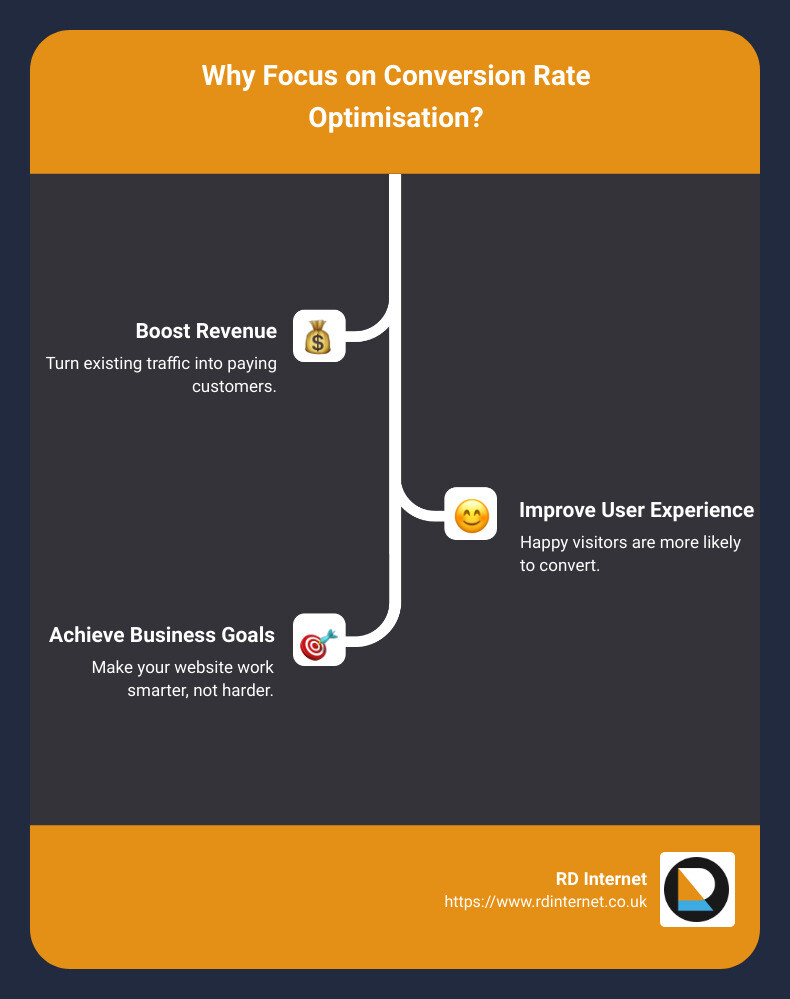
Why focus on CRO?
– Boost revenue: Turn existing traffic into paying customers.
– Improve user experience: Happy visitors are more likely to convert.
– Achieve business goals: Make your website work smarter, not harder.
Studies show 88 percent of online users are less likely to return to a website after a bad experience. This emphasizes the importance of a good user experience in conversion rate optimisation. RD Internet is here to help your business in Cardiff harness the power of CRO to stay competitive, improve user satisfaction, and reach your business goals.
What is Conversion Rate Optimisation (CRO)?
How CRO Impacts Your Business
Conversion Rate Optimisation (CRO) is the practice of enhancing your website to encourage more visitors to take desired actions, such as making a purchase or signing up for a newsletter. It involves a systematic process of testing and updating various elements on your website to achieve specific business goals.
Why is CRO so important? Imagine you run an online store. You get 1,000 visitors a month, but only 10 of them buy something. That’s a 1% conversion rate. Now, what if you could tweak your website so that 20 visitors buy something instead? That’s a 2% conversion rate, and it doubles your sales without increasing your traffic.
The Systematic Process of CRO
CRO is not about guessing what might work. It’s about making informed, data-backed decisions. Here’s how it works:
- Identify Goals: What do you want visitors to do? Buy a product? Fill out a form? Sign up for a newsletter?
- Analyse User Behaviour: Use tools like heat maps and user recordings to see how visitors interact with your site.
- Test Changes: Implement A/B tests to compare different versions of web pages.
- Measure Results: Track key metrics to see which changes improve your conversion rate.
- Optimise: Make the winning changes permanent and repeat the process.
Website Elements to Optimise
Several elements on your website can be optimised to boost conversions:
- Call-to-Action (CTA) Buttons: Experiment with different colours, sizes, and text.
- Content: Ensure your messaging is clear and compelling.
- Design: Improve layout and visual appeal to make navigation intuitive.
- Forms: Simplify forms to reduce friction for users.
Desired Goals
The specific goals of CRO can vary depending on your business needs. Common goals include:
- Increasing Sales: For eCommerce sites, the primary goal is to convert visitors into buyers.
- Generating Leads: For service-based businesses, the goal might be to get visitors to fill out a contact form.
- Growing Email Lists: Blogs and content-driven sites may aim to convert visitors into subscribers.
Increase Conversions
Improving your conversion rate means more visitors take the actions you want them to. This can lead to:
- Higher Sales: More purchases mean more revenue.
- More Leads: More contact form submissions mean more potential customers.
- Better Engagement: More newsletter sign-ups mean a larger audience for your marketing efforts.
Boost Revenue
Higher conversion rates directly impact your bottom line. For example, if you can increase your conversion rate from 1% to 2%, you effectively double your revenue without needing more traffic. This makes CRO a cost-effective strategy for growth.
Improve User Engagement
CRO also improves user engagement by making your website more user-friendly and relevant. When visitors find what they need easily and enjoy their experience, they’re more likely to stay longer, explore more pages, and return in the future.
In summary, conversion rate optimisation services can transform your website into a powerful tool for achieving your business goals. Whether you want to boost sales, generate leads, or improve user engagement, CRO offers a systematic way to get more value from your existing traffic.
Key Metrics in Conversion Rate Optimisation
Understanding key metrics is essential for effective conversion rate optimisation (CRO). These metrics help you gauge how well your website is performing and identify areas for improvement. Let’s explore some of the most important ones.
Bounce Rate
Bounce Rate is the percentage of visitors who leave your website after viewing only one page. A high bounce rate often indicates that visitors aren’t finding what they need.
Importance: Lowering your bounce rate is crucial for keeping visitors engaged and encouraging them to explore more of your site. A high bounce rate can hurt your search engine rankings and overall user experience.
How to Lower Bounce Rate:
– Improve Page Load Time: Slow pages drive users away. Aim for load times under 3 seconds.
– Clear Navigation: Make it easy for users to find what they need.
– Engaging Content: Provide valuable and relevant content that captures interest.
– Strong Call-to-Actions (CTAs): Guide users towards the next steps they should take.
Click-Through Rate (CTR)
Click-Through Rate (CTR) measures the percentage of users who click on a specific link or CTA out of the total users who view the page.
Importance: A high CTR indicates that your content and CTAs are compelling and relevant to your audience. It’s a good sign that your marketing messages are resonating.
How to Improve CTR:
– Compelling Headlines: Use engaging and benefit-driven headlines.
– Effective CTAs: Make your CTAs stand out with clear, action-oriented language.
– A/B Testing: Test different versions of your CTAs and headlines to see what works best.
Entrance
Entrance metrics show where visitors first land on your site. Knowing which pages attract the most traffic can help you optimize those entry points for better engagement.
Pages Per Visit
Pages Per Visit indicates the average number of pages a user views in a single session. Higher numbers suggest that users find your site interesting and easy to steer.
Page Load Time
Page Load Time is the time it takes for your webpage to fully load. Slow load times can lead to higher bounce rates and lower user satisfaction. Tools like Google PageSpeed Insights can help you identify areas for improvement.
ROI (Return on Investment)
ROI measures the profitability of your CRO efforts. It’s calculated by comparing the gains from your CRO investments against the costs. A positive ROI indicates that your optimisation strategies are paying off.
Leads Generated
Leads Generated are the number of potential customers who have shown interest in your offerings, such as by filling out a form or subscribing to a newsletter. Effective CRO can increase the number of leads without needing more traffic.
Website Traffic
Website Traffic tracks the number of visitors to your site. While increasing traffic is good, the quality of that traffic is more important. Effective CRO ensures that your visitors are more likely to convert.
Exit Rate
Exit Rate is the percentage of users who leave your site from a specific page after visiting other pages. High exit rates on important pages can indicate problems that need fixing.
Cost Per Conversion (CPC)
Cost Per Conversion (CPC), also known as Cost Per Action (CPA), measures how much you spend to gain a new customer. Lowering your CPC while maintaining or increasing conversions is a sign of effective CRO.
By focusing on these key metrics, you can make data-driven decisions to improve your website’s performance and achieve your business goals.
Next, we’ll look at best practices for conversion rate optimisation, including A/B testing and heat map analysis.
Best Practices for Conversion Rate Optimisation
A/B Testing
A/B Testing is a powerful method to optimize your conversion rate by comparing two versions of a web page or element to see which one performs better. Think of it as a scientific experiment for your website.
Definition
A/B testing involves creating two versions of a web page (Version A and Version B) and showing them to different segments of your visitors. You then measure which version achieves a higher conversion rate.
Process
- Identify the Variable: Choose the element you want to test, such as a headline, call-to-action (CTA), or image.
- Create Variations: Develop different versions of the chosen element.
- Split Traffic: Direct half of your traffic to Version A and the other half to Version B.
- Measure Results: Use metrics like conversion rate, bounce rate, and click-through rate to determine which version performs better.
- Implement Changes: Once you identify the winning version, make the change permanent.
Benefits
- Data-Driven Decisions: A/B testing provides concrete data on what works and what doesn’t.
- Improved User Experience: By continuously testing and optimizing, you create a better experience for your users.
- Higher Conversion Rates: Small tweaks can lead to significant improvements in conversions.
For example, a company might test two different headlines to see which one leads to more email sign-ups. If Version B gets 25% more sign-ups than Version A, it’s clear which headline is more effective.
Heat Maps Analysis
Heat Maps Analysis helps you understand how users interact with your website by visually representing data on user behavior.
Definition
Heat maps are graphical representations of data where individual values are represented as colors. They show where users click, how far they scroll, and what grabs their attention.
Process
- Install Heat Map Software: Tools like VWO can track user interactions on your site.
- Collect Data: Monitor user behavior over a period to gather sufficient data.
- Analyze Patterns: Look for patterns in the data, such as high-click areas or sections where users drop off.
- Identify Issues: Use the insights to pinpoint problem areas, like confusing navigation or unappealing CTAs.
- Optimize: Make changes based on the insights and test again to see if they improve user engagement and conversions.
Benefits
- Visual Insights: Heat maps provide a clear visual representation of user behavior, making it easier to identify issues.
- Improved User Experience: By understanding what users focus on, you can optimize your site to meet their needs better.
- Increased Conversions: Addressing the issues revealed by heat maps can lead to higher conversion rates.
For instance, if a heat map shows that users are not scrolling past the fold, it might indicate that your most important information needs to be moved higher up on the page.
User Behavior Assessment
Understanding user behavior is crucial for effective CRO. This involves analyzing how users interact with your website, what actions they take, and where they face difficulties.
Definition
User behavior assessment involves collecting and analyzing data on how visitors use your site, including clicks, scrolls, navigation paths, and time spent on pages.
Process
- Data Collection: Use tools like Google Analytics to gather data on user interactions.
- Behavior Analysis: Look for patterns and trends in the data to understand user preferences and pain points.
- Identify Bottlenecks: Find areas where users drop off or struggle to complete desired actions.
- Make Data-Driven Changes: Use the insights to improve user experience and streamline the conversion process.
- Iterative Testing: Continuously test and refine your changes based on user feedback and behavior data.
Benefits
- Deeper Insights: Gain a comprehensive understanding of what drives user actions and decisions.
- Improved User Experience: Tailor your website to better meet user needs and expectations.
- Higher Conversions: By addressing user pain points, you can improve the overall conversion rate.
Iterative Process
Conversion rate optimisation is not a one-time task but an ongoing, iterative process. It involves continuously testing, analyzing, and refining your website to achieve better results.
Definition
An iterative process in CRO means repeatedly testing and optimizing different elements of your website to gradually improve performance.
Process
- Set Goals: Define clear, measurable goals for what you want to achieve.
- Test Hypotheses: Formulate hypotheses about what changes might improve conversions and test them.
- Analyze Results: Review the data from your tests to see what worked and what didn’t.
- Implement Changes: Apply the successful changes to your website.
- Repeat: Continue testing new hypotheses and making improvements.
Benefits
- Continuous Improvement: Regular testing and optimization lead to ongoing improvements in performance.
- Adaptability: An iterative approach allows you to adapt to changing user behaviors and market trends.
- Maximized ROI: By constantly refining your site, you ensure that every marketing dollar is well spent.
By following these best practices, you can effectively leverage conversion rate optimisation services to maximize your sales and achieve long-term success.
Next, we’ll discuss the steps to implement a successful CRO strategy, including setting clear goals and understanding your audience.
Steps to Implement a Successful CRO Strategy
Setting Clear Goals
Setting clear goals is the cornerstone of a successful conversion rate optimisation strategy. Without specific objectives, you won’t know what you’re aiming for or how to measure success.
Importance of Clear Goals
Clear goals give you direction and help you stay focused. They enable you to measure progress and make data-driven decisions. For example, if your goal is to increase newsletter sign-ups by 20%, you can track this specific metric and adjust your strategies accordingly.
Examples of Goals
– Increase Sales: Boost online sales by 15% in the next quarter.
– Improve User Engagement: Reduce bounce rate by 10% over the next month.
– Boost Lead Generation: Increase form submissions by 25% in six months.
– Improve User Experience: Decrease page load time to under three seconds.
How to Set Goals
1. Identify Key Metrics: Choose metrics that align with your business objectives, such as sales, leads, or user engagement.
2. Set SMART Goals: Ensure your goals are Specific, Measurable, Achievable, Relevant, and Time-bound. For instance, “Increase sales by 10% in the next three months.”
3. Monitor Progress: Use tools like Google Analytics to track your metrics and see if you’re on track to meet your goals.
Understanding Your Audience
To optimize conversions, you need to understand your audience deeply. Knowing their behaviors, preferences, and pain points allows you to tailor your website to meet their needs.
User Behavior
Understanding how users interact with your site is crucial. Tools like heat maps and user behavior analytics can show you where users click, how far they scroll, and where they drop off.
Customer Insights
Gathering customer insights helps you understand what drives your audience. Surveys, feedback forms, and user testing can provide valuable information. For example, if users frequently abandon their shopping carts, you might find that your checkout process is too complicated.
Tools for Analysis
– Google Analytics: Track user behavior metrics like bounce rate, page views, and session duration.
– Heat Maps: Visualize where users click and how they steer your site.
– User Testing: Watch real users interact with your site to identify pain points and areas for improvement.
By setting clear goals and understanding your audience, you lay the foundation for a successful conversion rate optimisation strategy. Next, we’ll explore various testing and optimization techniques to fine-tune your approach.

Frequently Asked Questions about Conversion Rate Optimisation Services
What are conversion rate optimisation services?
Conversion rate optimisation services are specialized offerings designed to help businesses increase the percentage of website visitors who complete a desired action, such as making a purchase or signing up for a newsletter. These services involve a systematic process of testing and refining website elements like call-to-action buttons, content, and design to improve user experience and drive conversions.
The Process:
1. Data Collection: Gather data on user behavior and website performance.
2. Analysis: Identify areas where users drop off or fail to convert.
3. Hypothesis: Develop theories on why users aren’t converting.
4. Testing: Use A/B testing and other methods to test different versions of your site.
5. Implementation: Apply the winning changes to your website.
6. Review: Continuously monitor and refine the strategy.
Benefits:
– Increased Sales: More visitors turn into paying customers.
– Better User Experience: Improved site usability keeps users engaged.
– Higher Search Engine Rankings: Optimized pages are valued by search engines.
– Cost Efficiency: Maximizes the value of existing traffic, reducing the need for paid ads.
How much does conversion rate optimisation cost?
The cost of conversion rate optimisation services can vary widely based on several factors, including the complexity of your website, the scope of the project, and the expertise of the CRO agency you choose.
Pricing Range:
– Small Businesses: $500 to $5,000 per month
– Medium Businesses: $5,000 to $15,000 per month
– Large Enterprises: $15,000 to $50,000+ per month
Factors Affecting Cost:
– Website Complexity: More complex sites require more work.
– Traffic Volume: Higher traffic sites can run tests faster but need more analysis.
– Number of Tests: More tests mean higher costs.
– Agency Expertise: More experienced agencies often charge higher fees.
Is conversion rate optimisation worth it?
Absolutely. Conversion rate optimisation offers a high return on investment (ROI) by turning more of your existing traffic into customers. This not only boosts your revenue but also improves user engagement and long-term customer loyalty.
Benefits:
– Higher ROI: By converting more visitors, you get more value from your marketing spend.
– Long-Term Impact: Improved user experiences lead to sustained growth and customer retention.
– Cost Savings: Reduces the need for expensive paid advertising by making the most of organic traffic.
Case Studies:
– Empire Flippers: Achieved a 51.6% increase in conversions in just 47 days.
– JustThrive: Saw a 100%+ increase in conversions within three months.
Investing in CRO services can be a game-changer for your business, providing lasting benefits that go beyond immediate sales increases.
Conclusion
In summary, conversion rate optimisation (CRO) is essential for any business aiming to maximize its online potential. By focusing on user experience and systematically improving website elements, CRO helps convert more visitors into leads and customers. This not only boosts revenue but also ensures long-term growth and customer retention.
The importance of CRO cannot be overstated. Studies show that 88% of online users are less likely to return to a website after a bad experience. If your site isn’t optimized, you’re not just losing potential sales, but also long-term customers. CRO services help identify pain points and optimize your website to keep both users and search engines happy.
At RD Internet, we specialize in conversion rate optimisation services designed to drive real results. Our expert team uses data-driven strategies like A/B testing, heat maps analysis, and user behavior assessment to ensure your website performs at its best. We provide turnkey solutions that generate measurable improvements, helping you outpace the competition and achieve your business goals.
Ready to transform your website and boost your sales? Contact RD Internet today to learn how our CRO services can help you achieve incremental revenue growth and a higher return on your marketing investments.
Maximize your sales with RD Internet’s conversion rate optimisation services. Let’s turn your traffic into revenue and drive your business forward.
Recent Comments