

Are you a small business owner constantly wrestling with the thought of how to notch up your online visibility? Do you find yourself lost in the crowd of countless websites, struggling to grab the attention of potential customers? As members of the digital marketing team at RD Internet, we feel your pain and we want you to know there’s a roadmap to successfully boost SEO and skyrocket your website’s ranking.
In the pulsating digital universe, having a website and expecting automatic traffic flow to it is a misconception. Your website needs to be a beacon, strategically positioned and tuned to attract the right visitors—the ones likely to turn into loyal customers. It’s a task that’s far from straightforward, yet utterly crucial for your business survival and growth.
SEO, or Search Engine Optimization, is the compass guiding internet users straight to your website amidst the countless stars in the digital galaxy. It talks to search engines like Google in their own language, signaling the relevance and value of your website’s content. Without SEO, your sublime services or high-quality products might just stay hidden from those who need them the most.
To give you a quick overview of what to expect in this guide, here’s a snapshot of 10 actionable tips that will help boost your SEO:
- Conduct an SEO Audit of Your Website
- Prioritize User Experience for Better SEO
- Create High-Quality, Keyword-Rich Content
- Update and Optimize Older Content
- Implement a Robust Linking Strategy
- Optimize Your Website for Mobile Users
- Monitor Your Website’s Loading Speed
- Utilize Local SEO Techniques
- Use SEO Tools for Tracking and Analysis
- Stay Updated with the Latest SEO Techniques
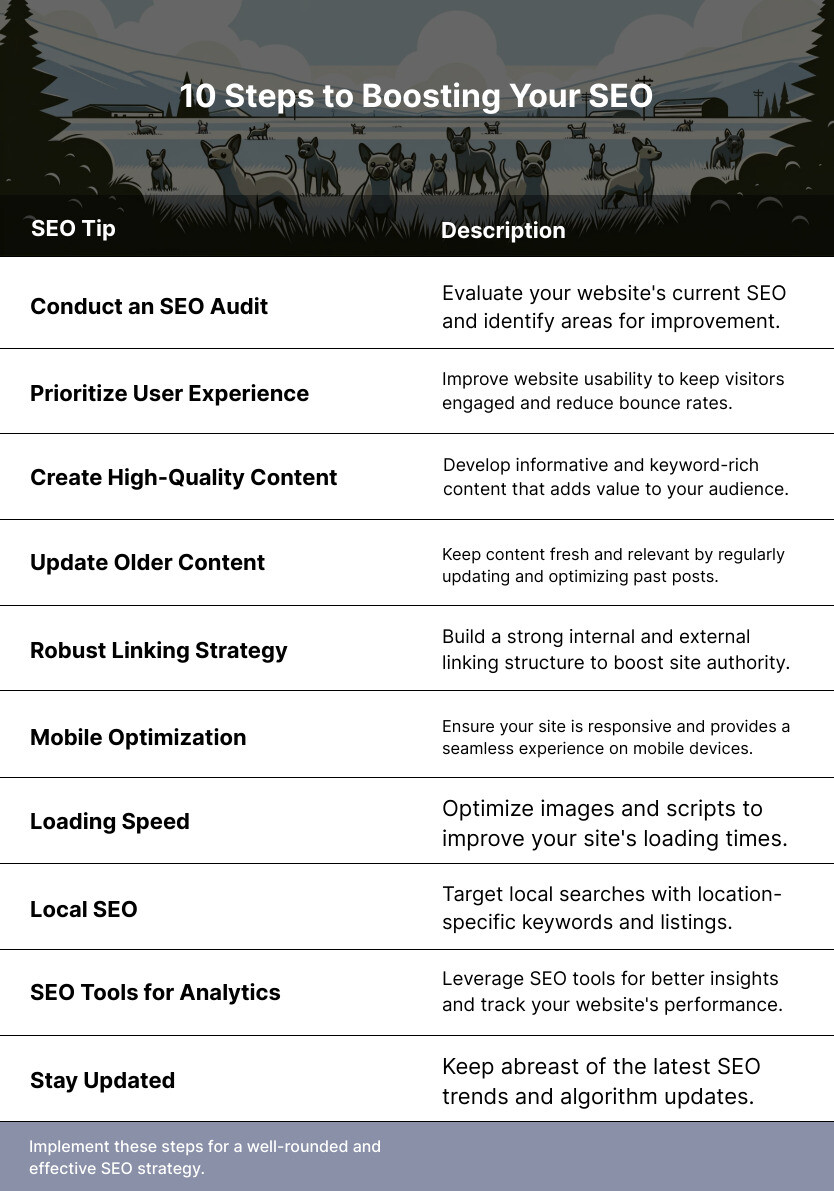
Every measure listed here is aimed at enhancing your digital presence. But remember, SEO is not a one-time effort, it’s a sustained commitment—an ongoing culinary art of blending the right ingredients in the right proportions. Stay with us, as we delve deeper into each of these steps, making them actionable and easy for you to implement your journey to improve SEO.
Understanding SEO: What It Is and How It Works
SEO—Search Engine Optimization—is the digital strategy that makes your business more visible on the internet. Think of it as the neon sign in the bustling digital world of Cardiff that guides users straight to your website. It’s not just a fancy term or a buzzword, but a powerful tool waiting to be harnessed to boost SEO and skyrocket your website’s rankings.
The Role of SEO in Digital Marketing
In the grand scheme of digital marketing, SEO is the lighthouse guiding users straight to your website amidst the vast expanse of the internet. The role of SEO is to communicate with search engines in their language, telling them what your website is about and why it should rank high in search results.
But SEO isn’t just about driving more traffic; it’s about attracting the right kind of traffic. By targeting specific keywords relevant to your business and location, you attract visitors who are more likely to be interested in your products or services. This targeted approach can significantly increase your conversion rates, making your business more accessible to those who need it most.
SEO and User Experience
SEO is also about providing a superior user experience. Factors like fast loading times, clear navigation, and a mobile-friendly design all contribute to a positive user experience. When your website is easy to navigate and provides valuable content, visitors are likely to stay longer and explore further. This not only helps to boost SEO but also encourages visitors to become loyal customers.
How SEO Works
SEO works by optimizing your website content and design to improve its visibility on search engine results pages (SERPs) for relevant queries. This involves strategically using keywords, adding alt tags to images, crafting compelling meta descriptions, and building a network of high-quality backlinks.
All these elements work together to make your website more attractive to search engines. The better your SEO, the higher your website will rank on SERPs, and the more visibility your business will gain.
In the next sections, we’ll guide you through actionable strategies to boost your SEO, including conducting an SEO audit, optimizing for mobile, implementing a robust linking strategy, and staying updated with the latest SEO techniques. So, are you ready to skyrocket your website’s ranking and improve your online visibility? Let’s dive in.
Tip 1: Conduct an SEO Audit of Your Website
Before you can effectively boost SEO for your website, it’s crucial to understand where you currently stand. That’s why conducting an SEO audit is the first step on your journey to improved rankings. Think of it as a health check for your website – it helps you identify and fix issues that might be hindering your site’s performance in organic search results.
What Does an SEO Audit Involve?
An SEO audit covers several elements, including your website’s loading speed, mobile-friendliness, broken links, and crawl errors. It’s like taking a deep dive into the inner workings of your website to uncover areas that need improvement.
How Do We Conduct an SEO Audit at RD Internet?
At RD Internet, we use proven tools and techniques to perform a comprehensive SEO audit. Our goal is to give you a complete overview of your website’s health, highlighting all detected issues, and providing actionable insights on how to address them effectively.
To get started, we use a reliable SEO audit tool that provides a detailed report of your site’s performance. This report will highlight the areas where your website excels and the areas that need improvement. Once we’ve gathered this data, we then work on implementing the recommendations from the SEO audit report.
This process might involve making changes to your website’s structure, optimising your content for relevant keywords, fixing broken links, and improving page load speeds. Don’t worry – we’ll guide you through each step, making sure you understand the changes being made and why they’re essential.
Why Is an SEO Audit Important?
An SEO audit isn’t just a one-time process. Regular audits are essential for keeping your SEO strategy up to date and ensuring your website remains optimised for search. This regular check-in can be particularly beneficial if you’re in a highly competitive industry or are actively working on boosting your online visibility.
Moreover, an SEO audit isn’t just a health check for your website – it’s a strategic tool that can help you stay ahead of the competition and continually climb the search engine ranks. So, while it might require some patience and investment, the insights and SEO enhancements you’ll gain from an audit make it well worth the wait.
In conclusion, conducting an SEO audit is a fundamental step towards understanding your website’s performance and charting a path towards improved visibility and increased organic traffic. It’s the first step in your journey to boost SEO and make your mark in the digital world. Stay tuned for more tips on how to skyrocket your website’s ranking.
Tip 2: Prioritize User Experience for Better SEO
User experience, often abbreviated as UX, is a critical factor that search engines take into account when determining your website’s ranking. As we at RD Internet like to say, a happy user is a returning user, and search engines like Google value websites that provide a seamless and enjoyable user experience.
Why is User Experience Important?
Firstly, a website with a good user experience keeps visitors on the site longer, reducing the bounce rate. Bounce rate is a metric that represents the percentage of visitors who leave a website after viewing only one page. A lower bounce rate is a positive signal to search engines that users find your website valuable and engaging.
Secondly, a well-designed website that is easy to navigate increases the chances of visitors returning, another positive signal to search engines.
How to Improve User Experience
Improving user experience starts with understanding your audience. Use analytics tools like Google Analytics to gain insights about your audience’s behaviour, needs, and preferences.
Make sure your website is optimized for mobile use. More and more people are using their smartphones to access the internet, and search engines like Google reward mobile-friendly websites with higher rankings. Check your website’s mobile-friendliness using tools like Google’s Lighthouse testing tool.
The structure of your website also plays a key role in user experience. A clean and organized URL structure that is easy for both users and search engines to navigate can significantly improve your website’s usability. Implement schema markup to enhance rich snippets and improve the visibility of your content in search results.
Ensure that your website loads quickly. Slow loading times can frustrate users and lead to higher bounce rates. Compress images, minimize HTTP requests, and enable browser caching to improve load times.
Finally, check for any broken links on your website that could lead to a 404 error using tools like Dead Link Checker. Broken links can hurt your search rank and damage the user experience.
At RD Internet, we believe that prioritizing user experience is not only a way to boost SEO but also a way to build a loyal audience and increase conversions. Stay tuned for our next tip on how to create high-quality, keyword-rich content.
Tip 3: Create High-Quality, Keyword-Rich Content
Creating high-quality, keyword-rich content is a crucial strategy to boost SEO. This involves crafting content that is not only engaging and informative but also optimized with relevant keywords to improve your website’s visibility on search engines.
The Power of Keywords
Keywords are the magic words that make your website appear when users type related queries into search engines. While high-volume keywords may seem attractive, they are often broad and challenging to rank for. Instead, we recommend focusing on long-tail keywords. These are more specific phrases that, while having lower search volumes, bring the most relevant traffic to your site, and are easier to rank for.
Keyword stuffing can lead to a poor user experience and damage your SEO efforts. Your priority should be to write for the user, not the search engine. Be strategic with your keyword usage and prioritize delivering value to your audience.
The Role of Evergreen Content
Evergreen content is content that remains relevant and fresh for your readers over a long period of time. You want to create content that can withstand the test of time and continue to drive traffic to your site year after year. Keep your evergreen content updated with the latest information to ensure it remains accurate and useful.
The Importance of Regularly Updating Your Content
Search engines love fresh content. Regularly updated content signals to search engines that your website is active and relevant. Beyond improving your visibility, fresh content keeps your audience engaged and encourages repeat visits to your website.
Crafting Link-Worthy Content
Creating content that is so valuable and insightful that other websites want to link to it can significantly boost your SEO. When you provide unique data, statistics, and insights, you become a go-to resource that bloggers and journalists want to link to.
In summary, creating high-quality, keyword-rich content is a critical step in your SEO journey. Not only does it boost your visibility on search engines, but it also provides valuable information to your audience, fostering trust and loyalty.
In the next section, we will discuss how to update and optimize older content to further boost SEO.
Tip 4: Update and Optimize Older Content
One of the most effective ways to boost SEO is to regularly update and optimize your older content. Search engines like Google value fresh content and consider it a strong indicator of a website’s relevancy. Therefore, making regular updates to your existing content can significantly improve your search engine rankings.
Why You Should Update Your Existing Content
Before you embark on creating new content, take a step back and review what you already have. This approach allows you to maximize the untapped potential of your existing content, avoid overlapping content that might confuse search engines and users, and reduce content creation costs.
From our blog posts to product descriptions, we at RD Internet regularly audit our content to ensure it’s up to date and relevant. If we find any outdated information or areas that need improvement, we make the necessary updates. This not only keeps our content fresh and engaging for our audience, but it also gives our pages a “freshness boost,” leading to improved SEO performance.
How to Update Your Content Effectively
When updating your content, focus on the pages that have the most potential to rank higher in the search engine results. This often includes pages that are currently ranking in positions 4-10. These pages already have some traction, and with a little boost, they could rank within the top three, driving more clicks and traffic to your site.
Here are some strategies to effectively update your content:
- Meet search intent: Ensure your content aligns with what users are searching for. This involves using relevant keywords and phrases, answering common questions, and providing value-added information.
- Improve readability: Format your content so it’s easier to skim. This can include using sub-headers, bullet points, and short paragraphs.
- Add visuals: Incorporate graphics, images, and videos to make your content more engaging and easy to understand. Remember to use alt tags for your images and videos to improve SEO.
- Use internal links: Connect your content by linking to other relevant pages on your site. This not only improves SEO but also enhances the user experience by providing more information on the topic.
At RD Internet, we use tools like On Page SEO Checker to get optimization ideas based on our top-ranking competitors and on-page SEO best practices.
Keep the Content Rolling
A well-curated content calendar can be your guiding light, helping you plan and ensure a consistent flow of fresh content. But remember, it’s not just about adding new content. It’s also crucial to review your existing web content at least every six months and remove any content that’s outdated or no longer relevant.
By regularly updating and optimizing your existing content, you can significantly boost SEO, improve your search engine rankings, and attract more visitors to your site. And at RD Internet, we’re here to help every step of the way.
Tip 5: Implement a Robust Linking Strategy
To further boost SEO and enhance your website’s visibility, it’s crucial to implement a robust linking strategy. This strategy should encompass both internal and external links.
Internal links help guide visitors through your website, while also aiding search engine crawlers in understanding the structure of your site. Think of your website as a city, and internal links as the roads connecting different parts of the city. These links help both users and search engines move from one part of your website to another, enhancing user experience and boosting your SEO.
In contrast, external links point to authoritative, relevant, and reputable sources outside your website. By linking to these sources within your content, you not only provide valuable resources for your readers but also increase your website’s credibility and authority.
Additionally, don’t forget about inbound links or backlinks. These are links from other websites that direct users to your site. Gaining high-quality backlinks can significantly enhance your site’s credibility in the eyes of search engines.
Here are some actionable tips to implement a robust linking strategy:
-
Use Descriptive Anchor Text: Make your anchor text (the clickable text in a hyperlink) descriptive. Use your targeted keywords or phrases whenever possible.
-
Check for Broken Links Regularly: Broken links can disrupt the user experience and negatively impact your SEO. Regularly check both your outbound and inbound links to ensure they are functioning properly.
-
Create Link-Worthy Content: High-quality, shareable content can attract more inbound links. Look for opportunities to guest post or create content that others in your industry would want to link to.
It’s not just about the quantity of the links, but the quality. A few high-quality links can have a greater impact on your SEO than a large number of low-quality links.
At RD Internet, we understand the importance of a strong linking strategy. We’re here to help you implement a strategy that will not only boost SEO but will also enhance user experience and increase your website’s credibility and authority.
Tip 6: Optimize Your Website for Mobile Users
In today’s digital era, the majority of online users access the web through mobile devices. Consequently, having a mobile-friendly website is no longer optional—it’s a necessity. Google even considers mobile usability when determining search rankings. That’s why we at RD Internet place a strong emphasis on mobile optimization to boost SEO and improve your overall online visibility.
Mobile Optimization: More Than Just Aesthetics
Making your website mobile-friendly goes beyond just altering its appearance to fit smaller screens. It’s about ensuring a seamless user experience at all levels. This includes optimizing images and media for faster loading on mobile devices and using a clean and organized URL structure that is easy for both users and search engines to navigate.
Ensure Speed and Functionality
A slow-loading site frustrates users and can significantly increase your bounce rate. Use Google’s Search Console’s Core Web Vitals report to check your site’s loading speed and identify any potential issues. Also, consider aspects like touchscreen friendliness. Ensure clickable elements are not too close together as it could hamper user experience.
Use Google’s Tools for Testing
Google’s Lighthouse testing tool is an excellent resource for checking your site’s mobile-friendliness. It not only assesses the mobile version of your website but also provides actionable insight on how to improve it.
Stay Ahead with Mobile-First Indexing
Google now uses mobile-first indexing, meaning its algorithms primarily focus on the mobile version of your content for indexing and ranking. By optimizing your website for mobile users, you cater to the majority of your audience and meet Google’s ranking criteria.
Mobile optimization is an ongoing process. As technology and user habits evolve, so should your website. At RD Internet, we continually evaluate and adjust our strategies to ensure your website remains optimized for mobile, helping to consistently boost SEO and increase your online visibility.
In the next section, we’ll discuss the importance of monitoring your website’s loading speed, another critical factor for improving your SEO.
Tip 7: Monitor Your Website’s Loading Speed
As we continue our journey to boost SEO, it’s time to take a closer look at your website’s loading speed. It’s a crucial, yet often overlooked, aspect of SEO that can make or break your visitor’s experience. A slow-loading website can lead to lower engagement, higher bounce rates, and ultimately, a drop in your search engine rankings.
Why is Loading Speed Important?
Google, the search engine giant, takes into account the loading speed of your website when determining its ranking. If your site takes longer to load compared to your competitors, you may find your website slipping down in the search engine results. On the other hand, a fast-loading website can help you outpace your competition and enhance your online visibility.
Moreover, the user experience is greatly influenced by the loading speed of your website. A slow-loading site can turn away potential customers, resulting in less engagement, fewer conversions, and a higher bounce rate.
Steps to Improve Your Website’s Loading Speed
Monitoring and optimizing your site’s loading speed may seem like a daunting task. But when you break it down into manageable steps, it becomes achievable
-
Leverage Browser Caching: Browser caching can store resources locally on users’ devices, significantly reducing load times. For WordPress users, free plugins like WP SuperCache can simplify this process.
-
Minimize HTTP Requests: Each file and image on your site requires a new HTTP request, which can slow down your site. By keeping your site’s design simple and efficient, you can improve loading speed.
Monitoring Your Site’s Speed
You can use tools like Google’s PageSpeed Insights to get a quick benchmark of your site’s load speed and identify specific areas for improvement. Improving your page loading speed isn’t a one-time task but an ongoing process. As your website is dynamic with new content being added regularly, it’s crucial to keep tabs on your site’s speed and make the necessary adjustments to maintain a seamless user experience and uphold your SEO ranking.
In conclusion, a fast-loading website not only pleases your users but also wins the favor of search engines. So, focus on enhancing your website’s loading speed to unlock your website’s potential to soar in search engine rankings. Stay with us for the next tip as we delve into the power of local SEO techniques to further boost your SEO.
Tip 8: Utilize Local SEO Techniques
Navigating the vast world of SEO can be challenging, but as we focus our efforts on local SEO, the journey becomes more manageable and the rewards more noticeable. Local SEO is a powerful strategy that targets specific geographical areas, making your business more visible in local search results. It’s a fantastic way to boost SEO and attract more traffic to your site.
Claim and optimize your Google My Business profile
One of the best ways to improve local SEO is through your Google My Business profile. Think of it as your business’s digital storefront, providing potential customers with vital information like your address, opening hours, and customer reviews. When you claim and optimize your profile, it shines a spotlight on your business, making it easier for local customers to find you.
Ensure that your name, address, and phone number (NAP) are consistent across all your online platforms, including social media pages. Consistency helps Google to recognize and trust your business, which can result in higher search rankings.
Engage with customer reviews
Engaging with your customers is a crucial part of enhancing your local SEO efforts. Responding to reviews left by users demonstrates that you value their feedback. High-quality, positive reviews can enhance your online visibility and increase the likelihood of a shopper visiting your location.
Optimize your website and blog content for local keywords
Your website and blog content should also be optimized for local keywords. This means including phrases or terms that people in your specific geographical area are likely to use when searching for your products or services.
Strive to rank in the Local Pack
Another major goal is to rank in what is referred to as the “Local Pack.” This pack of three local businesses shows up at the top of search engine results pages (SERPs), along with a Google map. To optimize your chances of ranking in the Local Pack, ensure you have consistent online directory citations (name, contact information, etc.) across the web.
By implementing these local SEO techniques, you’re not only making your business more visible to a local audience but also improving your overall SEO. In the next section, we’ll be discussing the importance of SEO tools in tracking and analyzing your website’s performance.
Tip 9: Use SEO Tools for Tracking and Analysis
To truly boost SEO, it’s crucial to track and analyze your website’s performance. This allows you to understand what strategies are working and which ones need improvement. Fortunately, there are a variety of SEO tools available that can help streamline this process.
Google Analytics and Google Search Console
Two indispensable tools to start with are Google Analytics and Google Search Console. Google Analytics is a comprehensive tool that provides insights about your website’s performance, visitor demographics, and user behavior such as bounce rate and session duration. This information can be used to optimize what’s working and adjust what isn’t, ultimately driving more targeted traffic to your site.
On the other hand, Google Search Console helps you understand how Google views your site. It provides information about your pages’ performance in search results, the queries leading to your site, and any indexing issues that need addressing. Regularly reviewing your performance in Google Search Console can help you fine-tune your SEO strategy for increased website traffic.
RD Internet’s SEO Tools
At RD Internet, we offer our clients access to specialized SEO tools that provide a comprehensive suite of features to help improve your website’s SEO. These tools allow you to conduct keyword research, get backlink analyses, analyze the search engine results page (SERP), audit your site, and more. By using these tools, you can identify content gaps, ranking opportunities, and even research your competitors’ strategies.
Tracking SEO Metrics
It’s also essential to track specific SEO metrics to measure the success of your SEO efforts. These include the number of unpaid website visits that come from search engines, the bounce rate, average session duration, and pages per session. These metrics provide valuable insights into user behavior on your site and can guide you in making improvements.
In conclusion, leveraging these SEO tools for tracking and improving your website traffic is crucial in the digital marketing landscape. Regularly reviewing and acting on the insights these tools provide will help you continually optimize your SEO strategy, leading to increased visibility and more website traffic.
In the next section, we’ll cover the importance of staying updated with the latest SEO techniques.
Tip 10: Stay Updated with the Latest SEO Techniques
Navigating the ever-evolving world of SEO can feel like trying to hit a moving target. Search engines like Google regularly tweak their algorithms, altering the way they rank websites. As a result, the SEO techniques that worked wonders for your business last year might not be as effective today. To consistently boost SEO and maintain a robust online presence, you need to stay updated with the latest SEO trends.
The Importance of Keeping Up with SEO Trends
Staying on top of SEO trends is not just about following the latest fads. It’s about understanding the shifts in technology and user behaviour that influence how search engines rank websites. For example, the increasing use of voice and image search has necessitated adjustments in SEO strategies. Only by understanding these changes can you optimize your website accordingly and stay ahead of your competitors.
Resources to Stay Informed About SEO
Thankfully, you don’t have to navigate SEO alone. There are numerous resources available to help you stay informed.
Google Search Central Blog is an excellent place to start. It’s where Google regularly publishes updates and advice, helping businesses understand what the search engine values.
Online SEO communities and forums such as Moz and Search Engine Land offer a wealth of knowledge. Here, industry experts share their insights and discuss the latest trends.
Subscribe to SEO newsletters or follow SEO experts on social media for regular updates.
SEO webinars and conferences are also valuable sources of information. These events provide opportunities to learn from leading experts in the field.
Staying informed about SEO is an ongoing commitment. But it’s one that can pay big dividends for your business. By understanding and implementing the latest SEO techniques, you can boost your website’s visibility, attract higher-quality traffic, and ultimately, increase your online sales.
At RD Internet, we are committed to staying at the forefront of SEO trends. We continuously adapt our strategies to ensure our clients’ websites continue to rank well and attract the right customers.
In conclusion, SEO is not a static strategy. It’s a dynamic and evolving field that requires constant learning and adaptation. But with the right resources and a commitment to staying updated, you can harness the power of SEO to boost your online visibility and drive more traffic to your website.
In the next section, we’ll wrap up our discussion on how to boost SEO and the role it plays in enhancing your online visibility.
Conclusion: The Role of SEO in Boosting Your Online Visibility
SEO is not just a buzzword; it’s an essential tool in the digital marketing toolbox. When effectively implemented, it can significantly boost your online visibility, driving more traffic to your website, and consequently increasing your potential for customer conversion and revenue generation.
With the right SEO strategies, like creating high-quality, keyword-rich content, prioritising user experience, and staying updated with the latest SEO techniques, you can ensure your website ranks higher in search engine results pages (SERPs). This enhanced visibility not only helps you reach more potential customers but also establishes your business as a trusted and credible entity in the digital marketplace.
SEO is not merely about attracting any traffic; it’s about attracting the right traffic. By targeting specific keywords relevant to your business, you attract visitors who are more likely to be interested in your products or services. This targeted approach can significantly increase your conversion rates, leading to higher revenues for your business.
Moreover, staying updated with the latest SEO trends and practices is crucial. SEO is a dynamic field, with search engine algorithms continually evolving. By staying informed and adapting your strategies accordingly, you can ensure that your website remains optimized for the latest SEO standards.
At RD Internet, we understand the complexities of SEO and are committed to helping our clients navigate its intricacies. We believe that with the right strategies, every business, no matter how small, can boost its SEO, enhance its online visibility, and ultimately, achieve business success.
We hope this article has provided you with valuable insights on how to boost SEO for your website. Improving your SEO is an ongoing process, not a one-time task. It requires consistent effort, continuous learning, and regular adjustments to your strategies. But trust us, the rewards are worth the effort!
We’re always here to help, so reach out if you have any questions or need further assistance. Here’s to your success in the digital world!
Frequently Asked Questions About SEO
What is SEO and why is it important?
SEO, Search Engine Optimization, is the practice of optimizing various elements of your website to make it attractive to search engines like Google. It involves using relevant keywords, creating high-quality content, acquiring high-quality backlinks, and improving technical aspects of your website. SEO is essential because it increases your website’s visibility in search engine results, driving more traffic to your site. This can lead to higher conversion rates and increased revenue.
How can I improve my SEO for free?
Improving your SEO doesn’t always require a big budget. Here are a few free ways to boost SEO:
- Use relevant keywords in your content, meta tags, and URLs.
- Create high-quality content that provides value to your audience.
- Improve your website’s loading speed.
- Make your website mobile-friendly.
- Acquire high-quality backlinks by creating shareable content.
SEO is an ongoing process that requires consistent effort and adjustments.
What are some effective SEO techniques?
There are several effective SEO techniques that can help improve your website’s visibility and ranking. These include:
- Conducting thorough keyword research.
- Creating and optimizing high-quality content.
- Implementing a robust link-building strategy.
- Optimizing your website for mobile users.
- Utilizing local SEO techniques for businesses targeting a local demographic.
- Regularly monitoring and analyzing your website’s performance using SEO tools.
Implementing these techniques can significantly boost your SEO and increase your website’s visibility on search engines.
How can I improve my SEO on Google?
Improving your SEO on Google involves several steps. First, you need to understand what Google is looking for, which includes relevant, high-quality content, a user-friendly website, and a site that’s optimized for mobile devices. Then, you need to make sure your website meets these criteria. Additionally, using relevant keywords in your content, meta tags, and URLs, and acquiring high-quality backlinks can also help improve your SEO on Google.
How can small businesses improve their SEO?
Small businesses can improve their SEO by focusing on local SEO techniques, which help attract local customers. This includes using location-specific keywords, optimizing your Google Business Profile, and getting positive reviews on Google. Additionally, creating and optimizing high-quality, relevant content and improving technical aspects of your website, such as loading speed and mobile-friendliness, can also boost SEO.
What does SEO stand for?
SEO stands for Search Engine Optimization. It’s a digital marketing strategy designed to enhance your website’s visibility on search engine results pages (SERPs), thereby driving more traffic to your site and increasing the likelihood of conversions.
If you’re a small business owner looking to boost your online presence and increase revenue, SEO can be a game-changer. At RD Internet, we’re dedicated to helping businesses like yours succeed in the digital world. Check out our comprehensive SEO services and get in touch with us today for a free consultation!
Recent Comments