

Understanding PPC Costs and How They Affect Your Business
How much does pay per click advertising cost? Let’s answer that upfront:
Quick Snapshot:
– For most businesses: $0.11 – $1.00 per click
– Monthly budgets: Can range from $100 to $10,000+
– Factors: Industry, competition, ad quality
Pay Per Click (PPC) advertising is an essential tool for businesses wanting to boost online presence fast. Unlike search engine optimization (SEO), which can take months to see results, PPC ads can bring traffic and leads almost instantly.
PPC allows you to bid on keywords related to your products and services. You only pay when someone clicks on your ad. Platforms like Google Ads and social media networks provide the reach needed to target potential customers right when they’re searching for solutions your business offers.
Stay tuned as we dive deeper into how PPC works, how costs are calculated, and what you can expect for your specific industry.
How much does pay per click advertising cost word roundup:
– Advanced PPC strategies
– PPC bid strategies
– what are the benefits of using pay-per-click advertising
What is Pay Per Click (PPC) Advertising?
Pay Per Click (PPC) advertising is a model where advertisers pay a fee each time one of their ads is clicked. It’s a way of buying visits to your site, rather than attempting to “earn” those visits organically. Let’s break down how it works:
The PPC Model
In the PPC model, advertisers bid on specific keywords related to their business. When a user searches for these keywords, the search engine runs an ad auction to determine which ads to display.
Ad Auction
The ad auction is a process where search engines like Google decide which ads to show and in what order. Here’s how it works:
– Advertiser Bids: Advertisers set a maximum bid they’re willing to pay for each click on their ad.
– Ad Quality: Search engines also consider the quality and relevance of the ads. This includes factors like click-through rate (CTR), ad relevance, and landing page experience.
– Ad Rank: The combination of bid amount and ad quality determines the ad’s position on the search results page.
The ad with the highest Ad Rank wins the auction and gets displayed.
Ad Placement
If your ad wins the auction, it gets placed in a prominent position on the search engine results page (SERP) or on relevant websites for display ads. These ads are typically labeled as “Ad” or “Sponsored” to differentiate them from organic search results.
Cost Per Click (CPC)
In the PPC model, advertisers only pay when someone clicks on their ad. This cost is known as Cost Per Click (CPC). The CPC can vary significantly based on:
– Keyword Competitiveness: More competitive keywords usually have higher CPCs.
– Ad Quality: Higher quality ads can lower your CPC due to better Ad Rank.
– User Relevance: Ads that are more relevant to the user’s search query can also lower CPC.
For example, HubSpot estimates the average CPC to be between $1 and $7, but it can be higher depending on the industry and keyword.
Advertiser Control
One of the key benefits of PPC advertising is the level of control it offers. Advertisers can:
– Set daily or monthly budgets to manage ad spending.
– Choose bidding strategies that align with campaign goals.
– Craft ad content and select targeting options to reach the desired audience.
– Use negative keywords to prevent ads from showing up in irrelevant searches.
Real-World Example
One of Your Marketing People’s clients increased their ad budget by 30% and saw a 105% higher conversion rate. This shows how effective PPC can be when managed well.
Understanding these elements is crucial for running successful PPC campaigns. Next, we’ll explore how much you can expect to pay for PPC advertising and the factors that influence these costs.
How Much Does Pay Per Click Advertising Cost?
When it comes to how much does pay per click advertising cost, the answer isn’t straightforward. Several factors influence PPC costs, making it essential to understand these elements to manage your budget effectively.
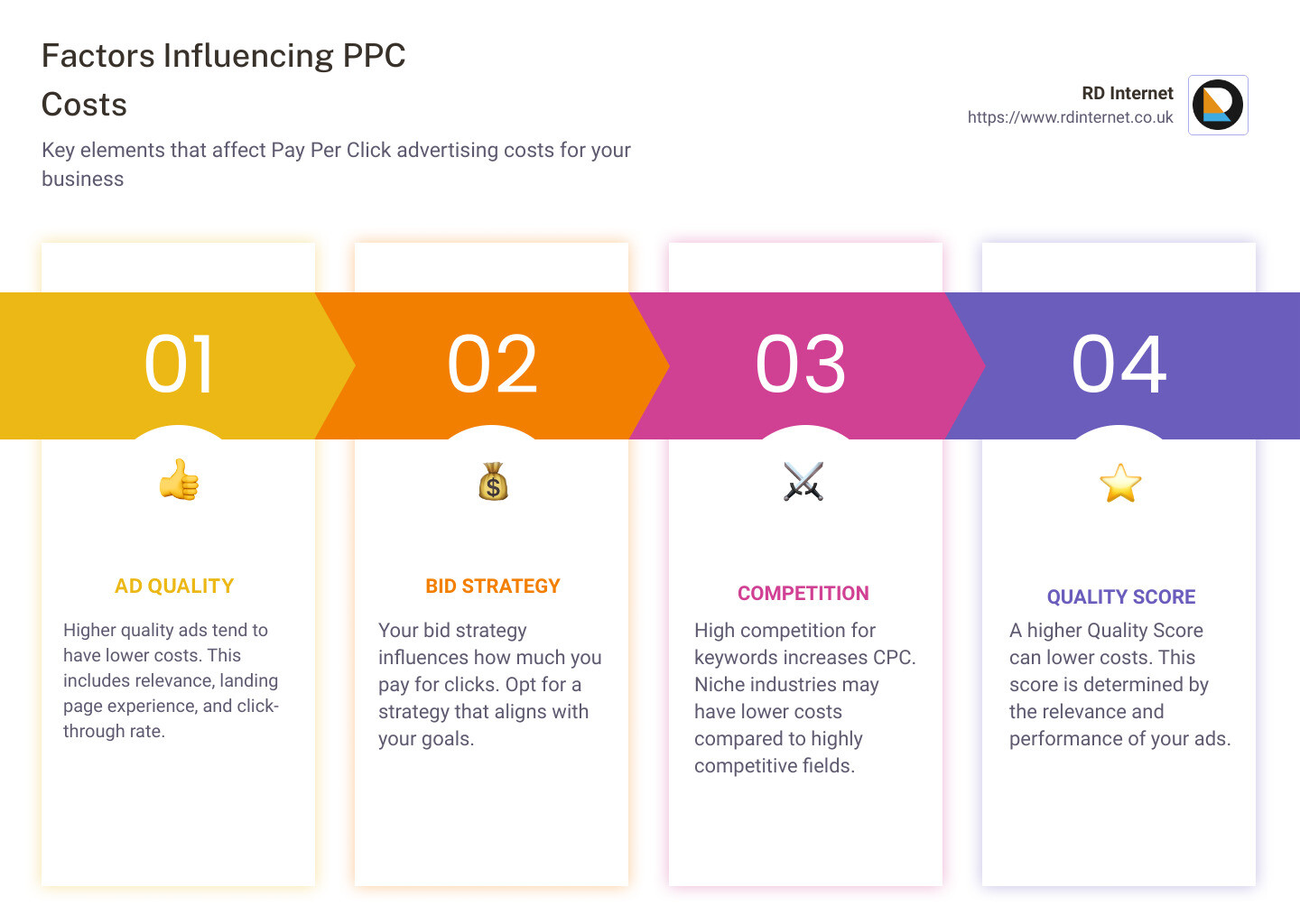
Factors Influencing PPC Costs
Ad Quality
Your ad’s quality plays a significant role in determining its cost. Google assigns a Quality Score to each ad based on its relevance, expected click-through rate (CTR), and the landing page experience. A higher Quality Score can lower your cost per click (CPC).
Bid Strategy
The maximum amount you’re willing to pay for a click, known as your bid, directly impacts your ad’s placement and cost. You can choose between manual bidding, where you set the bids yourself, or automated bidding, where Google’s algorithms adjust your bids to maximize your goals.
Competition
The level of competition for your chosen keywords also affects your CPC. Highly competitive keywords, often short-tail keywords, tend to have higher CPCs. Conversely, long-tail keywords, which are more specific and less competitive, usually cost less.
Ad Networks
Different ad networks have varying cost structures. For instance, Google Ads generally has higher CPCs compared to Microsoft Advertising due to its larger audience reach. However, each platform has its own advantages and can be more cost-effective depending on your target audience.
Average CPC by Industry
The average CPC can vary widely across different industries. Here are some examples:
- Business Services: $3 – $6 per click
- Arts and Entertainment: $1 – $3 per click
- Legal Services: $4 – $8 per click
- Accounting: $3 – $5 per click
- Real Estate: $2 – $4 per click

These figures are just averages, and your actual costs can be higher or lower depending on various factors like ad quality, competition, and bid strategy.
Keyword Competitiveness
Keywords are the backbone of PPC advertising. Their competitiveness significantly impacts your costs. For example, keywords like “insurance” or “lawyer” are highly competitive and can have CPCs upwards of $50. On the other hand, niche keywords with lower competition can have CPCs as low as $1.
Ad Quality and Quality Score
Google’s Quality Score is crucial in determining your CPC and ad placement. A higher Quality Score means you pay less per click and get better ad positions. This score is influenced by:
- Relevance of your ad to the keyword
- Expected click-through rate (CTR)
- Quality of the landing page
For example, an ad with a high Quality Score of 10 might pay $3 per click, while another ad with a Quality Score of 5 might pay $6 for the same keyword.
Real-World Example
A client in the legal industry managed by Your Marketing People improved their Quality Score from 6 to 9. This change reduced their CPC by 30% and increased their ad visibility, leading to a 50% rise in conversions. This demonstrates the importance of focusing on ad quality and relevance.
Understanding these factors will help you manage your PPC costs more effectively. Next, we’ll discuss how to budget for your PPC campaigns.
Budgeting for PPC Campaigns
Budgeting for PPC campaigns is critical to ensure you maximize your return on investment (ROI) without overspending. Here’s how to set and manage your budget effectively.
Setting a Realistic PPC Budget
Campaign Goals
Start by defining your campaign goals. Are you aiming to increase sales, generate leads, or boost brand awareness? Your goals will help determine your budget. For example, a campaign focused on generating leads may require a different budget allocation compared to a brand awareness campaign.
Keyword Research
Conduct thorough keyword research to identify the most relevant and high-performing keywords for your campaign. Tools like Google Keyword Planner can help you estimate search volumes and costs. Highly competitive keywords will cost more, so balance your choices between high-traffic and niche keywords.
Industry Competitiveness
Consider the competitiveness of your industry. As mentioned earlier, industries like legal services and business services tend to have higher average CPCs. Knowing this can help you set a realistic budget that aligns with your industry standards.
Managing Your PPC Budget Effectively
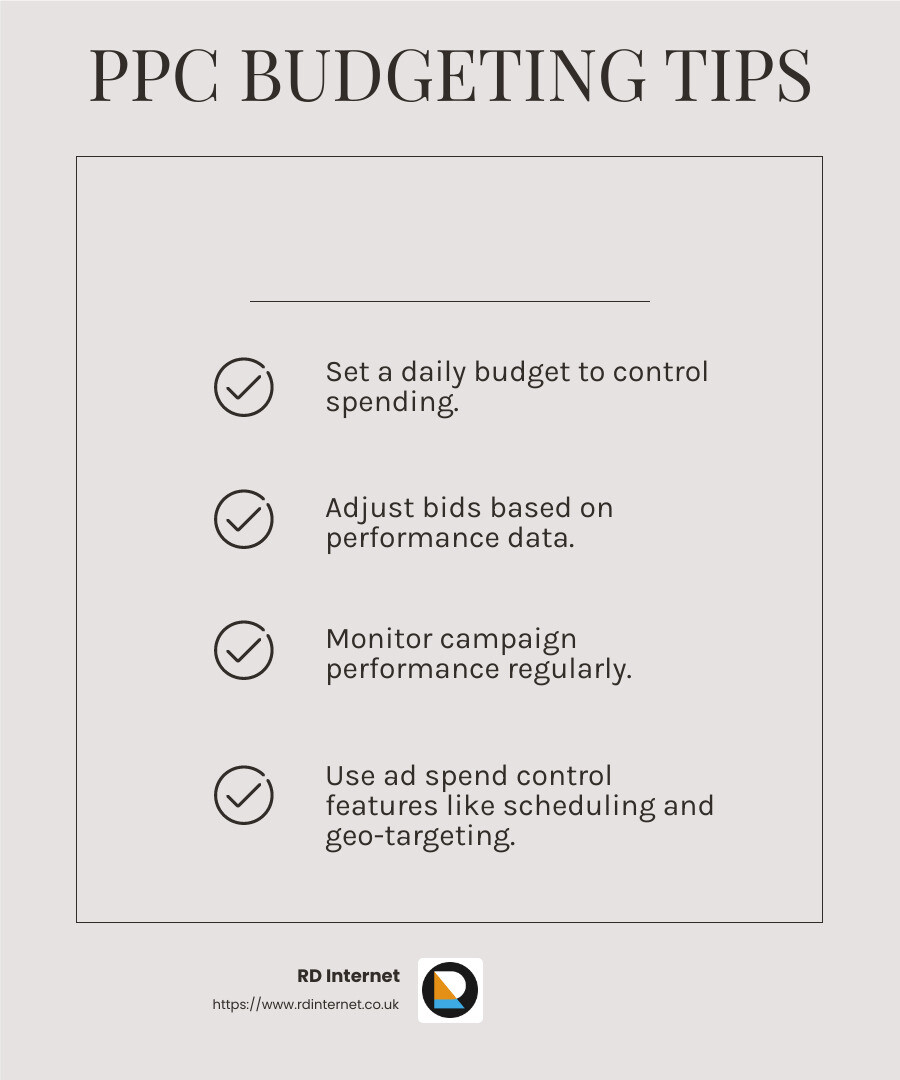
Daily Budget Allocation
Divide your total monthly budget into daily allocations. This helps control your spending and ensures your ads run throughout the month. For instance, if your monthly budget is $3,000, set a daily budget of $100. This approach prevents your budget from depleting too quickly and maintains consistent ad visibility.
Bid Adjustments
Adjust your bids based on performance data. If certain keywords or ad groups are performing well, consider increasing their bids to gain more visibility. Conversely, lower the bids for underperforming keywords to optimize your budget.
Performance Monitoring
Regularly monitor your campaign performance using tools like Google Analytics and your PPC platform’s dashboard. Track key metrics such as click-through rates (CTR), conversion rates, and return on ad spend (ROAS). This data helps you make informed decisions and refine your strategy.
Ad Spend Control
Implement ad spend control measures to avoid overspending. Use features like ad scheduling to run ads during peak hours and geo-targeting to focus on specific locations. This ensures your budget is spent efficiently and reaches the most relevant audience.
By setting a realistic budget and managing it effectively, you can optimize your PPC campaigns for better performance and ROI. Next, we’ll explore the different PPC management options available.
PPC Management Options
Managing your PPC campaigns well can make a big difference in your results. You have three main options: in-house management, hiring a freelance marketer, or working with a PPC agency. Let’s break down the pros and cons of each.
Pros and Cons of In-House PPC Management
Pros:
- Control: Managing PPC in-house gives you full control over your campaigns. You can make quick changes based on real-time data.
- Integration: Your in-house team can easily align PPC strategies with other marketing efforts like social media and email campaigns.
- Cost: Initially, it may seem cheaper since you’re not paying an external agency.
Cons:
- Expertise: Your team might not have the specialized skills needed for effective PPC management. PPC requires knowledge in bid strategies, keyword research, and performance analysis.
- Resource Allocation: Your team may already have other responsibilities. Adding PPC management could stretch them too thin, leading to lower performance in all areas.
- Learning Curve: PPC platforms constantly update their features. Keeping up with these changes can be time-consuming and challenging.
Benefits of Hiring a PPC Agency
Expertise and Technology:
- Specialized Knowledge: PPC agencies have experts who focus solely on managing PPC campaigns. They know the latest trends and best practices.
- Advanced Tools: Agencies have access to premium tools and software that might be too expensive for in-house teams. These tools can provide deeper insights and better optimization.
Scalability and Cost:
- Scalability: Agencies can easily scale your campaigns up or down based on your budget and goals. This flexibility is crucial for seasonal businesses or those experiencing rapid growth.
- Cost-Effective: While hiring an agency may seem expensive upfront, their expertise can lead to higher ROI. They can avoid common pitfalls that could waste your budget.
Resource Allocation:
- Focus: By outsourcing PPC management, your in-house team can focus on other important tasks, like content creation and customer engagement.
- Efficiency: Agencies often have streamlined processes and dedicated teams, ensuring your campaigns are managed efficiently and effectively.
Freelance Marketers
Freelance marketers can be a middle-ground option. They usually charge less than agencies but may not offer the same level of resources and support.
Pros:
- Cost: Generally cheaper than agencies.
- Flexibility: Freelancers can offer customized services based on your specific needs.
Cons:
- Limited Resources: Freelancers may not have access to advanced tools and technologies.
- Reliability: Finding a reliable and skilled freelancer can be challenging. Their availability might also be limited.
Choosing the right PPC management option depends on your business needs, budget, and goals. In-house management offers control but requires expertise. Freelancers provide flexibility at a lower cost but may lack resources. Agencies bring specialized knowledge and advanced tools but at a higher price.
Next, we’ll dive into the costs associated with popular PPC platforms like Google Ads and Microsoft Advertising.
Popular PPC Platforms and Their Costs
Google Ads Costs
Google Ads is the most popular PPC platform. It offers two main networks: the Google Search Network and the Google Display Network.
Google Search Network: Ads appear on Google search results pages. The average cost-per-click (CPC) can range from $1 to $2 for most industries. However, highly competitive keywords, like those in the legal or insurance industries, can cost upwards of $50 per click.
Google Display Network: Ads appear on websites that partner with Google. The average CPC here is generally lower, often ranging from $0.50 to $1. This network is great for increasing brand awareness.
Microsoft Advertising Costs
Microsoft Advertising, formerly Bing Ads, serves ads on Bing, Yahoo, and DuckDuckGo. While it has a smaller audience compared to Google, it can be more cost-effective.
Bing Ads: The average CPC on Bing is typically lower than Google, often around $1.54. This makes it a good option for advertisers with smaller budgets.
Yahoo and DuckDuckGo: These platforms are also part of the Microsoft Advertising network. Costs are similar to Bing, providing a cost-effective alternative to Google Ads.
Social Media PPC Costs
Social media platforms offer another avenue for PPC advertising. Here’s a quick look at the costs:
Facebook: The average CPC on Facebook is around $0.97. This platform is excellent for targeted advertising based on user interests and demographics.
Instagram: Owned by Facebook, Instagram’s average CPC is slightly higher, often between $1 and $2. It’s ideal for visual-centric advertising.
Twitter: Twitter’s average CPC ranges from $0.38 to $1. This platform is effective for real-time engagement and trending topics.
TikTok: TikTok is newer to the PPC scene. The average CPC is around $1, but this can vary widely depending on the target audience and ad format.
Understanding the costs associated with these platforms can help you make an informed decision about where to allocate your PPC budget. Next, we’ll discuss how to set a realistic PPC budget for your campaigns.
Frequently Asked Questions about PPC Costs
How Much Do Click Ads Pay?
The cost per click (CPC) can vary widely based on several factors, including the platform and the competitiveness of the keywords. On average, click ads pay between $0.10 to $1 per click. However, for highly competitive industries like legal or insurance, the CPC can soar up to $6 to $7 per click or even higher. For example, a law firm might pay an average CPC of $65 on Google Ads.
What Is the Average Budget for a PPC Campaign?
The budget for a PPC campaign can vary significantly based on the size of the business and the industry. For small businesses, the average monthly budget ranges from $1,000 to $10,000. Mid-size companies might spend around $15,000 to $20,000 per month on PPC campaigns. Larger enterprises can allocate $50,000 to $100,000 or more per month, especially if they are in highly competitive sectors.
Is Pay Per Click Advertising Worth It?
Absolutely, PPC advertising can be highly cost-effective and offer a good return on investment (ROI). A recent study by Google showed that the average ROI on Google Ads is 800%—that is, $8 for every $1 spent. Popular PPC platforms like Google Ads, Microsoft Advertising, and social media platforms offer various ways to target your audience, making it easier to reach potential customers and drive conversions.
Next, we’ll discuss how to set a realistic PPC budget for your campaigns.
Conclusion
In summary, understanding how much pay per click advertising costs involves a variety of factors such as keyword competitiveness, industry, and ad quality. While the average cost per click can range from $0.10 to $1 for less competitive industries, it can soar up to $6 to $7 per click in highly competitive sectors like legal or insurance.
At RD Internet, we specialize in helping businesses steer the complexities of PPC advertising. Our Cardiff-based team offers services like website optimization, social media management, and pay-per-click advertising to improve your search engine rankings and online visibility.
A well-crafted PPC strategy is essential for maximizing your ROI. Here are some key points to consider:
- Set Clear Goals: Define what you want to achieve, whether it’s increasing sales, generating leads, or boosting brand awareness.
- Conduct Thorough Keyword Research: Use tools like Google Keyword Planner to find high-performing keywords.
- Optimize Ad Quality: Craft compelling ad copy and create relevant landing pages to improve your Quality Score.
- Monitor and Adjust: Continuously monitor your campaign’s performance and make data-driven adjustments.
By following these steps, you can make your PPC campaigns more effective and cost-efficient.
If you’re ready to take your PPC campaigns to the next level, contact RD Internet today. Our team of experts is here to help you maximize your online visibility and achieve your business goals.
With the right strategy and expert guidance, PPC advertising can be a highly effective way to drive traffic and increase revenue for your business. At RD Internet, we’re committed to helping you achieve the highest ROI possible.
Recent Comments