

What is Conversion Optimization: 10 Best Tips for Success
Understanding Conversion Rate Optimization
What is conversion optimization?
Conversion optimization, also known as conversion rate optimization (CRO), is the practice of improving your website or app to increase the percentage of visitors who take a desired action. This can include making a purchase, signing up for a newsletter, or booking a service.
Why is it important?
- Boosts Sales: Helps turn more visitors into paying customers.
- Improves User Experience: Makes your site easier and more enjoyable to use.
- Lowers Costs: Reduces the amount you spend to get new customers.
- Drives Business Growth: Leads to more revenue and a stronger online presence.
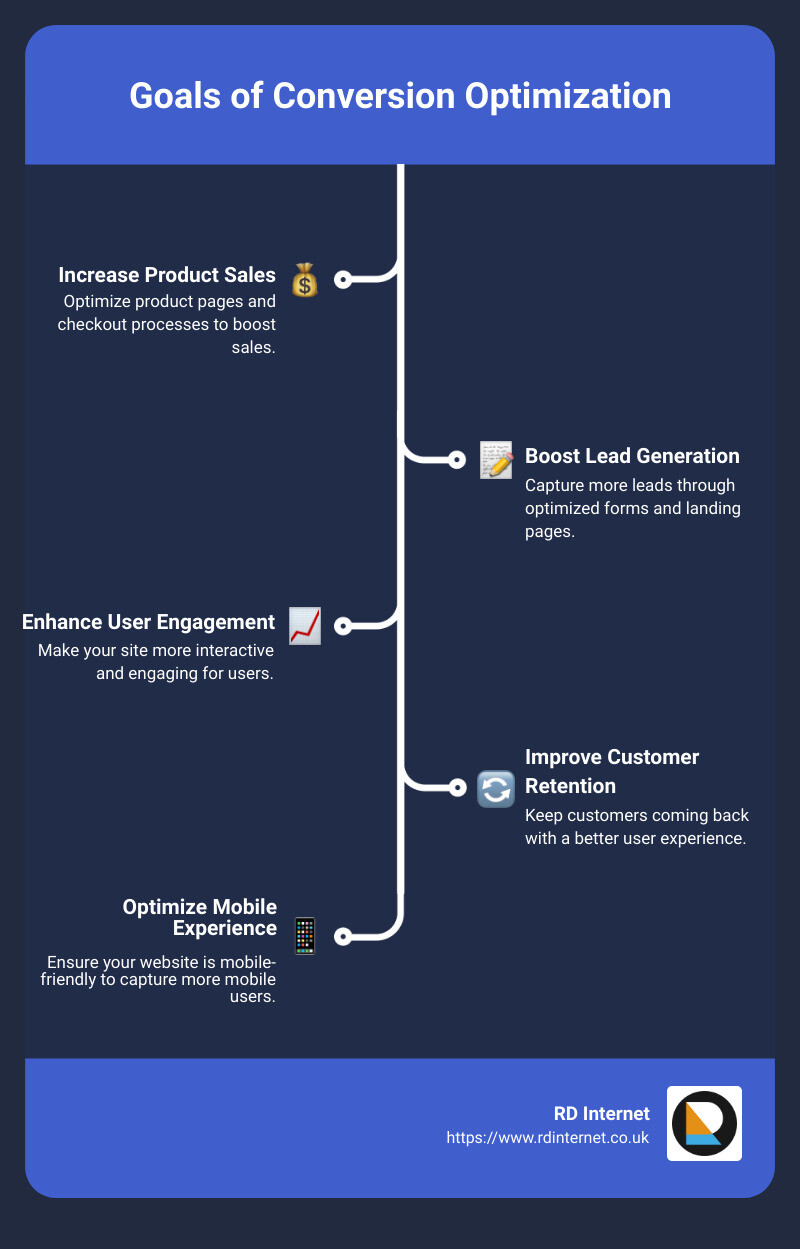
Goals of Conversion Optimization:
1. Increase product sales
2. Boost lead generation
3. Improve user engagement
4. Improve customer retention
Conversion optimization is essential for any small business seeking to maximize online success. Let’s dive deeper into how it works and why it’s critical.
What is Conversion Optimization?
Conversion optimisation, or conversion rate optimisation (CRO), is the process of increasing the percentage of website visitors who take a desired action. These actions can range from making a purchase, filling out a form, or subscribing to a newsletter. The goal is to convert more of your site’s visitors into customers or leads.
Examples of Conversion Rate Optimisation
To understand CRO better, let’s look at some examples:
-
Landing Page Optimisation: A software company noticed that their landing page had a high bounce rate. They decided to test different headlines and images using A/B testing. The new version, which highlighted customer testimonials and had a clearer call-to-action (CTA), saw a 20% increase in sign-ups.
-
Ecommerce Site: An online clothing store realised their “Add to Cart” button was not prominent enough. By changing its colour and position, they increased their add-to-cart rate by 15%.
-
B2B Website: A B2B company optimised their lead generation forms by reducing the number of fields. This simple change led to a 30% increase in form submissions.
Conversion Rate Calculation
Your conversion rate is a key metric in CRO. Here’s how to calculate it:
Formula:
[ \text{Conversion Rate} = \left( \frac{\text{Number of Conversions}}{\text{Total Visitors}} \right) \times 100 ]
Example:
If your ecommerce site had 50 sales from 1,000 visitors last month, your conversion rate would be:
[ \left( \frac{50}{1000} \right) \times 100 = 5\% ]
Sessions vs. Unique Users:
– Sessions: If users can convert multiple times (like buying products), count each session.
– Unique Users: If users can convert only once (like subscribing), count each user only once.
Optimisation Elements
Several elements can be optimised for better conversions:
- Headlines: Catchy and relevant headlines can grab attention.
- CTAs: Clear and compelling CTAs guide users to take action.
- Images and Videos: High-quality visuals can make your site more engaging.
- Forms: Simplify forms to make them easier to complete.
A/B Testing and Multivariate Testing
A/B Testing:
This involves creating two versions of a webpage (A and B) and testing them against each other to see which performs better. For instance, you might test two different headlines to see which one results in more conversions.
Multivariate Testing:
This is more complex than A/B testing. It involves testing multiple elements on a page at the same time to see which combination works best. For example, you might test different headlines, images, and CTAs all at once.
Increased Conversions
By implementing CRO strategies, you can significantly increase your conversions. For example, when Roger’s Robotics optimised their product pages and checkout process, they saw a 25% increase in sales within three months.
Summary: Conversion optimisation is about making data-driven changes to your website to increase the number of visitors who take a desired action. Whether you run an ecommerce site or a B2B company, optimising elements like headlines, CTAs, and forms can lead to significant improvements in your conversion rate.
Why is Conversion Rate Optimization Important?
Benefits of Conversion Rate Optimization
Conversion rate optimization (CRO) is crucial for several reasons. Let’s break down the key benefits:
Lower Customer Acquisition Costs
By improving your conversion rate, you get more value from the visitors you already have. This means you don’t need to spend as much on marketing to attract new visitors. For example, if your website’s conversion rate goes from 1% to 2%, you double your conversions without spending extra on ads.
Increased Revenue
Higher conversion rates directly lead to increased revenue. Imagine a landing page that has a 10% conversion rate and receives 2000 visitors a month. That’s 200 conversions. If you optimize it to 15%, you get 300 conversions, which is a 50% increase. More conversions mean more sales and higher revenue.
Better User Experience
CRO is about improving the user experience. When you make your site easier to steer and more engaging, visitors are more likely to take action. This doesn’t just increase conversions; it also makes your visitors happier. Happy users are more likely to return and recommend your site to others.
Business Growth
Optimizing your conversion rate helps your business grow. More conversions mean more customers, and more customers mean more opportunities for upselling and cross-selling. It’s a positive cycle that can significantly impact your business’s growth.
Lower Cost Per Acquisition (CPA)
When your conversion rate improves, your cost per acquisition (CPA) decreases. You don’t need to invest as much in paid channels to get the same number of conversions. This is a more efficient use of your marketing budget.
Customer Insights
CRO involves a lot of research and testing. This process helps you understand your customers better. You learn what they like, what they don’t, and what motivates them to take action. These insights can be valuable for other areas of your business, like product development and customer service.
Competitive Advantage
A well-optimized site will perform better than your competitors’ sites that aren’t optimized. This gives you a competitive edge. If your site converts better, you’ll get more customers from the same amount of traffic.
Increased Sales
More conversions mean more sales. This is especially important for ecommerce sites. If you can turn more visitors into buyers, you’ll see a significant boost in sales. For example, when a clothing retailer optimized their product pages, they saw a 25% increase in sales within three months.
Lower Effort
CRO leverages your existing content and traffic. You don’t have to create new content or attract new visitors. Instead, you make small changes to what you already have. This is often easier and faster than other marketing strategies.
Summary: Conversion rate optimization offers numerous benefits, from lowering customer acquisition costs to increasing revenue and improving user experience. It’s a powerful tool for business growth that provides valuable customer insights and a competitive advantage.
Next, let’s explore how to establish conversion metrics and identify areas to optimize.
Establishing Conversion Metrics
Identifying Areas to Optimize
Once you’ve defined your conversion goals and success metrics, it’s time to identify which parts of your website need optimization. This step is crucial for improving your conversion funnel and achieving immediate impact.
Conversion Goals and Success Metrics
Different industries have distinct conversion goals and metrics:
- Ecommerce: Product sales, add-to-carts, and shopping cart completion rate
- B2B: Leads generated and deals closed
- Media: Pageviews, ad views, and newsletter subscriptions
- Travel: Booking conversions and ancillary purchases
To optimize effectively, you must first understand what success looks like for your business.
High Traffic Pages
Start by focusing on pages that receive the most traffic. These pages provide the quickest feedback on changes and have the potential to significantly impact your overall conversion rate.
For example, imagine a clothing retailer with a popular “Hats” page that gets a lot of visitors but has a low conversion rate. By improving this page, the retailer could see a substantial increase in sales.
Underperforming Pages
Next, look at pages that are underperforming compared to the rest of your site. These pages are often low-hanging fruit for optimization. Improving them can provide immediate benefits.
High-Value Pages
High-value pages are those that contribute significantly to your conversion goals. These might not always be the most visited pages but are crucial for your business. For instance, a B2B company might focus on its “Contact Us” page because it’s pivotal for generating leads.
Conversion Funnel
Your conversion funnel represents the steps visitors take to complete a desired action. Analyzing this funnel helps identify where users drop off before converting. Use tools like Hotjar or Google Analytics to visualize this data.

Immediate Impact
To see quick results, prioritize optimizing areas with the highest traffic or conversion potential. This approach ensures that your efforts have the most significant and fastest impact on your conversion goals.
For instance, DocuSign improved its mobile app’s user experience, leading to higher conversions. Similarly, Calendly optimized its scheduling page, resulting in more bookings.
By focusing on high-traffic, underperforming, and high-value pages, you can effectively optimize your conversion funnel and achieve immediate benefits.
Next, let’s dive into the best practices for conversion rate optimization.
CRO Best Practices
Tailor Your Messaging to Your Audience
Understanding your audience is key. Conduct audience research to identify their pain points and needs. Use surveys and feedback to gather insights. This helps you create personalized content that resonates with them.
Align Your Content with User Expectations
Your content should match what users are looking for. Use keyword analysis to understand search intent. Ensure your landing pages are consistent with what users expect. This builds trust and keeps them engaged.
Conduct Tests
Testing is crucial. Use A/B testing and split testing to find what works best. Test different elements like headlines, images, and CTAs. Tools like heatmaps can help you see where users click the most.
Diversify Your CTAs
Don’t rely on just one type of CTA. Use multiple forms, buttons, in-text CTAs, and banners in different locations. This gives users more opportunities to convert.
Remove Distractions
Keep your pages focused on conversion. Make your CTA prominent and minimize distractions. Too many options can confuse users. Simplify your navigation bar and remove unnecessary elements.
Improve Page Load Speed
A slow page can turn users away. Aim for a load time of 2.5 seconds or less. Use tools to optimize images and scripts. Faster pages improve the user experience and increase conversions.
Apply Learnings from High-Converting Content
Analyze your high-converting pages to understand what works. Identify the conversion drivers and apply those tactics to other pages. This can help you replicate success across your site.
Prioritize Above-the-Fold Content
The content users see first is crucial. Use compelling messaging, high-quality visuals, and a clear CTA. Ensure there’s enough white space to make the content easy to read.
Revamp Headlines and Subheadings
Strong headlines grab attention. Use action words, relevant keywords, and highlight benefits. You can also pose questions to pique curiosity. Test different headlines to see which ones perform best.
Next, let’s address some frequently asked questions about conversion rate optimization.
Frequently Asked Questions about Conversion Rate Optimization
What is the conversion optimization process?
The conversion optimization process is about increasing the percentage of website visitors who take a desired action. This could be anything from making a purchase to signing up for a newsletter. The process involves:
- Understanding User Behavior: Use tools like heatmaps and session recordings to see how users interact with your site.
- Identifying Barriers: Find out what’s stopping users from converting. This could be slow load times, confusing navigation, or unclear CTAs.
- A/B Testing: Test different versions of your pages to see which one performs better. Tools like Optimizely make this easy.
- Analyzing Results: Look at the data to see what worked and what didn’t. Make adjustments based on these insights.
What is an example of conversion rate optimization?
Let’s look at a real-world example. A clothing retailer noticed their hat page had a lot of traffic but low conversions. They decided to:
- Revamp the CTA: Made the “Buy Now” button more prominent.
- Improve Load Time: Reduced image sizes to make the page load faster.
- Add Trust Signals: Included customer reviews and ratings.
After these changes, the hat page saw a significant increase in sales. This is a classic case of conversion rate optimization in action.
What is the difference between conversion rate optimization and SEO?
Conversion Rate Optimization (CRO) focuses on getting more out of the traffic you already have. It’s about making your site more effective at turning visitors into customers. CRO involves:
- Improving user experience
- Testing different elements on your site
- Streamlining the conversion funnel
Search Engine Optimization (SEO), on the other hand, is about getting more traffic to your site. It involves:
- Keyword research
- On-page optimization (like meta tags and content)
- Building backlinks
While both are crucial for online success, they serve different purposes. SEO brings visitors to your site, and CRO turns those visitors into customers.
Next, let’s dive into some detailed strategies that can help you optimize your conversion rate even further.
Conclusion
At RD Internet, we specialize in helping businesses improve their online performance through Conversion Rate Optimization (CRO). By focusing on turning website visitors into customers, we help you achieve your business goals more effectively.
In summary, CRO is all about making small but impactful changes to your website or mobile app to increase the likelihood of your visitors taking desired actions, such as making a purchase or signing up for a newsletter. This process involves:
- Identifying key conversion metrics
- Analyzing areas for optimization
- Implementing best practices like clear CTAs and mobile optimization
- Conducting A/B tests to find what works best
By following these steps, you can lower customer acquisition costs, increase revenue, and improve user experience.
Ready to get started? Optimize your conversion rates today with RD Internet. Learn more about our Conversion Rate Optimization services and see how we can help you turn more visitors into loyal customers.
Let’s make your website work harder for you!
Feel free to reach out to us for any questions or to get started on your CRO journey. We’re here to help you succeed.
Recent Comments