

CRO Digital Marketing: Top 5 Ways to Boost Revenue in 2024
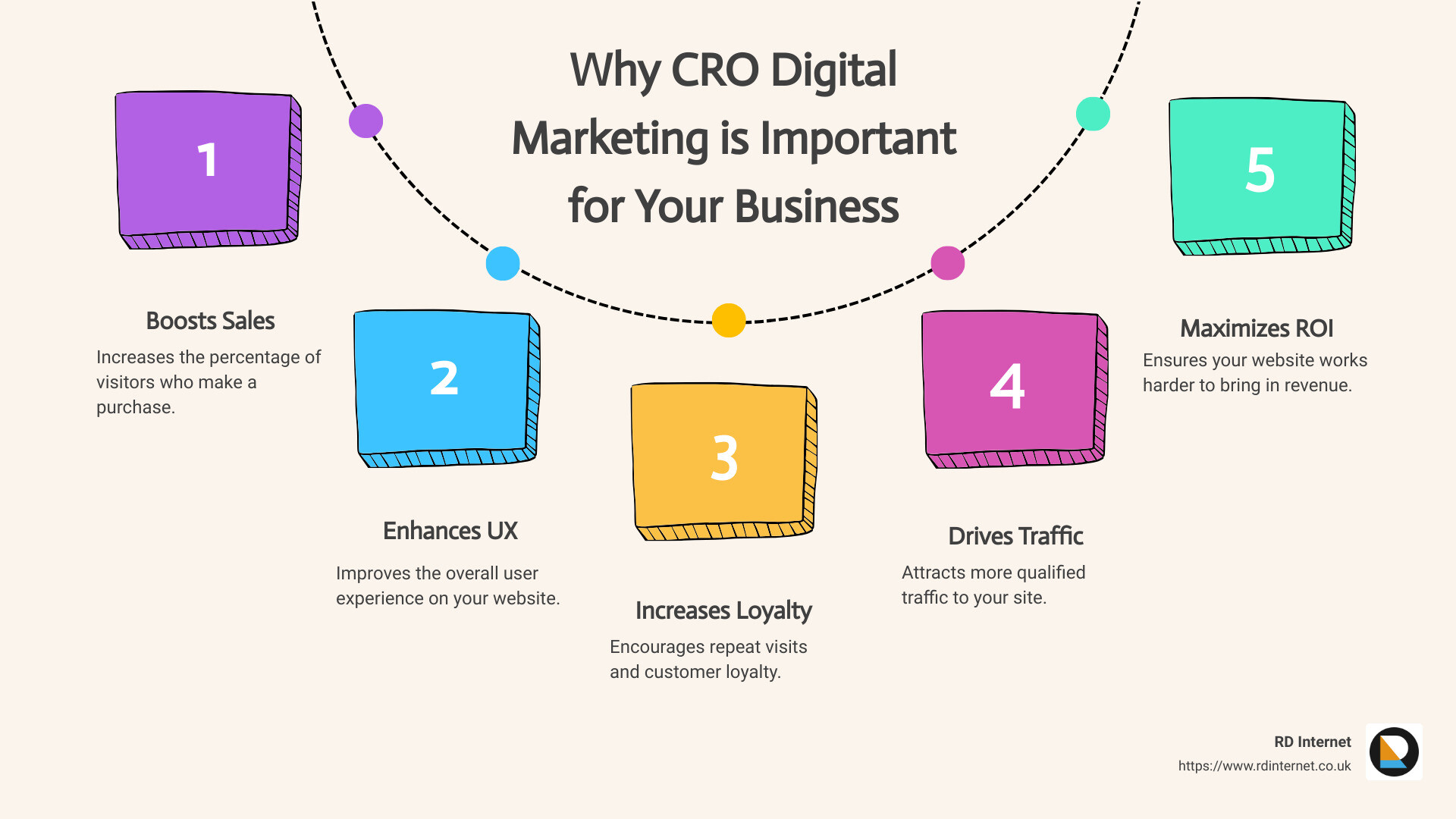
Why CRO Digital Marketing is Important for Your Business
CRO digital marketing is a game-changer for small businesses aiming to make a powerful impact online. If you’re wondering why this matters, here’s a quick breakdown:
-
What is CRO?
Conversion Rate Optimization (CRO) maximizes the percentage of visitors who perform a desired action on your website. -
Why Is It Important?
It boosts sales, improves user experience, and improves customer loyalty. -
What Are the Goals?
Increase online visibility, drive more qualified traffic, and convert visitors into customers.
Having a website isn’t just about having an online presence—it’s about turning that presence into profit. Conversion Rate Optimization, or CRO, is the process of tweaking your website to compel more visitors to take desired actions, like making a purchase or signing up for a newsletter.
CRO is important because it directly impacts your revenue. By making small yet effective changes to your site, such as improving page layout or enhancing call-to-action buttons, you can significantly increase customer engagement and sales.
The goals of CRO are straightforward: drive more people to your site, make their experience seamless, and turn them into loyal customers. It’s about making your website work harder for you, using analytics and testing to guide your improvements.
What is CRO Digital Marketing?
Conversion Rate Optimisation (CRO) digital marketing is all about making your website more effective at turning visitors into customers. This can mean getting people to buy something, sign up for a newsletter, or even spend more time on your site. It’s about fine-tuning every aspect of your website to boost these actions, known as conversions.
CRO vs SEO
While CRO focuses on making the most of the traffic you already have, SEO (Search Engine Optimisation) is about attracting more visitors to your site through organic search results. Think of SEO as getting people to your door, and CRO as convincing them to come inside and stay.
SEO improves your website’s visibility on search engines like Google. It involves optimising your content with keywords, improving site speed, and getting backlinks. All these actions help you rank higher in search results, increasing your organic traffic.
On the other hand, CRO is about what happens after people arrive at your site. It’s about enhancing their journey and making sure they take the desired actions, whether that’s making a purchase, signing up for an email list, or downloading a report.
Both CRO and SEO are essential for a successful online presence. While SEO gets people to your site, CRO ensures they engage and convert.
How to Calculate Conversion Rate
To succeed in CRO digital marketing, you need to know your conversion rate. This tells you how well your site turns visitors into customers or leads. Let’s break down the formula, key performance indicators (KPIs), and some examples.
Formula
Calculating your conversion rate is simple:
Total number of conversions ÷ Total number of website visitors x 100 = Conversion Rate %
For instance, if your site had 10,000 visitors last month and 200 of them made a purchase, your conversion rate is:
200 ÷ 10,000 x 100 = 2%
Key Performance Indicators (KPIs)
KPIs help you measure what matters most. Here are some common KPIs for CRO digital marketing:
- Sales: The number of purchases made.
- Email Sign-ups: The number of visitors who subscribe to your newsletter.
- Form Submissions: The number of visitors who fill out a contact or inquiry form.
- Downloads: The number of visitors who download a resource like an e-book or white paper.
Choosing the right KPIs depends on your business goals. For example, an e-commerce site may focus on sales, while a B2B site might prioritise form submissions.
Examples
Let’s look at a few examples to make this clearer.
Example 1: E-commerce Site
- Goal: Increase sales
- Visitors: 15,000 per month
- Conversions: 300 purchases
- Conversion Rate: 300 ÷ 15,000 x 100 = 2%
Example 2: SaaS Company
- Goal: Get more free trial sign-ups
- Visitors: 8,000 per month
- Conversions: 400 sign-ups
- Conversion Rate: 400 ÷ 8,000 x 100 = 5%
Example 3: Blog with Ad Revenue
- Goal: Increase email subscribers
- Visitors: 20,000 per month
- Conversions: 1,000 sign-ups
- Conversion Rate: 1,000 ÷ 20,000 x 100 = 5%
By understanding these metrics, you can see where your site stands and where you need to improve. This is crucial for effective CRO digital marketing.
Why CRO is Essential for Your Business
Revenue Generation
CRO digital marketing directly impacts your bottom line. By optimizing your website, you can increase the number of visitors who take the desired action, whether that’s making a purchase, signing up for a newsletter, or downloading a report. Even indirect conversions, like content downloads, can lead to increased revenue over time. For example, a well-placed Call to Action (CTA) can turn a casual visitor into a paying customer.
Customer Engagement
Higher conversion rates mean more engaged customers. When visitors interact with your website—by spending more time, signing up for content, or making purchases—they are more likely to develop a connection with your brand. This engagement can lead to better customer experiences and stronger brand loyalty. Simple changes, like a more readable font or a more inviting layout, can make a significant difference.
Cost-Effectiveness
Attracting new visitors can be expensive. CRO focuses on getting more value from your existing traffic. By redesigning your website or tweaking your marketing strategy, you can convert current visitors more effectively. This is much more cost-effective than continuously trying to attract new visitors. For instance, improving your webpage layout or making your CTAs more compelling can yield better results without additional marketing spend.
Customer Loyalty
A higher conversion rate often means a better user experience, which can lead to increased customer loyalty. Happy customers are more likely to return, make repeat purchases, and recommend your brand to others. This not only helps in retaining existing customers but also in acquiring new ones through word-of-mouth. As the saying goes, “A happy customer is a loyal customer.”
By focusing on CRO digital marketing, you can ensure that your website not only attracts visitors but also converts them into loyal customers. This creates a cycle of continuous improvement and revenue growth.
Next, let’s explore the steps to develop an effective CRO digital marketing strategy.
Steps to Develop a CRO Digital Marketing Strategy
Define Conversion
To start, you need to define what a conversion means for your business. This can vary:
- Purchases if you’re an e-commerce site.
- Email sign-ups for a newsletter.
- Downloads of a white paper or report.
- Service upgrades to a higher tier.
Key Performance Indicators (KPIs) like these help measure your success. Without clear KPIs, it’s impossible to know if your efforts are working.
Map Customer Journey
Next, map out your customer journey. Understand how customers find your site and what they do once they get there. Collect data on:
- Demographics: Age, gender, income.
- Psychographics: Attitudes, aspirations.
- Geographics: Location.
- Interests and behaviors.
Create sub-segments for a more detailed view. Rank these segments by their likelihood to convert. This helps in targeting the most valuable customers.
Analyze Current Conversion Process
Now, look at why visitors aren’t converting. Common issues include:
- Hard-to-read fonts.
- Slow-loading pages.
- Unconvincing testimonials.
- Poorly formatted images.
- Weak CTAs.
- Too many pop-ups.
- Poor layout.
- Mismatch between headlines and content.
Identify pages with high traffic but low conversion rates. These pages have the most potential for improvement.
Test Solutions
Once you identify issues, it’s time to test different solutions. There are two main types of testing:
- A/B Testing: Test two versions of a page but change only one variable (e.g., the font). This helps pinpoint what works.
- Multivariate Testing (MVT): Test multiple variables on different versions of a page simultaneously. It’s like running several A/B tests at once.
Analyze and Revise
Finally, analyze the results of your tests. Did the changes increase conversions? Can you prove it with data? If a test fails, don’t worry. Learn from it and move on.
This leads to continuous improvement. Keep tweaking and testing. Over time, small changes can lead to significant gains in your conversion rate.
By following these steps, you can develop a robust CRO digital marketing strategy that turns visitors into loyal customers.
Best Practices for CRO Digital Marketing
When diving into CRO digital marketing, there are several best practices to follow. These tactics can help you get the most out of your website and turn visitors into loyal customers.
Clear CTAs
Call-to-Action (CTA) buttons are the backbone of CRO. Make sure your CTAs are clear and direct. Use action words like “Buy Now,” “Sign Up,” or “Learn More.” Place them where they are easy to find and click.
Pro Tip: Don’t overwhelm your visitors with too many CTAs on one page. Each page should focus on a single, clear next step.
Mobile Optimization
More people are browsing on mobile devices than ever before. Ensure your site is mobile-friendly. This means buttons that are easy to tap, text that is easy to read, and images that load quickly.
Fact: Mobile optimization can significantly reduce bounce rates and improve user experience, leading to higher conversion rates.
Load Time
A slow website can kill conversions. Reduce your load time by optimizing images, using a content delivery network (CDN), and minimizing the use of heavy scripts.
Statistic: A one-second delay in page load time can reduce conversions by 7%.
Trust Signals
Trust is crucial for conversions. Use trust signals like customer testimonials, case studies, and industry badges. These elements reassure visitors that your product or service is reliable.
Example: Adding a testimonial from a happy customer near your CTA can increase trust and encourage conversions.
Personalization
Tailor your content to the individual user. Use personalization to show product recommendations, personalized greetings, or custom content based on user behavior.
Research: Personalized content can increase conversion rates by up to 20%.
Heatmaps
Use heatmaps to understand where visitors are clicking and how they are scrolling through your pages. Tools like Hotjar can show you hotspots where users spend the most time.
Insight: If users are dropping off before reaching your CTA, consider moving it higher on the page or making it more prominent.
By following these best practices, you can improve your CRO digital marketing efforts and see a noticeable improvement in your conversion rates.
Frequently Asked Questions about CRO Digital Marketing
What is CRO in digital marketing?
CRO, or Conversion Rate Optimization, is the practice of increasing the percentage of website visitors who take a desired action—like making a purchase, signing up for a newsletter, or downloading a report. It’s all about making your website more effective at converting visitors into customers or leads.
Example: Imagine you have an online store with 1,000 visitors a month, but only 10 make a purchase. Your conversion rate is 1%. By optimizing your site, you might increase that to 50 purchases, boosting your conversion rate to 5%.
How does CRO differ from SEO?
While both CRO and SEO aim to improve your website’s performance, they focus on different aspects:
-
SEO (Search Engine Optimization) is about increasing the quantity and quality of traffic to your website through organic search engine results. It focuses on keywords, backlinks, and content quality to rank higher on search engines like Google.
-
CRO is about improving the effectiveness of your website once visitors arrive. It focuses on user experience, site design, and content to encourage visitors to take specific actions.
Think of SEO as getting more people to your store, while CRO is about making sure they buy something once they’re inside.
Why is CRO important for my business?
CRO is crucial for several reasons:
-
Generates Revenue: Even small improvements in your conversion rate can lead to significant increases in revenue. For example, if your conversion rate increases from 2% to 4%, you could potentially double your sales.
-
Cost-Effective: It’s often cheaper to convert existing visitors than to attract new ones. Improving your website’s performance can yield better results without additional marketing spend.
-
Improves Customer Experience: A well-optimized site is easier to steer and more engaging, leading to happier users who are more likely to return and recommend your site to others.
-
Builds Brand Affinity: Increased engagement means your brand becomes a bigger part of your customers’ lives, making them more likely to think of you when making a purchase.
By focusing on CRO digital marketing, you can transform your online presence and drive substantial growth for your business.
Conclusion
At RD Internet, we believe in the power of continuous improvement. Our approach to CRO digital marketing is not a one-time fix but an ongoing process of refining and optimizing your online presence. By consistently analyzing, testing, and revising, we ensure that your website evolves with your customers’ needs and market trends.
Customer focus is at the heart of our strategy. We aim to create seamless and enjoyable experiences for your visitors, making it easy for them to find what they need and take action. This not only boosts your conversion rates but also improves customer satisfaction and loyalty.
Investing in CRO digital marketing with RD Internet can lead to increased revenue without the need for additional marketing spend. By maximizing the potential of your existing traffic, you can achieve higher returns and sustainable growth.
Let us help you transform your online presence. Explore our services and find how we can drive continuous improvement and increased revenue for your business.
Recent Comments