

CRO Ecommerce Guide 2024: Top Strategies for Success
Ecommerce CRO (Conversion Rate Optimization) is vital for any online business striving to maximize profitability and efficiency. Simply put, it involves refining your website and marketing strategies to boost the percentage of visitors who complete a purchase. This process not only helps in attracting more customers but also enhances their shopping experience, leading to increased customer loyalty and higher revenue.
The importance of effective CRO cannot be overstated, especially in a competitive digital market. For small businesses in particular, like those based in Cardiff grappling with fierce competition, it’s essential. CRO can elevate your online visibility, distinguish your brand from competitors, and convert casual browsers into loyal customers.
The benefits of prioritizing CRO include reduced acquisition costs and improved return on investments from your marketing efforts. By honing in on what really drives conversions, businesses can allocate resources more effectively, crafting targeted campaigns that truly resonate with their audience.
Understanding Ecommerce CRO
Definitions
Ecommerce Conversion Rate Optimization (CRO) is the systematic approach of increasing the percentage of website visitors who take a desired action — be that filling out a form, becoming customers, or otherwise. The goal of CRO ecommerce is to make your online store more efficient at converting visitors into buyers.
Conversion Rate
Simply put, the conversion rate is the percentage of visitors who complete a desired action. To calculate it, divide the number of conversions by the total number of visitors and multiply the result by 100. For example, if your site receives 1,000 visitors and 50 of them make a purchase, your conversion rate would be 5%.
CRO Process
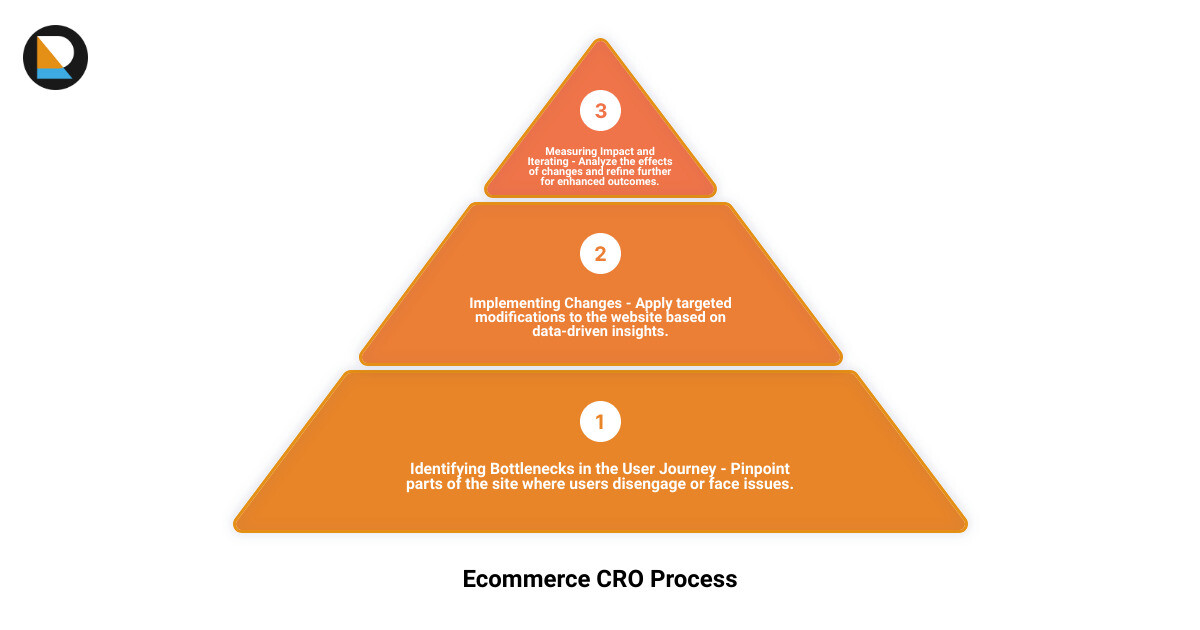
The CRO process involves understanding how users move through your site, what actions they take, and what’s stopping them from completing your goals. Here’s a breakdown of the typical steps involved in a CRO process:
-
Gather Data: Use analytics tools to understand where you are starting from. Look at your current conversion rates and gather insights from tools like heatmaps or user session recordings.
-
Identify Problems: Determine where users are dropping off or where the flow seems to be interrupted. This could be on product pages, during checkout, or at any point where user engagement decreases.
-
Hypothesize Solutions: Based on the data, come up with theories on what changes could improve conversion. This might involve changing a call-to-action button, redesigning a page, or simplifying the checkout process.
-
Test Changes: Implement A/B testing to compare the new versions of your site against the current design. This helps you understand if the changes are positively impacting your conversion rate.
-
Review and Repeat: Analyze the test results and either implement the successful changes or go back to the drawing board if the desired improvements were not seen. Continuous improvement is key in CRO.
By following these steps, ecommerce sites can create a more engaging user experience that is more likely to convert visitors into customers. The aim is to make data-driven decisions that incrementally improve the performance of your online store.
Understanding CRO ecommerce is fundamental for any online business looking to improve their sales numbers without necessarily increasing traffic. This process not only enhances the user experience but also maximizes your marketing efforts, ensuring that every visitor has the highest chance to convert.
Moving forward, we’ll delve into the key metrics that every ecommerce site should monitor to effectively implement CRO strategies.
Key Metrics for Ecommerce CRO
When diving into CRO ecommerce, it’s crucial to understand and monitor specific metrics. These metrics provide insights into how users interact with your site and where there might be room for improvement. Let’s explore each one:
Conversion Rate
This is the percentage of visitors who complete a desired action on your site, such as making a purchase. It’s calculated by dividing the number of conversions by the total number of visitors and multiplying by 100. Aiming for a rate higher than the average (2.5-3%) is generally good, but even small improvements can have significant impacts on revenue.
Bounce Rate
Bounce rate indicates the percentage of visitors who leave your site after viewing only one page. A high bounce rate could suggest that your landing pages are not relevant or engaging enough. Reducing this rate often involves improving page content and user navigation.
Exit Rate
While similar to bounce rate, the exit rate measures the percentage of visitors who leave after viewing a particular page, regardless of how many pages they visited before that. A high exit rate on a specific page can signal issues with content or design on that page.
Click-through Rate (CTR)
CTR is essential for understanding the effectiveness of your ads and emails. It measures how many people click a link compared to how many saw it. Improving CTR involves refining your ad copy or the design of your call-to-action (CTA) buttons.
Average Session Duration
This metric shows how long visitors stay on your site. A low average session duration might indicate that your content or site structure is not engaging enough to hold visitors’ interest.
Average Page Depth
Also known as Pages Per Session in Google Analytics, this metric tells you how many pages a typical visitor views during a session. More page views can indicate higher engagement, but it could also suggest that visitors are having trouble finding what they need.
Monitoring these metrics allows you to pinpoint areas where your ecommerce site might be underperforming. By understanding and improving these key areas, you can significantly enhance your site’s conversion rate, making the most of every visitor that comes your way. Next, we will look at specific strategies you can employ to improve these metrics and boost your ecommerce CRO.
Strategies for Improving Ecommerce CRO
High-Quality Images and Videos
Photography and Lifestyle Images
To capture the attention of your visitors, use high-quality images that showcase your products in real-life scenarios. This not only enhances the visual appeal but also helps customers envision themselves using the product. A picture is worth a thousand words, and in ecommerce, it could be worth a thousand clicks!
Product Videos
Videos can dramatically enhance the shopping experience by providing a dynamic view of your products. They allow customers to see the product in action, which can reduce doubts and lead to a more confident purchase decision. For example, a video showing the different features and use cases of a product can be more persuasive than static images.
Engaging Product Descriptions
Copywriting
Craft product descriptions that not only inform but also engage and persuade your audience. Use language that resonates with your target demographic, and ensure that every word serves a purpose in convincing potential buyers of the value of your products.
Use Cases
Highlight practical applications and benefits of your product to give potential customers a clear understanding of how it can fit into their lives. This approach helps in reducing the abstract nature of online shopping, making the product more tangible.
CTAs (Calls to Action)
Incorporate compelling calls to action that prompt users to take the next step, whether it’s adding a product to their cart or making a purchase. Ensure these are prominently placed and use urgent, action-oriented language.
Showcasing Product Reviews
User Reviews
Product reviews are crucial as they provide social proof and build trust with potential buyers. Displaying honest reviews, including both positive and negative feedback, can help customers make informed decisions and feel more secure in their purchases.
Trust Building
Reviews also play a significant role in trust-building by transparently showing what other customers think about your product. This transparency is key to fostering a trustworthy online shopping environment.
Simplifying the Checkout Process
Form Fields
Reduce the number of fields in the checkout process to the essentials. Overly complicated forms can be a deterrent and lead to cart abandonment. Simplify the process to enhance user experience and increase conversions.
Payment Options
Offer a variety of payment methods to cater to different preferences and ensure a smoother checkout experience. This flexibility can significantly reduce friction in the final steps of the purchasing process.
User Experience
Streamline the entire checkout process to make it as quick and painless as possible. This includes intuitive navigation, clear instructions, and a progress indicator to show customers how far along they are in the process.
Offering Free Shipping and Returns
Shipping Costs
Consider offering free shipping to all customers as unexpected costs added at checkout can lead to cart abandonment. If free shipping isn’t viable across the board, set a minimum purchase amount to qualify for free shipping.
Return Policies
A clear and lenient return policy can ease the concerns of customers about purchasing online. Offering free returns can further encourage purchasing decisions, as customers feel secure that they can return the product if it doesn’t meet their expectations.
Utilizing Live Chat and Chatbots
Customer Service
Implementing live chat options can provide immediate assistance to shoppers who have questions or need more information. This real-time interaction enhances customer service and can lead to higher conversion rates.
Real-Time Support
Tools like ServiceBell can integrate live video chats, offering a more personal touch and a higher level of interaction. This type of engagement can significantly improve customer satisfaction and loyalty.
By implementing these strategies, ecommerce businesses can create a more engaging and user-friendly shopping environment that encourages visitors to convert into customers. Each element, from detailed product descriptions and high-quality visuals to streamlined checkout processes and robust customer support systems, plays a crucial role in optimizing conversion rates.
Advanced Ecommerce CRO Techniques
In ecommerce, staying ahead means continuously optimizing your website to better meet customer needs and improve conversion rates. Advanced CRO (conversion rate optimization) techniques such as A/B testing, heatmaps, personalization, and mobile optimization are crucial tools in this ongoing process. Let’s dive into how these techniques can supercharge your ecommerce strategy.
A/B Testing
A/B testing, or split testing, is a fundamental CRO ecommerce technique. It involves comparing two versions of a web page to see which one performs better in terms of converting visitors. For instance, you might test two different call-to-action (CTA) buttons to see which one gets more clicks. Using tools like Google Optimize, you can set up these tests easily and gain insights based on real user interactions. A/B testing helps in making data-driven decisions that can lead to significant improvements in conversion rates.
Heatmaps
Heatmaps are visual representations of where users click, scroll, and spend time on your pages. Tools like VWO Insights offer heatmaps that help you understand user behavior beyond basic analytics. For example, a heatmap can show if users are ignoring your most important content because it’s too far down the page or too cluttered. By analyzing this data, you can rearrange elements on your page to better align with how users naturally interact with your content, potentially increasing engagement and conversions.
Personalization
Personalization in ecommerce is about tailoring the shopping experience to the individual user. Techniques include displaying products based on browsing history, personalized email marketing, and customized product recommendations. VWO Personalize, for instance, allows you to craft unique experiences for users based on their previous interactions with your site. This relevance can dramatically enhance user engagement and conversion rates, as customers feel more understood and valued.
Mobile Optimization
With an increasing number of users shopping via mobile devices, mobile optimization is no longer optional. It involves designing your ecommerce site to ensure it is as easy to use on a smartphone as it is on a desktop. This includes faster load times, responsive design, and simplified navigation. Mobile optimization is critical because a poor mobile experience can drive potential customers away, hurting your conversion rates.
By implementing these advanced CRO techniques, ecommerce businesses can not only enhance the user experience but also see a noticeable improvement in conversion rates. Each technique offers unique insights and optimization opportunities that, when used together, can form a powerful strategy for ecommerce success.
Frequently Asked Questions about Ecommerce CRO
What is a Good Ecommerce Conversion Rate?
A good ecommerce conversion rate is one that aligns with or exceeds industry averages, which typically hover around 2% to 3%. However, this can vary significantly depending on the sector, product type, and market conditions. For example, luxury goods may have lower conversion rates due to higher prices, while everyday commodities might see higher rates. It’s essential to benchmark against similar businesses and continuously strive for improvement.
How Do I Calculate My Ecommerce Site’s Conversion Rate?
To calculate your ecommerce site’s conversion rate, you need to divide the number of conversions (this could be sales, sign-ups, or other defined actions) by the total number of visitors, then multiply the result by 100 to get a percentage. Here’s the formula:
[ \text{Conversion Rate (\%)} = \left( \frac{\text{Number of Conversions}}{\text{Total Visitors}} \right) \times 100 ]
For instance, if your site receives 5,000 visitors in a month and makes 100 sales, your conversion rate would be:
[ \text{Conversion Rate (\%)} = \left( \frac{100}{5000} \right) \times 100 = 2\% ]
How Can I Use A/B Testing for Ecommerce CRO?
A/B testing is a powerful technique for improving CRO ecommerce by comparing two versions of a web page to see which performs better. You can test elements like headlines, product descriptions, images, or call-to-action buttons to determine which variations drive the highest conversion rates. Here’s how to do it effectively:
-
Identify the Element to Test: Choose one variable to test at a time, such as the color of a ‘Buy Now’ button or the placement of customer reviews.
-
Create Two Versions: Develop two versions of the same page (Version A and Version B), with only one element different between them.
-
Split Your Traffic: Direct equal amounts of traffic to each version.
-
Analyze the Results: Use tools to track which version leads to more conversions. Look for statistically significant differences to decide which element performs better.
-
Implement the Successful Version: Once a clear winner is identified, implement the more successful version on your site.
-
Repeat: CRO is an ongoing process. Continue to test other elements and refine your approach based on data and customer feedback.
By addressing these common questions, you can better understand the nuances of CRO ecommerce and take actionable steps to optimize your site for higher conversions. The goal is to make informed decisions based on data, enhancing the shopping experience and ultimately boosting your bottom line.
Conclusion
As we wrap up our ultimate guide to ecommerce conversion rate optimization (CRO), emphasize the role of continuous improvement and staying competitive in the world of online retail. At RD Internet, we understand that the landscape of ecommerce is changing, and so should your CRO strategies.
RD Internet: Your Partner in Growth
At RD Internet, we don’t just set up your CRO strategies and step away. We believe in being a part of your ongoing journey towards improvement. Our team of experts is dedicated to helping you refine and enhance your ecommerce strategies, ensuring that your site not only meets but exceeds the expectations of modern consumers. We’re here to assist you in implementing the latest and most effective CRO techniques, keeping you ahead of the curve.
The Importance of Continuous Improvement
In CRO ecommerce, what worked yesterday might not work today. That’s why continuous testing and optimization are crucial. By embracing a culture of continuous improvement, you ensure that your ecommerce site remains effective and efficient, adapting to changes in consumer behavior and technological advancements. This ongoing process involves regularly reviewing your site’s performance, implementing updates, and always looking for new ways to enhance the user experience.
Staying Competitive
The ecommerce sector is crowded and competitive. To stand out, you need more than just a functional website—you need a website that captivates and converts. Staying competitive means staying innovative, not just in your CRO tactics but in every aspect of your digital presence. From the latest in AI-driven personalization to the most intuitive user interface designs, staying at the forefront of ecommerce trends is key.
By partnering with RD Internet, you leverage our expertise in cutting-edge CRO strategies and our commitment to your brand’s growth. We help you not only to adapt to changes but to lead the charge in setting industry standards.
In conclusion, mastering CRO ecommerce is not a one-time task but a continuous journey. With RD Internet, you have a partner who is committed to your ongoing success, helping you stay competitive in a bustling market. Let’s keep pushing the boundaries of what’s possible in ecommerce together. Ready to optimize your site for better conversions? Join us at RD Internet, where your growth is our priority.
Recent Comments